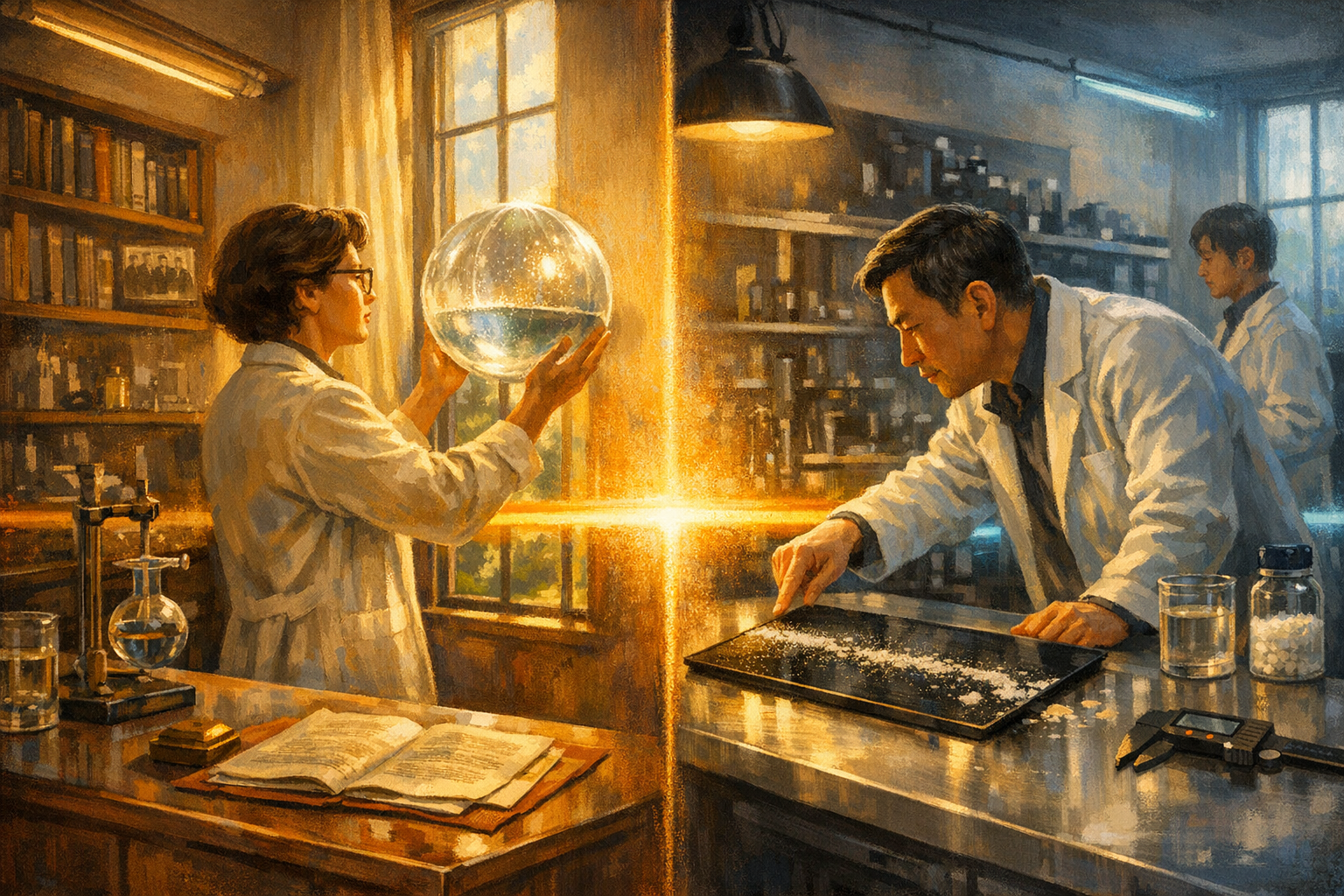
In 1941, Maria Telkes was a forty-one-year-old Hungarian-American physical chemist at the Massachusetts Institute of Technology, recently transferred from Westinghouse Electric to the new MIT Solar Energy Conversion Project, when the US Office of Scientific Research and Development called her in for an emergency task. American service members in the Pacific theatre, mostly Navy airmen shot down over open water and submariners and merchant seamen torpedoed off their ships, were dying of dehydration in their life rafts within days of being adrift. Seawater accelerated thirst rather than relieving it. The Navy had no compact field-deployable way to get fresh water into a single survivor floating in the Pacific Ocean. The OSRD wanted Telkes to design one.
She had a PhD in physical chemistry from the University of Budapest, conferred in 1924 when she was twenty-three. She had emigrated to the United States in 1925 and naturalised in 1937. She had spent the intervening years measuring the properties of phase-change materials and storage substances that absorbed and released large amounts of energy at characteristic temperatures, the unglamorous and laboriously empirical foundation of any later applied solar-engineering project. She had joined the MIT Solar Energy Conversion Project in 1940 specifically because she believed the discipline was ready to leave the demonstration laboratory and enter consumer and military service.
By the summer of 1942 her solar-still prototype was a clear inflatable plastic balloon the size of a paper cup when empty and the size of a basketball when filled. A survivor floated it on the ocean surface tethered to the raft and filled an inner cup at the bottom with collected seawater through a small valve. Sunlight passed unimpeded through the upper clear plastic, evaporated the seawater inside the lower cup, and the fresh water vapour condensed on the cooler upper inside wall of the balloon, ran down to a small collection trough, and was drunk through a straw. The salt and other dissolved solids stayed behind in the bottom cup. The principle was textbook physical chemistry. The application was wartime engineering against a casualty rate.
The Telkes solar still became standard equipment on every US Navy lifeboat by 1944. The exact number of lives saved is not in the historical record but is by every credible estimate several thousand. The same fundamental design was scaled up, after the war, to a permanent solar-desalination installation in the US Virgin Islands that is still in operation. Telkes went on to design, with the architect Eleanor Raymond, the first solar-heated house ever built (Dover, Massachusetts, 1948). She filed more than twenty patents. She was nicknamed "The Sun Queen" by her colleagues. She continued inventing into her eighties and died, two months short of her ninety-fifth birthday, in Budapest in 1995.
The physical-chemistry argument she ran in her wartime balloon has been the basis of every solar desalination scheme since.
It has also had a problem since the 1960s, when desalination scaled up to industrial output. Conventional industrial reverse-osmosis and thermal desalination plants do not actually separate seawater into fresh water and dry salt. They separate it into fresh water and a hyper-saline brine, which they then dump back into the ocean. The brine sinks, concentrates locally, and damages the marine ecosystem near the outfall pipe. Every solar-desalination paper of the past sixty years has had to engage with the brine problem and most have not solved it.
On 30 May 2026, in Light: Science and Applications (volume 15, article 246), Chunlei Guo and his colleagues at the University of Rochester's Institute of Optics published "Mineral-rich additive-free solar desalination without brine." Guo's group had spent more than a decade developing femtosecond-laser-textured metal surfaces with engineered wettability. The 2026 paper applies that technique to desalination. The active surface is a black thin sheet of aluminium whose top side has been etched with a femtosecond pulsed laser into an ordered pattern of micron-scale grooves. Seawater spreads as a thin film across the panel by capillary action ("superwicking"). Sunlight is absorbed by the black surface and the water film evaporates from above. The salts, instead of crystallising on the working surface and clogging it, are forced by the coffee-ring effect (the same fluid-dynamical phenomenon that leaves the brown ring at the rim of a dried coffee spill) to migrate sideways into a passive collection region of the panel. The team recovered approximately one hundred percent of the dissolved salts as dry crystalline solid, ran the device on seawater collected from three continents, and noted that the recovered solid is mineral-rich enough to be a candidate source of battery-grade lithium and other rare-earth elements that are increasingly the limiting input of the energy transition.
The 1942 Telkes balloon kept one downed airman alive at a time. The 2026 Rochester panel proposes to turn a desalination plant from a marine-damage source into a fresh-water plus mineral-recovery operation. The thermodynamics is identical, eighty-four years apart: sunlight evaporates seawater, fresh water condenses, salt stays behind. The engineering shift is in what happens to the salt. Telkes left the salt in the bottom cup because the cup was thrown away when the survivor was rescued. Guo collects the salt because, at industrial scale, the salt is no longer a waste-disposal problem but a feedstock.
The Rochester laser-textured surface is currently a laboratory-scale demonstration. The team is open about the engineering questions a deployment-scale system would need to answer: how the panel ages under continuous sun and salt exposure, how a real plant would harvest tonnes of salt per day per square kilometre, how a system would clean its own surfaces during off-cycle hours. None of these are unsolved problems in principle. They are the questions you ask when a technology is moving from a Science Advances table to an Industrial Engineering Chemistry line drawing.
Telkes moved from a single-survivor balloon to a Virgin Islands fresh-water plant in six years. The Rochester team has a path of its own to walk. The path is the same path.
She would have liked the salt going somewhere useful.