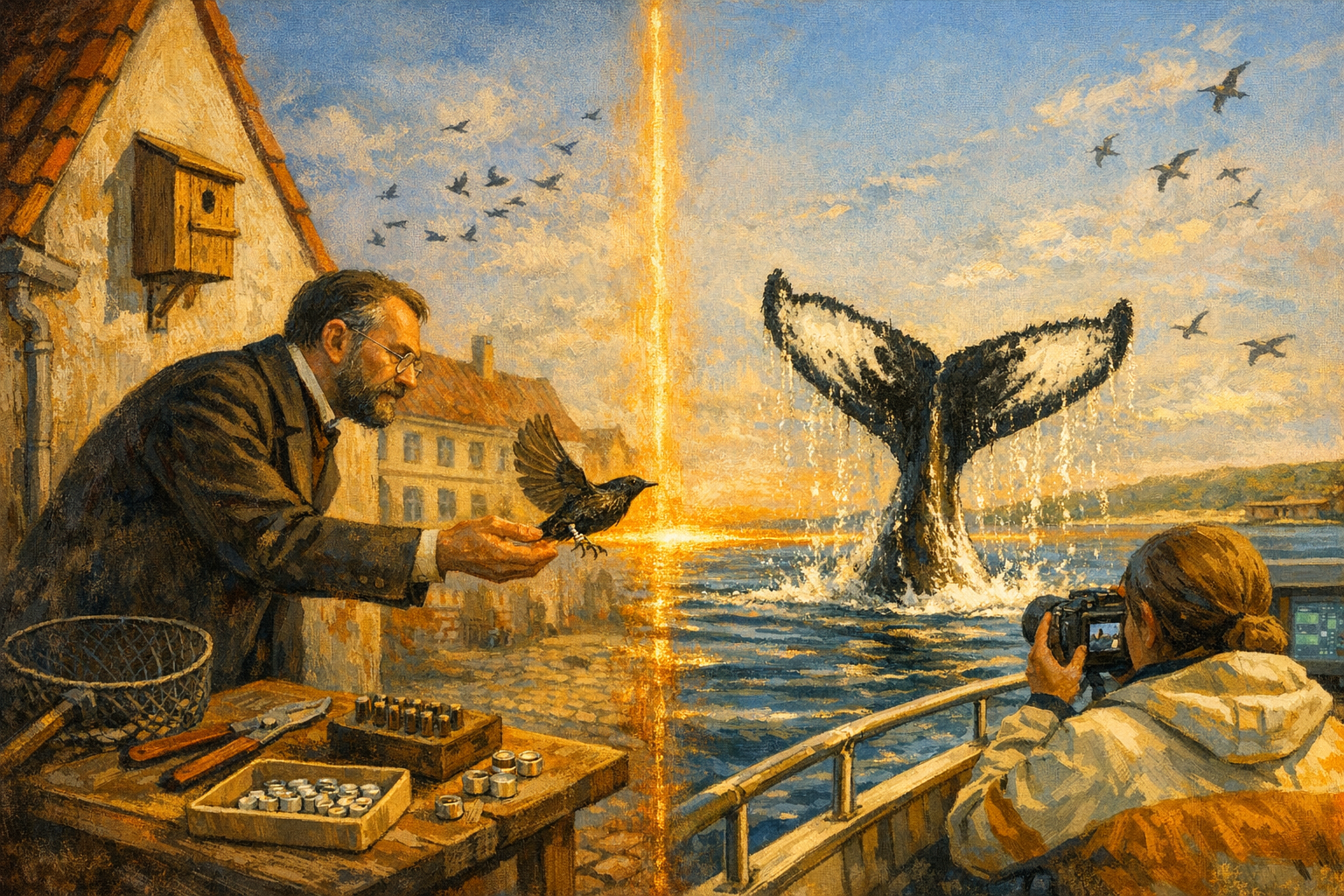
The school is the Latinskole at Viborg in the Jutland heartland of Denmark, a small market town three hours' carriage drive northwest of Copenhagen. The teacher is Hans Christian Cornelius Mortensen, forty-three years old in the summer of 1899, classics master, originally from Aarhus, twelve years married to Ingeborg Lemming who teaches at the same school. He has been ringing birds, as a hobby, for nine years. He started in 1890 with white storks, which he tried to mark with a zinc plate slipped under the wing. The technique killed birds and produced no useful returns. He has since spent his evenings cutting small rings from aluminium sheet, soldering each into a circle, and stamping each with his Viborg address and an individual number. In the breeding season of 1899 he sets up twelve home-made wooden nest-boxes around the gables of the houses near the Latinskole, fitted with simple gravity-trap doors, and over the course of about three months catches and rings a hundred and sixty-five adult common starlings.
He does it because he wants to know where the starlings go in winter. The proposition behind the experiment is so basic that it has not previously been treated as research: that if you give every individual bird a permanent unique mark, and you and a network of correspondents recover that mark later somewhere else in the world, you will learn where the bird went. The Smithsonian had tried something similar with bands on robins in 1803, but only for a single bird. Mortensen's contribution is the system. The address-and-number stamp. The standard ring. The correspondent network. The careful record book.
The returns trickle in over the next few seasons. Several of his Viborg starlings are recovered in southern France in winter. One is shot in the Iberian peninsula. A few are caught alive and the rings are mailed back to the master at the Latinskole. By 1906 Mortensen co-founds the Danish Ornithological Society. By the time he dies in 1921 his method has been picked up by ringing schemes in Britain, Germany, the United States, the Netherlands, Switzerland, and Russia. By the mid-twentieth century millions of birds carry small rings stamped with addresses and numbers and the principle on which an entire field of migration ecology rests is the principle the Viborg classics master invented at his kitchen table.
The principle holds for any animal that carries, on its body, a unique permanent mark.
On 1 May 2026, in Royal Society Open Science, a multi-institution team led by Cristina Castro Ayala of the Instituto Aqualie in Brazil and Ted Cheeseman of the citizen-science platform Happy Whale, with collaborators at the Pacific Whale Foundation in Hawaii, the Instituto Baleia Jubarte in Bahia, the Federal University of Rio Grande do Norte, and at half a dozen other institutions, published "First evidence of bidirectional exchange between distant humpback whale breeding populations in eastern Australia and Brazil." The paper sits behind a database of 19,283 photographs of humpback whale tail-flukes, collected between 1984 and 2025, by dozens of field crews, citizen-scientist boat operators, whale-watch passengers, naturalists, and government researchers along the breeding coasts of eastern Australia and southwestern Brazil. The undersides of humpback flukes carry, in the same way a human fingerprint does, a pattern of black-and-white pigmentation and scarring that is unique to each individual and stable for life.
Until 2019, all matching of the photos had to be done by eye. A research assistant would sit in front of a screen and compare a new submission, fluke by fluke, against the existing catalogue. Above ten thousand photographs the labour cost became prohibitive. Happy Whale's automated image-recognition algorithm, trained on the existing catalogue and steadily improved over six years, can now cross-match a candidate fluke against a hundred thousand catalogued ones in seconds, with a final manual confirmation step for any match the algorithm proposes. The 2026 paper is the first formal demonstration of a finding the algorithm produced that human-only matching had never produced in forty years of trying. A whale photographed in Hervey Bay, Queensland in 2007, again in Hervey Bay in 2013, then on the Brazilian breeding coast off São Paulo in 2019. A second whale photographed off Brazil in 2003, then off the Australian east coast in 2025 having travelled approximately fifteen thousand one hundred kilometres in the intervening twenty-two years. Bidirectional exchange between two breeding populations on opposite sides of the South Pacific, confirmed for the first time, by reading the natural marks the whales themselves carried.
The crossings represent about 0.01 percent of identified individuals. They are exceptional events, not population-scale exchanges, and the paper makes no claim that they imply genetic mixing or population merger. What they imply is that the question of whether humpback whales ever cross is no longer answerable by an in-principle argument. They cross. We can name the crossings.
The Australian field-naturalist tradition of identifying individual whales by tail-fluke pattern was established along the east coast in the 1970s, contemporaneously with Steven Katona and Hal Whitehead's parallel work on North Atlantic humpbacks at the College of the Atlantic in Maine. Mortensen's Viborg starlings of 1899 carried marks he stamped himself. Hervey Bay's humpbacks of 2026 carry marks they were born with, and that an algorithm trained on forty years of citizen photographs can read at scale.
The principle is the same. It is the principle of treating an individual animal as a moving piece of information that can be sampled, identified, and re-identified across as much geography and as much time as the recovery network can cover. Mortensen invented it for starlings with a hammer and an aluminium sheet. Royal Society Open Science applied it to humpback whales with a database and a neural network and a hundred and twenty-seven years of intervening method-building.
A Danish schoolteacher fitted a hundred and sixty-five birds with a number and an address. The address was his own school in Viborg. The numbers are still going.