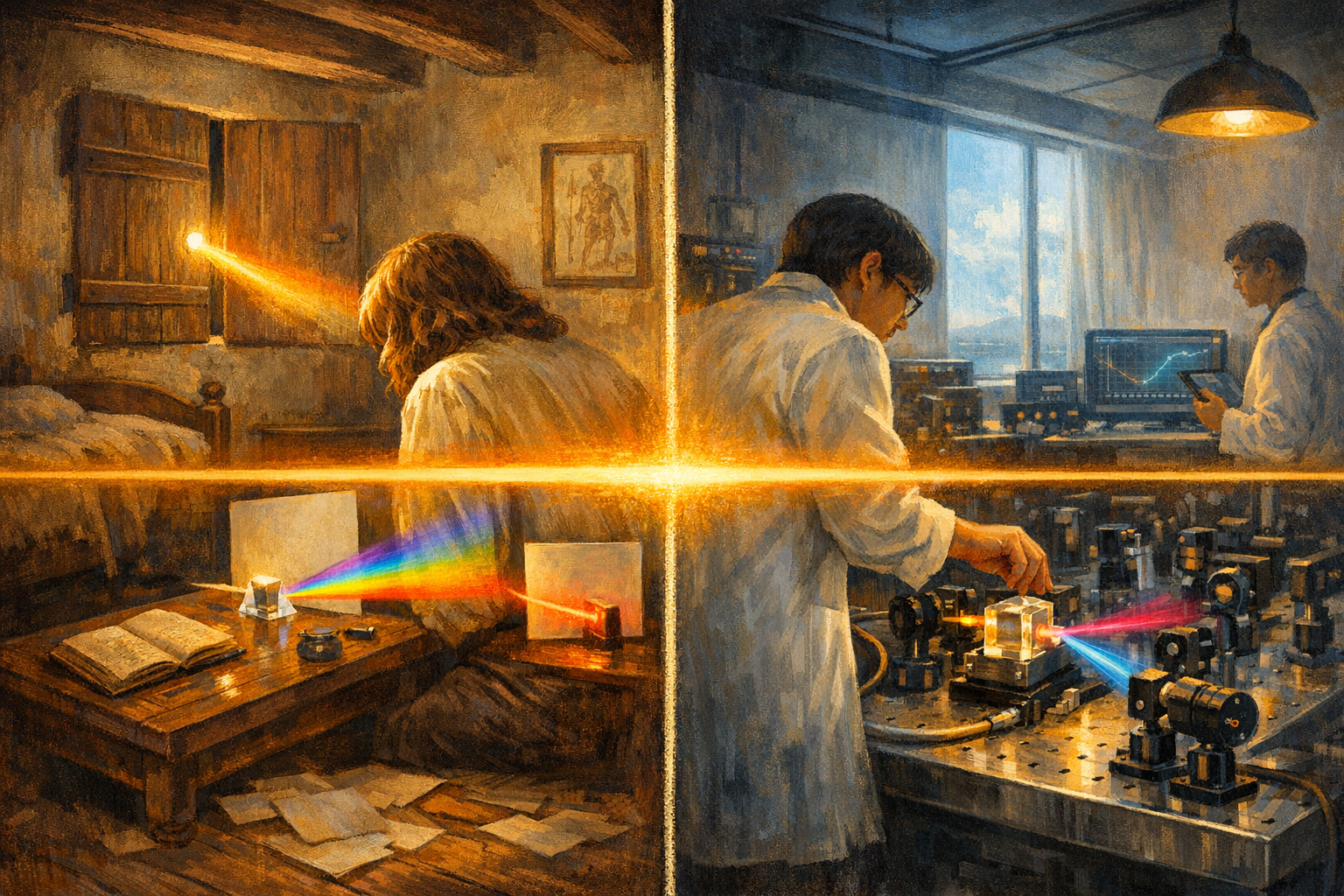
The university had been closed for plague. In the summer of 1665 the Cambridge senate had voted to disperse the students and Fellows of Trinity College to whatever country house could take them, and Isaac Newton, twenty-two, just graduated, had gone back to his mother Hannah Smith's farm at Woolsthorpe Manor in the gentle countryside seven miles south of Grantham in Lincolnshire. He stayed eighteen months. He later said of those months, with the immodesty of someone who was right, that he had been "in the prime of my age for invention" and that he "minded Mathematicks and Philosophy more than at any time since." His private notebooks from the period show him inventing the calculus, working out the inverse-square law of gravitation, and beginning the work on light and colour that would become Book One of the Opticks.
The piece of equipment he used for the third project he bought at the Stourbridge Fair, an annual mile-long market on the outskirts of Cambridge that travelled from cattle to spices to glassware to bookshops. He bought a glass prism. He cut a small hole in the wooden shutter of his upstairs bedroom window, let a single narrow beam of sunlight in, and put the prism in the beam.
The well-known result is the fan of colours from red to violet. That part was not new. What Newton then did was set up a second prism in the path of the dispersed beam, isolate the red component, and pass it through the second prism. The red did not split further. It stayed red. He repeated the experiment with each colour. Each was internally pure. The colours, he concluded, were properties of the sunlight itself. The prism was only sorting them. He called the result his experimentum crucis, the crucial experiment, the moment a single demonstration could compel a conclusion. He returned to Trinity in 1667. He sat on the work for five years while he polished and turned a brass-and-glass reflecting telescope and finally, in the issue of Philosophical Transactions dated 8 July 1672, published a letter to the Royal Society titled "A Letter... containing his New Theory about Light and Colours." Within weeks the French Jesuit Ignace-Gaston Pardies wrote to challenge him. Newton replied within ten days. The argument over Newton's optics ran in print for fifty years and ended in his favour.
What Newton could not have known is that the same beam of sunlight he had let in through his bedroom shutter at Woolsthorpe contained, encoded in the random arrival times of the individual photons, the deepest weirdness of physics.
On 24 April 2026, in Advanced Photonics, a team led by Wuhong Zhang and Lixiang Chen at the College of Physical Science and Technology at Xiamen University in southeastern China published a paper titled "Sunlight-excited spontaneous parametric down-conversion for ghost imaging." On the roof of their laboratory they had installed a heliostat, a small mirror on a motorised mount that tracks the sun across the sky. The heliostat fed reflected sunlight into a twenty-metre plastic multimode optical fibre that ran down through the building into a darkened laboratory. The fibre brought the sunlight, still incoherent, still ordinary, into a periodically poled potassium titanyl phosphate crystal, the kind of nonlinear crystal that an optical engineer typically pumps with a precisely tuned laser. The crystal split individual sunlight photons into entangled photon pairs.
Spontaneous parametric down-conversion of sunlight had been thought practically impossible. The intensity of the sun's light, measured photon-by-photon, was too low and too messy. The phase relationships, the quantum-mechanical handshake between photons, were thought to require a laser source for any signal to rise above the noise. The Xiamen team and an independent team at the Max Planck Institute for the Science of Light in Erlangen, working with the long-time quantum-optics pioneer Robert W. Boyd at the University of Ottawa, showed that the assumption was wrong. The arXiv preprint from the Max Planck and Ottawa team, posted within days of the Xiamen paper, reports that the sunlight-generated photon pairs violate Bell's inequality with a measured parameter S of 2.54, comfortably above the classical bound of 2. That is the same Bell test John Bell wrote down at CERN in 1964 to distinguish quantum mechanics from any local-realistic theory. Sunlight, run through the right crystal, passes it.
What the result means in practice is that the entanglement Albert Einstein in 1935 called "spooky action at a distance," that Alain Aspect's group at Orsay demonstrated with a laser in 1982, that won Aspect the 2022 Nobel prize in physics, is also produced by the sun itself, free of charge, has been arriving at the Earth's surface in measurable quantity for as long as the sun has been shining, and has been waiting only for the right crystal and the right detector to be measured. The Xiamen demonstration imaged a small standard test target by ghost imaging, a technique in which the image is reconstructed from the correlations between paired photons rather than from any single photon directly. They reconstructed the image using nothing but daylight.
The implication for the laboratory is operational. A school physics class can in principle run a Bell test on sunshine and get the same statistical violation of classical reality that Aspect's group got with a precisely tuned argon-ion laser in 1982. The implication for the long argument over what light is, the argument Newton started at his bedroom window in 1666, is harder to summarise. The sunlight Newton sorted through his prism contained, as he correctly inferred, all the colours. It also contained, as he could not have inferred, all the quantum correlations that would take physics three more centuries to discover. The colour and the correlation were both already there.
Newton said, of the optics work, that he could see further only because he stood on the shoulders of giants. The phrasing was conventional in his time, and possibly sarcastic in his case. The giants whose shoulders the Xiamen experimenters are standing on include him.
A boy of twenty-three on a country farm in 1666 put a prism in a beam of sunlight to see what colours it carried. A laboratory in southeastern China in 2026 put a different kind of crystal in the same beam to see what correlations it carried. Both got back more than they expected.