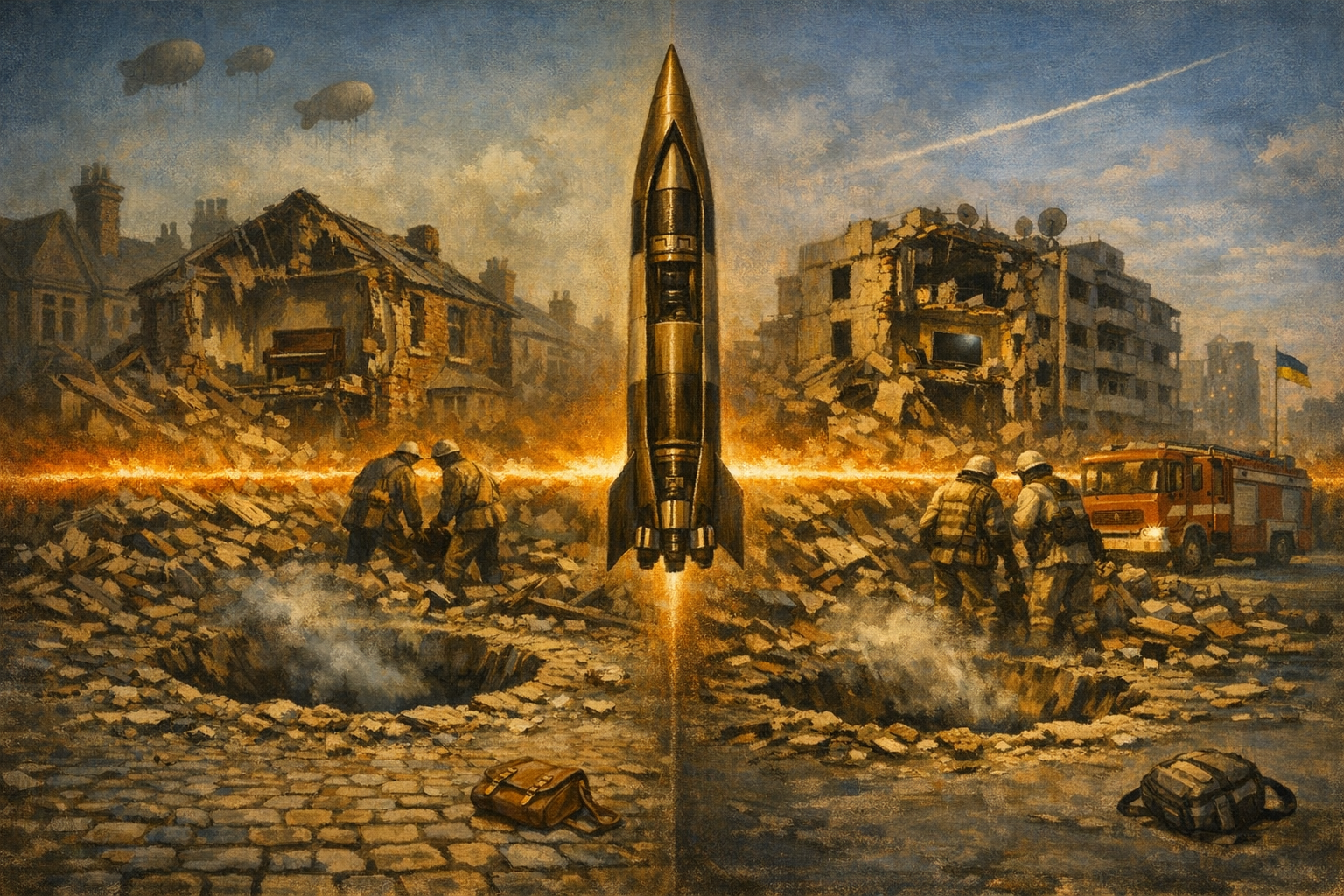
At approximately twenty-three minutes past one on the morning of Sunday 24 May 2026, the air-raid sirens at the National Radio Centre on Khreshchatyk Street in central Kyiv began the longest continuous alert of the war so far. The attack would last more than five hours. Russian forces launched ninety cruise and ballistic missiles and six hundred attack drones, in waves, against the Ukrainian capital and its surrounding region. Twenty-eight residential apartment buildings in Kyiv were damaged or destroyed. The Cabinet of Ministers building on Hrushevskoho Street had its ground-floor windows blown out by a kinetic-impact air-blast. By dawn the city's emergency services were reporting four dead and approximately one hundred wounded; the final count of the night by Sunday evening was twelve dead and one hundred and fifty injured. President Volodymyr Zelensky confirmed that one of the weapons used in the attack was a Russian Oreshnik medium-range ballistic missile, fired against Bila Tserkva, a city about eighty kilometres south of Kyiv. It was the third operational deployment of the Oreshnik against Ukraine and the first against a target in the Kyiv-region cluster. French President Emmanuel Macron called the attack "the dead end of Russia's war of aggression." European Union High Representative Kaja Kallas called it "reckless nuclear brinkmanship."
The Oreshnik (Russian for "hazel tree") is the operational name of a new Russian intermediate-range ballistic missile, a variant of the cancelled RS-26 Rubezh design, with a reported speed of Mach 10 and a multiple-reentry-vehicle payload designed to defeat any existing missile-defence system. It was deployed in combat for the first time on 21 November 2024 against the Yuzhmash defence plant in Dnipro. Vladimir Putin announced the launch on Russian state television that night, calling it Russia's response to the United States and Britain permitting Ukraine to fire American ATACMS and British Storm Shadow missiles against targets inside the Russian Federation. He described the weapon as one that travels "like a meteorite" and is "immune to any air defence system in the world." It was the first IRBM-class weapon used in combat since the INF Treaty was signed in 1987, the first such weapon launched by either superpower in any of their proxy or direct wars, and the first ballistic-missile attack against a European capital since 1945. The 24 May 2026 attack on Kyiv was the eighteenth month of the Oreshnik's existence as an operational weapon and the third time it had been used.
The 1945 reference in that sentence is not casual.
On Tuesday 13 June 1944, exactly one week after the Allied landings on the Normandy beaches, a Fieseler Fi 103 flying bomb launched from a fixed ramp at Eclimeux in the Pas-de-Calais and travelled approximately one hundred and ninety kilometres before its pulse-jet engine cut out over Mile End Road in East London. The bomb fell on a railway bridge at Grove Road, Bow, and killed six civilians. It was the first operational use of the Fieseler Fi 103, designated by the German Luftwaffe as the Vergeltungswaffe Eins, the Vengeance Weapon One, and known to the British public as the buzz-bomb or the doodlebug. Over the next nine months, the Luftwaffe launched approximately nine thousand five hundred V-1 flying bombs against the United Kingdom. About two thousand four hundred reached London. The civilian death toll in Britain from V-1 attacks alone was approximately six thousand one hundred and eighty-four. The Royal Air Force established a counter-V-1 fighter air-defence belt over Kent and Sussex. Fighter pilots learned to ride alongside the doodlebugs and tip them off course with a careful wingtip-to-wingtip flick. Anti-aircraft barrage guns at the coastal cliffs shot the V-1s out of the sky. The Operation Crossbow strategic-bombing campaign against the V-1 launch sites in France required the diversion of more than 117,000 Allied bomber sorties from other theatres of the European war.
On Friday 8 September 1944, three months after the V-1 debut and one day after the Allied liberation of Brussels, a single rocket fired from a mobile launcher at the Wassenaar woods outside The Hague reached the upper atmosphere at supersonic speed, fell back through it without any sound that arrived ahead of the explosion, and detonated in a residential street in Chiswick in west London. The rocket killed three civilians and injured twenty. It was the first operational use in human history of a long-range ballistic missile. The Vergeltungswaffe Zwei, the Vengeance Weapon Two, was a weapon against which there was no air defence and no warning. Over the next seven months the Wehrmacht launched approximately three thousand one hundred seventy-two V-2 rockets, of which about one thousand four hundred reached London. The civilian death toll in Britain from V-2 attacks was approximately two thousand seven hundred fifty-four. The last V-2 to hit London arrived on Tuesday 27 March 1945 at Kynaston Road, Orpington, killed a 34-year-old woman called Ivy Millichamp, and was followed two hours later by another V-2 at a block of flats in Whitechapel that killed one hundred and thirty-four. Forty-two days later Germany surrendered.
The weapon was militarily insignificant. Both V-1 and V-2 together killed approximately nine thousand British civilians over nine months at the very end of a war in which one hundred and twenty-three thousand British civilians had already died from aerial attack. They did not change the trajectory of the war by a day. The Allied liberation of Western Europe proceeded on schedule. The German Wehrmacht ran out of fuel, ammunition, manpower and territory on the same schedule it would have run out of them without the vengeance weapons.
The weapon was strategically epoch-making in two separate and equally important ways.
First, the V-2 was the world's first long-range ballistic missile. Every intercontinental and intermediate-range ballistic missile built since 1945, by every nation, is its lineal technological descendant. The Soviet R-7 (which launched Sputnik in October 1957 and Yuri Gagarin in April 1961) was designed by a team that had captured the V-2 documentation and the V-2 personnel they could acquire. The American Saturn V (which took the Apollo astronauts to the moon between 1969 and 1972) was designed by a team led by Wernher von Braun, who had been the V-2's chief designer, was captured by US forces in May 1945, was relocated to the United States under Operation Paperclip, and finished his career as the director of NASA's Marshall Space Flight Center. The technology that landed Russia's Oreshnik missile on Bila Tserkva at 01:23 this morning is the technology that fell on Chiswick on the evening of 8 September 1944, refined over eighty-two years of post-war development by both superpowers and their proxies.
Second, the V-2 was built on slave labour. The Mittelwerk underground factory near Nordhausen in the Harz Mountains was supplied by the Mittelbau-Dora concentration camp. Approximately 60,000 prisoners passed through Mittelbau-Dora; at least 20,000 died of malnutrition, exhaustion, hangings, and beatings; approximately 10,000 of those deaths can be directly attributed to V-2 production. More people died building the V-2 than were killed by it as a weapon. Wernher von Braun visited the Mittelwerk many times. He admitted in a 1969 interview that the conditions there were "repulsive." He was never charged with a war crime. He died in 1977 a NASA hero.
The pattern in the V-weapon case is the pattern in the Oreshnik case. A regime fighting a long war it can no longer decisively win in the field deploys a novel and technologically unprecedented weapon against the enemy capital. The weapon's military effect is small. The weapon's psychological effect is the point. The weapon's actual strategic legacy is the eighty-year technological aftermath. The London civilians who died under the Vergeltungswaffen between June 1944 and March 1945 were paying not for the loss of the Second World War, which Germany was about to lose anyway, but for the Soviet nuclear-missile programme, the American nuclear-missile programme, the Saturn V, the Apollo Program, the entire postwar nuclear-armed peace, and (on the morning of 24 May 2026) the Oreshnik strike on Bila Tserkva.
The vengeance weapon does not change the war. It changes what the next war begins with.