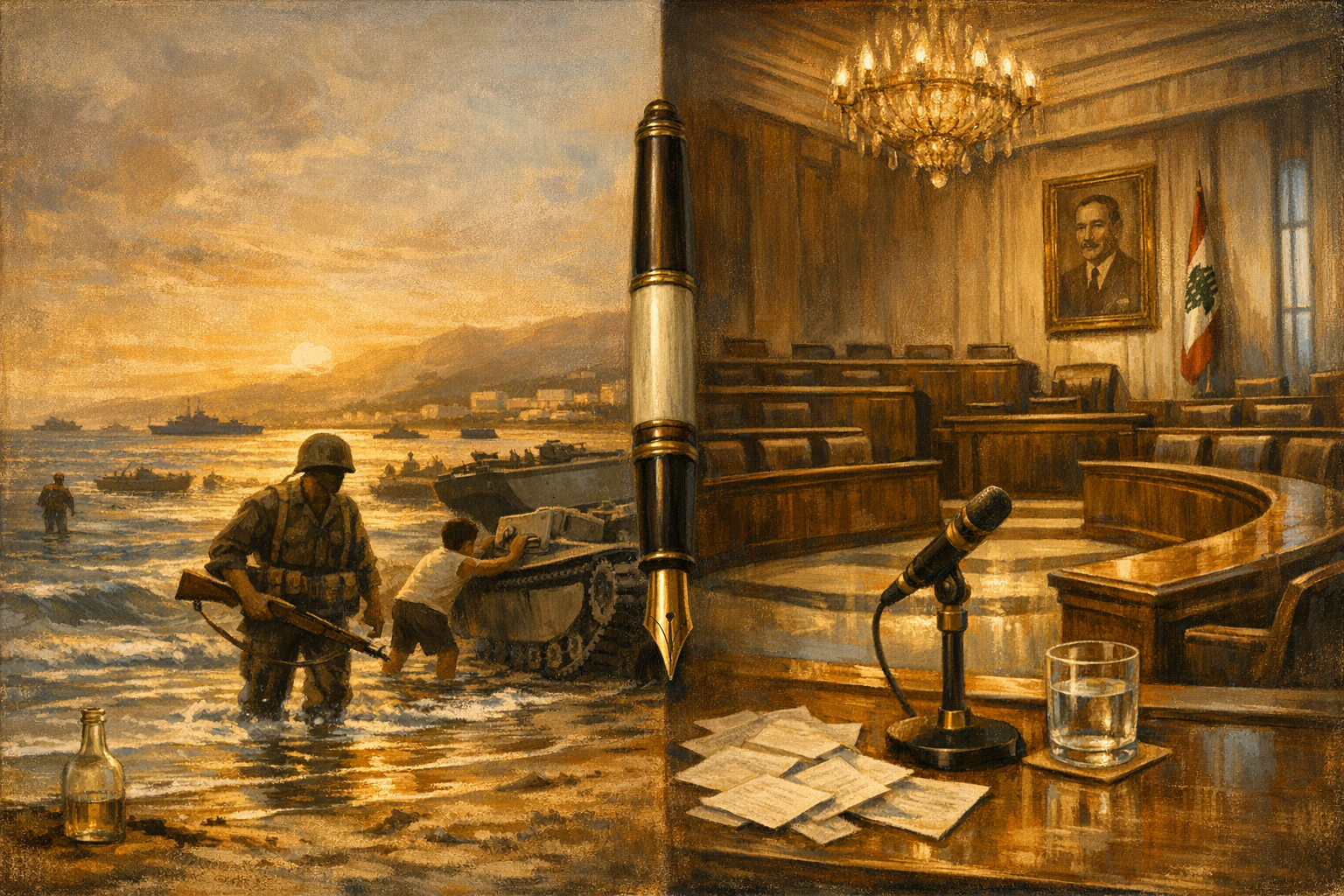
At one minute past three on the afternoon of Tuesday 15 July 1958, the first wave of US Marines from Battalion Landing Team 2/2 came ashore at Red Beach, the gentle sand crescent of Khalde just south of Beirut International Airport. They were the leading element of fourteen thousand troops the Eisenhower administration had ordered into Lebanon over the previous thirty hours. The Marines waded in with M1 rifles up, in full pack, expecting to be fired upon. They were not fired upon. The Lebanese beach was full of sunbathers. Souvenir vendors had already begun working the line. A small boy ran into the surf to help a Marine corporal whose amphibious tractor had bogged down in the soft sand. By six in the afternoon the airport was secure and the embassy in Beirut had been reinforced. By the end of the week, an Eisenhower envoy named Robert Murphy was in a hotel room with the president of Lebanon negotiating his departure. The Marines stayed three months. By the time they left in late October, Lebanon had a new president, a new compromise, and the same constitution. Sixty-eight years later, the compromise is breaking down again, in the same place, over the same question. The question is who arbitrates when the Lebanese can no longer arbitrate themselves.
Camille Chamoun had been president of Lebanon since 1952. He was a Maronite Christian, as the National Pact of 1943 required the president to be. He was a foreign-trained lawyer, an Anglophile, and an early adopter of the Eisenhower Doctrine, the January 1957 declaration that the United States would protect any Middle Eastern country requesting help "against overt aggression from any nation controlled by international communism." Chamoun signed on. He was alone among Arab leaders in doing so. His neighbour Gamal Abdel Nasser, the Egyptian president and apostle of secular Arab nationalism, decided that Chamoun was an American satellite. In February 1958 Nasser sealed the United Arab Republic with Syria, putting a single hostile Arab state on Lebanon's northern and eastern borders. The Sunni and Druze opposition inside Lebanon, led by Saeb Salam in Beirut and Kamal Jumblatt in the Chouf mountains, drew the obvious conclusion: the June 1957 parliamentary elections that Chamoun had won by a comfortable pro-Western majority had been, as everyone privately agreed, rigged.
By May 1958 Lebanon was in low-grade civil war. Sunni neighbourhoods of Beirut and Tripoli were under opposition control. Druze militias were fighting Maronite militias in the Chouf. Syrian arms were crossing the Bekaa Valley to the opposition. The army's commander, Maronite General Fuad Chehab, refused to order the army to fire on either side, because doing so would split the army along sectarian lines and end Lebanon as a country. Chamoun was rumoured to be preparing a constitutional amendment to allow himself a second consecutive term, the very thing the original 1926 constitution had been designed to prevent. The rumour itself legitimised the rebellion.
What finally tipped Eisenhower into action was not Lebanon. It was Iraq. On the early morning of Monday 14 July 1958, the 19th and 20th Brigades of the Iraqi army under Brigadier Abd al-Karim Qasim entered Baghdad. By dawn they had stormed the Rihab Palace and killed the twenty-three-year-old King Faisal II of Iraq, his uncle the regent Abdul-Ilah, and the prime minister Nuri al-Said. The Hashemite monarchy that the British had installed in 1921 was over by lunchtime. Eisenhower, who was at the White House when the cables came in, called the National Security Council that afternoon. Chamoun's request for American help, which had been on file in some form since May, was now urgent. The next morning the Sixth Fleet, already cruising the eastern Mediterranean, received its orders. Operation Blue Bat began at 0301 the following day with the leading Marine battalions transferring from troopships to landing craft.
The official mission of the fourteen thousand Americans now in Lebanon was to "protect American lives." The actual mission was to give Robert Murphy enough leverage to broker a Lebanese political compromise that would replace Chamoun without overthrowing the country. Murphy, a career State Department officer and the most experienced American Arabist of his generation, arrived in Beirut on the evening of 16 July. He met with Chamoun, with the opposition leaders Salam and Jumblatt, and with General Chehab. He determined within five days that the available compromise was Chamoun's exit and Chehab's election. Chamoun resisted briefly. The Lebanese parliament, with American Marines guarding the road from the airport, elected General Fuad Chehab as the next president of Lebanon on Thursday 31 July 1958, by a vote of 48 to 8. Chehab took office on 23 September. The Marines began their phased withdrawal in mid-August and finished on 25 October. One American serviceman, an army engineer, had been killed by sniper fire during the deployment. The Lebanese civil war of 1958 was over.
Chehab's six-year presidency was the closest Lebanon ever came to a functioning sectarian democracy. He reorganised the state services, expanded the army, recruited Shia officers and Sunni civil servants on a measured quota basis, and ran a quiet anti-corruption campaign. He refused to run for a second term. His successor Charles Helou (1964-1970) held the system together for another six years. Then, in November 1969, an Egyptian-mediated agreement signed in Cairo handed the Palestinian Liberation Organisation effective sovereignty over the Palestinian refugee camps inside Lebanon and authorised armed PLO operations against Israel from Lebanese soil. Lebanon's six-year stability lasted exactly that. The civil war that began on 13 April 1975 was the unwinding of the 1958 compromise. The Israeli invasion of 1982 was its second unwinding. Hezbollah, founded in the Bekaa Valley during the 1982 invasion by Shia Lebanese trained by Iran's Revolutionary Guards, was the third. The Taif Agreement of 1989 was the fourth. The current Lebanese constitution, the Taif rebalancing, is the great-great-grandchild of the 1958 compromise. And the question that the United States resolved at Khalde in July 1958, by depositing fourteen thousand Marines on a beach, was the question of who arbitrates the Lebanese sectarian-territorial balance when the Lebanese cannot.
The same question is open this week.
Lebanon is due to hold parliamentary elections in May 2026. The 128 seats are allocated by the Taif constitution between Christian and Muslim blocs in a fifty-fifty split, with subdivisions by confession. The dispute that has stalled the elections is over how the Lebanese diaspora may vote. In 2022, as a one-time accommodation during the financial collapse, expatriates were allowed to vote from abroad for all 128 seats in their home districts. The 2022 expat vote was decisive in elevating reformist anti-establishment members of parliament against the Hezbollah-Amal Shia bloc. The current dispute, which has run since February 2026, is whether to keep the 2022 arrangement or revert to the original 2017 law, which allotted only six dedicated seats to expatriate voters across all of the diaspora. The Speaker of Parliament, Nabih Berri, who has held that office since 1992 and is the political head of the Amal Movement, has insisted that the elections will be held on time and refused both the diaspora-friendly arrangement and the postponement that the Western Quintet of ambassadors (the United States, France, Saudi Arabia, Egypt and Qatar) has urged on him.
The Quintet's pressure for a postponement is being explained as the need to "create time for the disarmament of Hezbollah." That phrase covers the second arbitration that is arriving in Lebanon this week. On the morning of 25 May the Israeli security cabinet authorised an intensified offensive in southern Lebanon designed to "crush Hezbollah." On Thursday 28 May Israeli air and drone strikes killed nineteen people across Tyre, the Adloun Highway, and southern Beirut, the first strike on the capital in three weeks. Six members of one family in southern Lebanon were killed by a drone while fleeing at dawn. The Israeli military announced that operations would now extend beyond its declared "forward defence line." The Quintet diplomats and the Israeli air force are arbitrating the same question, by different methods.
The 1958 lesson is not that Marines work. They worked once. The lesson is that the question they answer keeps reopening. Every twenty or thirty years the Lebanese constitution requires an external referee to re-balance its sectarian formula against the demographic reality. In 1958 the referee was the United States Sixth Fleet. In 1969 it was Egypt. In 1989 it was Saudi Arabia. In 2006 it was UN Security Council Resolution 1701. In 2026 it appears to be a five-power diplomatic Committee in Beirut and an Israeli air campaign coordinated against the southern suburbs. The compromise that the Americans imposed at Khalde in 1958 worked for sixteen years, until the constitutional contradiction at the heart of it re-emerged. The compromise being negotiated this month is unlikely to last that long.
The country whose elections cannot be held without external arbitration is a country whose constitution is the same as the compromise.