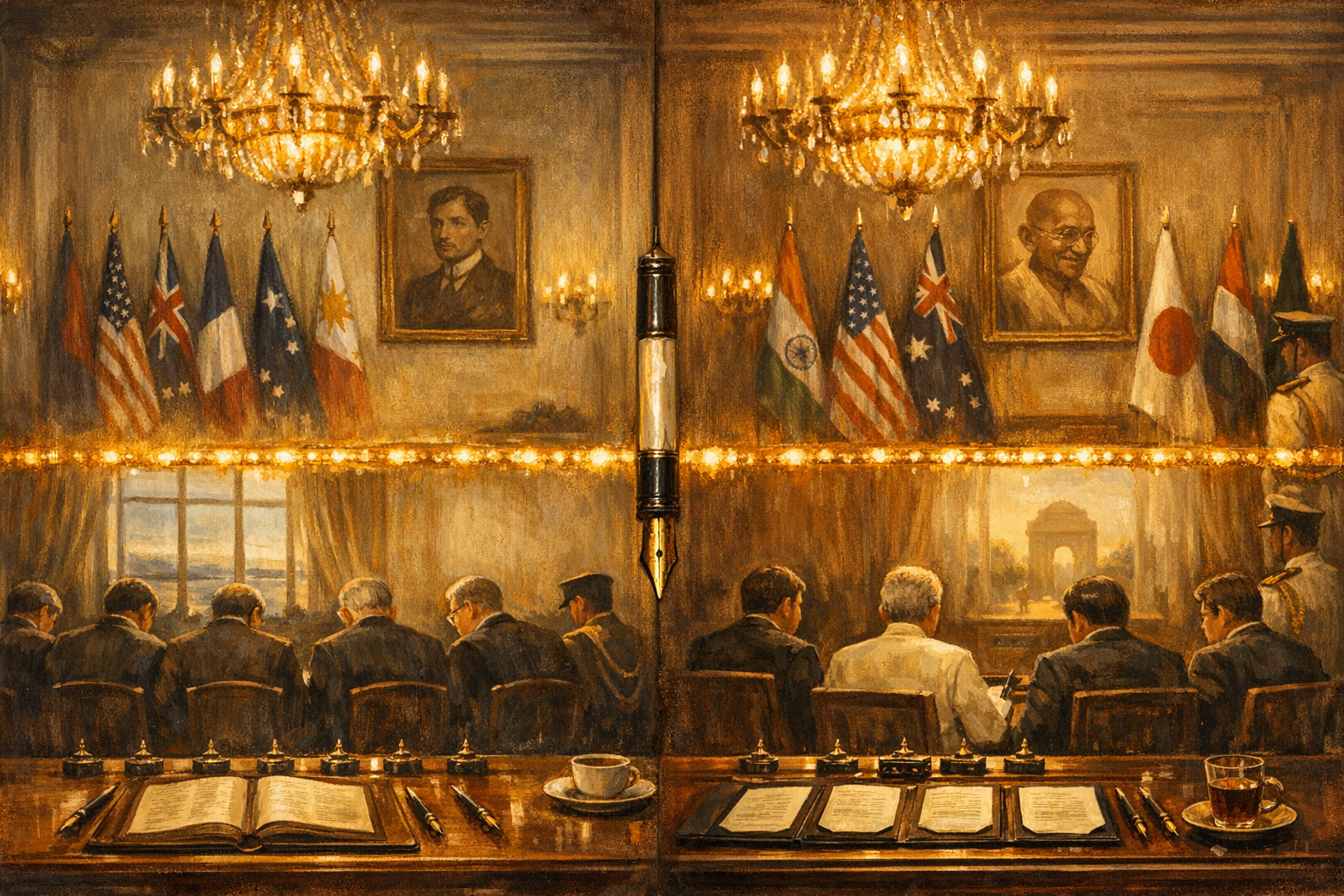
At eleven o'clock on the morning of Wednesday 8 September 1954, in the painted-cream ballroom of the Manila Hotel on the edge of Rizal Park, eight foreign ministers signed an instrument called the Southeast Asia Collective Defense Treaty. The signatories were the United States (John Foster Dulles), the United Kingdom (Lord Reading), France (Guy La Chambre), Australia (Richard Casey), New Zealand (T. Clifton Webb), the Philippines (Carlos P. Garcia), Pakistan (Zafrulla Khan) and Thailand (Wan Waithayakon). The treaty was an eight-page document with eleven articles. It became operational on 19 February 1955 at a meeting of the same eight countries in Bangkok, where the new organisation acquired a permanent secretariat, a Secretary-General, an office building on Sri Ayudhya Road, and the acronym SEATO: the Southeast Asia Treaty Organization. In the months between the Geneva Conference of 1954 (which had partitioned Vietnam into a Communist North and a non-Communist South) and the Hungarian Revolution of 1956 (which would crystallise the Cold War's European front), the Manila Pact was the American answer to the question of how to organise the Asian containment of the People's Republic of China. The pact lasted twenty-three years. It is generally remembered, when it is remembered at all, as a failure. The structure that replaced it sat down to a working lunch in New Delhi on Tuesday 26 May 2026.
The Dulles design was deliberate. The Manila Pact was the Pacific equivalent of the North Atlantic Treaty signed in Washington five years earlier. Like NATO it was a multilateral defence alignment among democracies and friendly authoritarians. Unlike NATO its Article IV did not commit the signatories to come to one another's military aid if attacked, only to "act to meet the common danger in accordance with [their] constitutional processes." This was the language Dulles had to use in order to get the treaty through the United States Senate, which would never have ratified a true Asian NATO. The treaty's protocol, signed the same day, extended its protection to three non-signatory states: South Vietnam, Laos, and Cambodia. The protocol was the legal predicate the Johnson administration would invoke ten years later, in 1965, to deploy combat forces to South Vietnam. The Manila Pact, in other words, was the legal architecture of the Vietnam War.
SEATO's high-water mark was 1957 to 1965. The organisation built a permanent secretariat building in Bangkok and elected the Thai diplomat Pote Sarasin as its first Secretary-General. It ran joint military exercises in the South China Sea (Operation Firmlink, 1959; Operation Pony Express, 1962). It funded a postgraduate Asian Institute of Technology in Bangkok that survives today and remains one of the leading engineering universities in Southeast Asia. It built a SEATO Graduate School of Engineering in Bangkok and a SEATO cholera-research laboratory in Dhaka (now the International Centre for Diarrhoeal Disease Research). It coordinated counter-insurgency intelligence-sharing in the Philippines (against the Huks), Thailand (against the Communist Party of Thailand), and Malaya. It published a magazine called SEATO Record. It had its own flag (a chequered yellow-and-white pattern around a globe). It had, by 1962, the full institutional infrastructure of a serious international organisation.
What it never had, after the institutional founding moment of 1955, was a meaningful collective response to a member's actual security crisis. Pakistan invoked the Manila Pact in September 1965 when India attacked the disputed Kashmir front. The United States declined to honour the invocation on the grounds that the treaty was directed against Communist aggression and India was not Communist. Pakistan never forgave the failure: when East Pakistan seceded as Bangladesh in 1971 with Indian military backing, Pakistan formally withdrew from SEATO on 7 November 1973. France had stopped paying its dues in 1965 and formally withdrew in 1974. The United Kingdom stopped attending meetings during the early 1970s. The Carter administration concluded by mid-1976 that the organisation had no operational utility left, that the secretariat in Bangkok was producing nothing the State Department could not produce more efficiently in Washington, and that the Manila Pact had been overtaken by Nixon's opening to China (the actual hinge moment of US Asia policy after February 1972). SEATO was formally dissolved at a final ministerial council meeting in Bangkok on 30 June 1977. The Sri Ayudhya Road headquarters building was handed back to the Thai government. The Manila Pact treaty itself remains in force as the legal predicate for the United States-Thailand alliance, which is still operational today. The institutional memory of SEATO was carried forward, in classified form, in the personnel files of the State Department's Bureau of East Asian and Pacific Affairs, and is the basis of the personal relationships that produced the Quad.
The Quadrilateral Security Dialogue is what SEATO's institutional memory rebuilt itself into. The concept was first proposed by Japanese Prime Minister Shinzo Abe in 2007 as a four-power coordination forum among Japan, the United States, Australia and India. It atrophied after 2008 when the Rudd government in Canberra withdrew Australia's participation in response to Chinese objections. It was revived in 2017 at the ASEAN summit by the Trump and Modi administrations. It was institutionalised by the Biden administration into a regular leaders' summit and a regular foreign ministers' summit. It was inherited by the second Trump administration in 2025 amid widespread expectation, including from Quad partners, that Trump's tariff war on India and Trump's apparent personal rapprochement with Xi Jinping would functionally kill the Quad.
The Quad foreign ministers met in New Delhi on Tuesday 26 May 2026, chaired by India's External Affairs Minister Subrahmanyam Jaishankar, and attended by United States Secretary of State Marco Rubio (his first official visit to India), Australia's Foreign Minister Penny Wong and Japan's Foreign Minister Toshimitsu Motegi. They did not kill the Quad. They produced three concrete deliverables: a joint Indo-Pacific Maritime Surveillance Initiative for sharing patrol-aircraft data on Chinese fishing and naval movements; a Critical Minerals Framework for coordinating the four members' investment in rare-earth and battery-mineral supply chains outside Chinese control; and (most strikingly) the Quad's first-ever joint infrastructure project, a port redevelopment at Lautoka on Fiji's main island Viti Levu, where Chinese-funded port projects have produced a decade of Pacific island-nation political alignment toward Beijing. The Quad also committed to extending undersea fibre-optic cables to the South Pacific island nations of Vanuatu, the Solomon Islands and Tonga by the end of 2026, integrating their telecommunications infrastructure into the Western internet rather than into China's Belt and Road digital network.
These are precisely the kinds of concrete deliverables SEATO produced between 1955 and 1962. A regional surveillance arrangement (the Indo-Pacific Maritime Surveillance Initiative is the functional equivalent of SEATO's Pacific Maritime Patrol Programme of 1957). A coordinated economic-development initiative (the Critical Minerals Framework is the functional equivalent of the SEATO Industrial Development Fund of 1958). A joint infrastructure project in a small allied state (the Lautoka port is the functional equivalent of the Asian Institute of Technology Bangkok of 1959). The shape of the rising institution and the shape of the institution that died in 1977 are the same shape.
The differences matter. The Quad is not a defence treaty. There is no Article IV. There is no permanent secretariat. There is no Secretary-General. There is no flag. There is no headquarters building. There is no chartered international-organisation status. The Quad is technically a "non-treaty alignment." It produces joint statements and joint working groups, and it has nothing else. The advantage of this form is that the Quad cannot be killed the way SEATO was killed: there is no headquarters lease to terminate, no Secretary-General to dismiss. The disadvantage is that the Quad has nothing structural that survives the political shifts that change the foreign ministers around the table. SEATO had a building in Bangkok that outlasted the Vietnam War; the Quad has a working-group calendar that does not.
The first SEATO was killed by a US president going to Beijing. That president's name was Richard Nixon and the date was 21 February 1972 and the result was that the entire architectural rationale of the Manila Pact (contain Communist China through the alignment of its Asian neighbours) collapsed within months. The Quad survives this week in spite of a US president who has already gone to Beijing, met with Xi Jinping at the Great Hall of the People on 14 May 2026, and announced a "constructive China-United States relationship of strategic stability." The second SEATO is being built by the same hand that, if the first SEATO is any guide, would unbuild it. The three Delhi deliverables are the early-stage public works of an institution that may either become the durable Indo-Pacific architecture of the second half of the twenty-first century, or may follow its predecessor into the State Department archives.
The shape of the rising institution and the shape of the institution that died in 1977 are the same shape. The fate of the building is what differs. And the fate of the building, in either era, is decided in Washington.