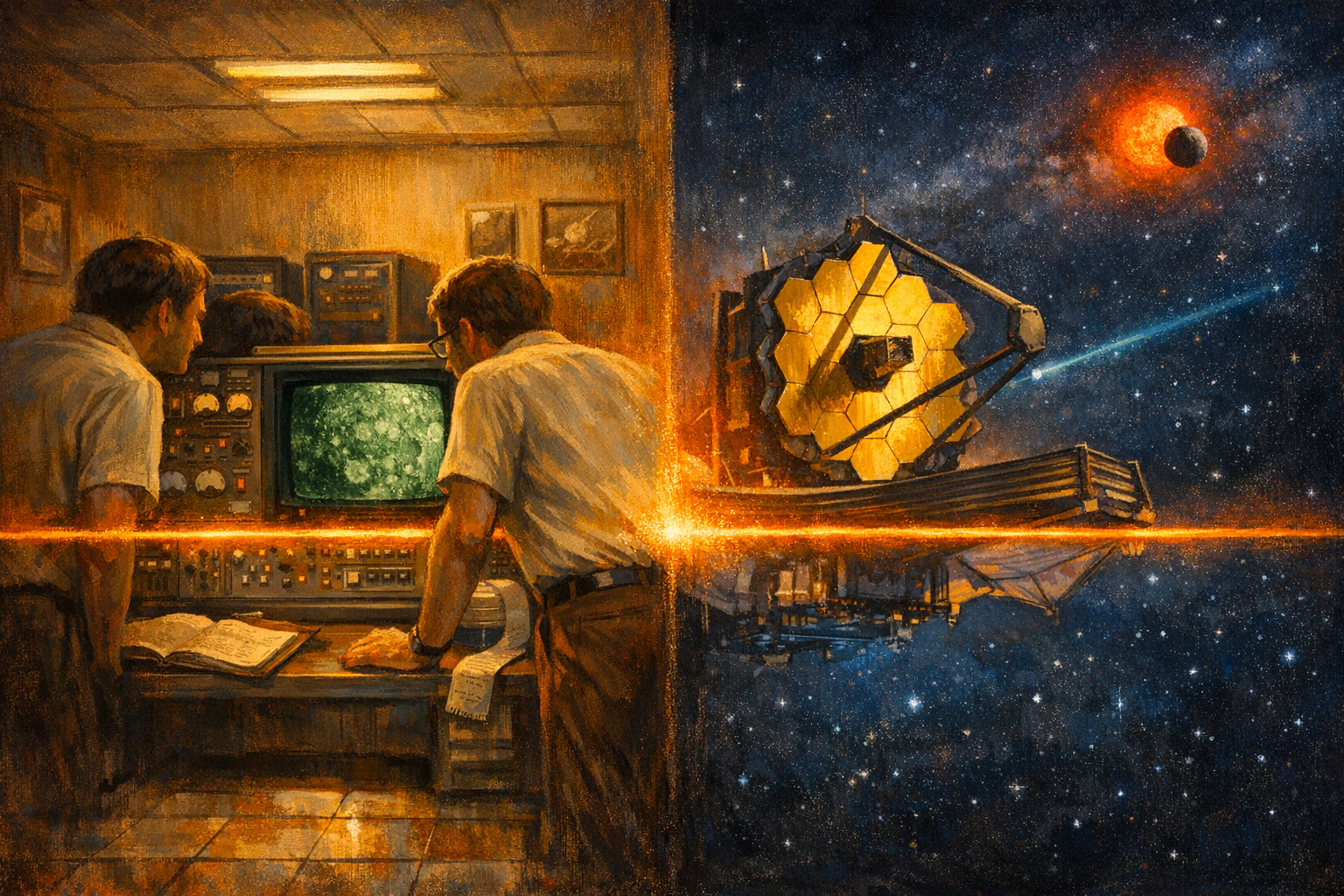
The spacecraft launched from Cape Canaveral on the night of 3 November 1973. It weighed five hundred and three kilograms, carried a small ultraviolet spectrometer, a magnetometer, a charged-particle telescope and, on a deployable boom, two vidicon television cameras. It cost the United States ninety-eight million dollars in 1973 currency. It was called Mariner 10. It was the first deep-space mission ever sent to make use of a gravitational slingshot off another planet, and the planet it was sent to study was Mercury, the innermost world of the Solar System, a body that no human eye had ever seen in close-up and that ground-based telescopes could resolve only as a small fuzzy disc on the rare nights when it was not lost in the glare of the Sun.
The man who had pushed the imaging campaign through the NASA committees, who had assembled the eleven-member television team, who would sit in the Mariner 10 imaging room at the Jet Propulsion Laboratory in Pasadena on the night of 29 March 1974 when the first close-up photographs of Mercury began to arrive at painfully low bandwidth, was Bruce Murray, a forty-two-year-old geologist at Caltech. Murray had taken his PhD at Caltech in 1955 under the geologist Eugene Shoemaker (Shoemaker had been mapping lunar craters from the air; Shoemaker would later co-discover comet Shoemaker-Levy 9). He had spent the next eighteen years on the planetary-science faculty. He had pushed the case for sending Mariner 10 to Mercury at every committee meeting since 1969.
The first flyby was at an altitude of about seven hundred kilometres above the planet's day side. The cameras returned, frame by frame over four months, around two thousand seven hundred photographs covering roughly forty-five percent of the surface. The photographs showed exactly what an Earth-based planetary scientist of 1974 would have hoped to confirm and dreaded to find. Mercury was a thoroughly cratered rock. It had no detectable atmosphere. The surface was the original record of four and a half billion years of bombardment by every meteoroid the inner Solar System had ever produced. The Caloris Basin alone, a fifteen-hundred-kilometre impact crater on the side of Mercury that had faced the Sun during the impact, was the largest recognisable structure on the planet. The whole world was a museum of what the inner Solar System looked like when the planets were still cooling. Mariner 10 made two more flybys, in September 1974 and March 1975, and then its onboard manoeuvring gas ran out and it drifted on past Mercury into solar orbit, where, presumably, it is still drifting today.
Murray went on to direct the Jet Propulsion Laboratory from 1976 to 1982. He co-founded The Planetary Society with Carl Sagan and Louis Friedman in 1980. He published the standard textbook (Earthlike Planets, with R. Greeley and Schubert in 1981) and the popular memoir (Journey into Space, 1989). He died in 2013. His New York Times obituary called him "the man who showed America Mercury."
Fifty-two years after the Mariner 10 imaging team sat at the JPL terminal watching the first crater appear, a different telescope, at a different distance, looked at a different planet, and found Mercury.
On 4 May 2026, Nature Astronomy published "The dark and featureless surface of rocky exoplanet LHS 3844 b from JWST mid-infrared spectroscopy." The lead author was Sebastian Zieba at the Harvard-Smithsonian Center for Astrophysics. The senior author was Laura Kreidberg, director of the atmospheric physics of exoplanets department at the Max Planck Institute for Astronomy in Heidelberg. LHS 3844 b is a rocky super-Earth about thirty percent larger than Earth, orbiting an M-dwarf star forty-eight light-years from Earth in the southern constellation Indus, every eleven hours. It is tidally locked to its star, so one hemisphere is always in daylight. The day side is at about a thousand Kelvin, around seven hundred and twenty-five degrees Celsius, hot enough to melt lead and to vaporise most volatiles a planet would carry into orbit from formation.
The Zieba and Kreidberg team pointed the Mid-Infrared Instrument on the James Webb Space Telescope at LHS 3844 b for a total of more than one hundred hours, sampling the planet's thermal emission at multiple orbital phases and across a wavelength range from five to twelve microns. The team's analysis ruled out almost every kind of atmosphere with a five-sigma upper limit of one hundred millibars on bulk gases like carbon dioxide and a three-sigma upper limit of ten microbars on more spectroscopically active species like sulphur dioxide. They modelled the thermal spectrum against a library of possible surface compositions and found the best match was a dark, space-weathered basalt. LHS 3844 b is, to the precision JWST can measure across forty-eight light-years, the same kind of object as the world Bruce Murray and his television team mapped at seven hundred kilometres altitude in 1974: an airless rocky planet whose surface is the record of its history.
The shift is in what counts as proximity. In 1974, "close" meant seven hundred kilometres above the day side. In 2026, "close" means a four-tonne infrared telescope orbiting the Sun-Earth Lagrange point one and a half million kilometres outside Earth's orbit, doing spectroscopy on a target whose dayside thermal signal is twenty parts per million of the host star's. The cratered airless rock the cameras showed Murray in 1974 is now a category of object, not a curiosity. It is the first one of a category JWST can actually measure.
Two decades of exoplanet science before JWST had treated atmospheric spectroscopy as the only available diagnostic of a small rocky world's nature. The Zieba and Kreidberg result extends the diagnostic past the atmospheres a planet might or might not have, to the surface a planet definitely does have. The next generation of JWST programmes is now looking at half a dozen comparable targets to see whether airless rocks are common in the M-dwarf super-Earth population, which would tell us something about how the inner regions of those systems form and lose volatiles. Mariner 10 needed gravity to go to Mercury. The Webb needs only a pointing schedule to go to another star's Mercury, and to come back with a surface map. The closeup is the closeup. The crater is still the crater.
The Mariner 10 spacecraft is still in solar orbit, fifty-three years after Murray watched its first frame come down. Some Tuesday in 2049 it will pass within thirty million kilometres of Mercury again. Nobody is watching.