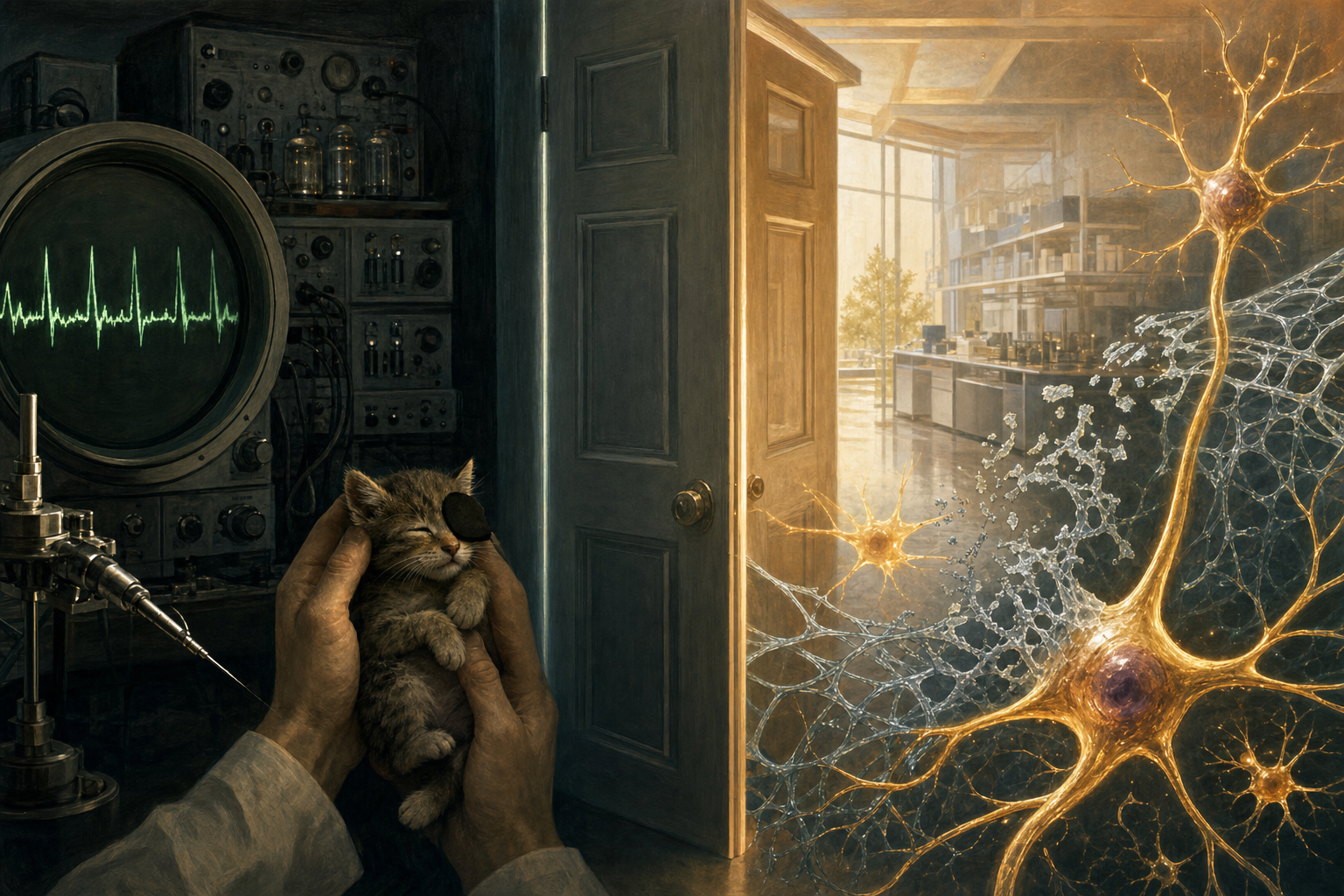
In a basement laboratory in the early 1960s, two young scientists sewed shut one eye of a newborn kitten, waited a few weeks, then opened it again and went looking for the damage. What they found, threaded into the wiring of the brain, would explain why a child with a lazy eye must be treated before they start school, and why an adult with the same problem usually cannot be fixed at all.
The kitten and the closing door
David Hubel and Torsten Wiesel were not trying to study blindness. They were doing something stranger and more patient: listening, one cell at a time, to the visual cortex of a cat. They had built a way to lower a fine electrode into the brain and hear individual neurons crackle as the animal looked at lines and edges, and for this painstaking mapping of how the brain builds vision they would eventually share a Nobel Prize. But along the way they noticed something they had not gone looking for.
When they deprived a young kitten of sight in one eye for just a couple of months and then reopened it, the eye itself was perfectly healthy. The retina worked. The problem was upstream, in the cortex. The territory that should have belonged to the closed eye had been quietly invaded and annexed by the open one. The brain regions that should have listened to the deprived eye now answered only to its neighbour. The animal was, through that eye, effectively blind, and no amount of later use could win the territory back.
Then came the crucial detail, the one that turned an observation into a law. The damage only happened if the deprivation fell inside a narrow window early in life. Sew a kitten's eye shut at the peak of that window, around four weeks of age, and just three or four days could permanently rewire its cortex. Do exactly the same thing to an adult cat, for a year, and almost nothing changed. There was a brief season when the brain was soft and plastic and shaped by experience, and then a door closed, and after that the wiring was set.
They called it the critical period. It was one of the most consequential ideas in all of neuroscience, because it was not just about cats and eyes. It explained why children pick up languages and accents effortlessly and adults struggle. It explained amblyopia, the lazy eye, and why ophthalmologists patch a child's good eye to force the weak one to fight for cortex while it still can, and why if you miss that window the chance is gone for good. The brain, it turned out, has youth built into its biology, a limited-time offer of plasticity that expires.
For sixty years that door looked like a one-way valve. We knew the window existed. We knew roughly when it opened and closed. We did not know what actually slammed it shut, or whether it could ever be reopened.
The Echo
In late May 2026, a team at Harvard Medical School reported that they had found the lock, and, more startling, a key. Working in mice, they traced the closing of the critical period to an unlikely culprit: cortisol, the body's main stress hormone. As a young animal's cortisol rises, it switches on a gene program, not in neurons, but in the brain's support cells, the astrocytes. Those astrocytes then build a kind of scaffolding around the neurons, a dense lattice in the spaces between cells called perineuronal nets. The nets hold the circuitry rigidly in place. The soft clay sets into fired pottery. The window closes.
That alone would be a satisfying answer to a sixty-year-old question. But the Harvard team went further. In adult mice, whose critical period had long since ended, they genetically removed the receptor that lets cells hear the cortisol signal. And the closed window reopened. The adult brains recovered a youthful, childlike plasticity that should have been gone for decades. The door that Hubel and Wiesel had shown swings shut once and stays shut turned out to have a latch, and the latch could be lifted.
They then did the careful, honest thing and checked whether this was just a mouse curiosity. Combing through an existing atlas of single human brain cells, they found the very same astrocyte pathway switching on in human infancy and peaking around adolescence. The mechanism that closes the window in a mouse appears to be closing it in us.
The implications run far past the lazy eye that started the story. If the brain's plasticity can be deliberately reopened, then the things we assume are fixed after childhood, recovery after a stroke, the rewiring needed after injury, perhaps even how we learn late in life, might not be as fixed as the critical period made them seem. The same biology also hints at something poignant: that the very stress hormones meant to help a young animal survive may be the thing that hardens its brain and ends its plasticity, that growing up under pressure may quite literally close the window sooner.
A century of work separates the two ends of this story, and they rhyme almost exactly. In the 1960s, two men listening to single brain cells discovered that the mind has a season, that the window of plasticity opens in youth and then closes, hard, for life. In 2026, another team found the hormone and the cells and the molecular net that close it, and showed that in a mouse you can open it again.
Hubel and Wiesel proved the door exists and shuts behind us. The new work suggests it may have a handle on the other side. The question now is not whether the brain's window closes, but whether, and at what cost, we should ever choose to prop it back open.