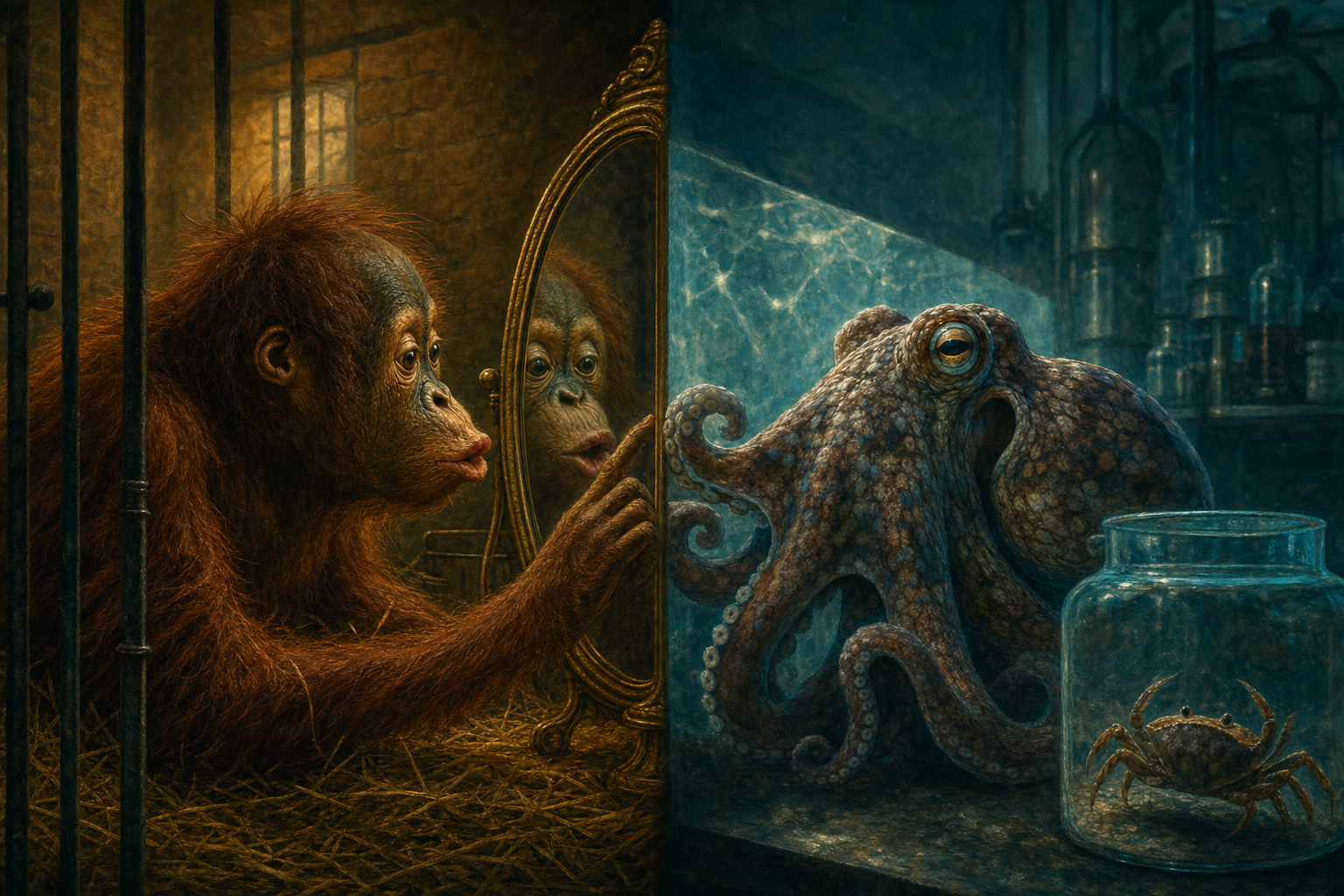
In a tank at Dartmouth College, an octopus did something in 2026 that no invertebrate had ever been seen to do. A live crab sat in a glass jar behind the animal, out of sight, visible only as a reflection in a mirror on the far wall of the tank. The octopus looked at the crab in the mirror. Then it turned ninety degrees, moved around a corner, and went straight to the real crab it could not see. It had used the mirror not as a rival or a curiosity, but as a tool, a window onto a world it could not directly observe.
To understand why that is strange, you have to go back a hundred and eighty-eight years, to a March morning in London, and to the first time a great scientist looked an ape in the eye.
Darwin and the glass
On the twenty-eighth of March 1838, Charles Darwin, not yet thirty and years away from publishing a word about evolution, walked into the Gardens of the Zoological Society in Regent's Park. There he met Jenny, a young orangutan, the first non-human ape he had ever seen. Darwin was transfixed. He watched a keeper tease her with an apple and then withhold it, and Jenny, he wrote, "threw herself on her back, kicked and cried, precisely like a naughty child." He saw in her face what he called rage, sulkiness, and despair.
Then someone gave Jenny a mirror.
Darwin watched her reaction and scribbled it down. She was, he wrote, "astonished beyond measure." She looked at the glass every way, sideways, with steady surprise. She stuck out her lips toward it as if to kiss it. She reached a hand behind it, looked over the top, rubbed the front, and made faces at the stranger who made the same faces back. Darwin did not know, and could not have known, what was going on behind her eyes. But the question gripped him for the rest of his life. He filed his notes on Jenny not under animals, but under a single heading: "Man."
This was the heresy hiding in the encounter. If an orangutan threw a tantrum like a child and puzzled at a mirror like one, then the line between human and animal, the line everyone assumed was a wall, might be a smudge. The mirror had become an instrument, not for grooming, but for asking the oldest question in biology: what is going on inside another mind, and how much of it is like ours?
It took more than a century to turn Darwin's wonder into a test. In 1970 the psychologist Gordon Gallup put a mirror in front of chimpanzees, let them grow used to it, then secretly dabbed a spot of red dye on each animal's brow. When a chimp saw the mark in the mirror and reached up to touch its own forehead, not the glass, Gallup argued it had understood something profound: that the reflection was itself. The mirror self-recognition test was born, and the list of animals that pass it stayed stubbornly short and stubbornly familiar. Great apes. Then, with fierce debate, dolphins, elephants, a single species of bird, the magpie. A small club, almost all of them big-brained mammals, almost all of them, in some sense, our cousins.
The Echo
Which is what makes the animal in the Dartmouth tank so unsettling. An octopus is not our cousin in any near sense at all. Our last common ancestor was some flat, wormlike creature that crawled the sea floor more than five hundred million years ago, before brains as we know them existed. The octopus built its intelligence from scratch, on a completely separate branch, with two thirds of its neurons spread down its arms rather than packed in its head. It is, biologists like to say, the closest thing to an alien mind we can actually study.
In the study, published in 2026 in the journal Current Biology by Mary Kieseler and colleagues at Dartmouth, three California two-spot octopuses were trained on a careful problem. A crab was placed where the animal could see it only in a mirror, and to reach it the octopus had to ignore the reflection, infer where the real crab actually was, turn, and go there. After training, the animals found the hidden prey correctly about three quarters of the time. The researchers were careful about what they claimed. This is not the red-dot test. No one is saying the octopus recognised itself. What it did was arguably stranger: it treated a mirror as a source of true information about the layout of its world, and acted on it. It is the first invertebrate ever shown to do so.
So the short, familiar club has a new member that belongs to no family we recognise. And that forces a question Darwin would have loved. For nearly two centuries we have used the mirror to measure how close an animal's mind is to our own, quietly assuming that intelligence is a ladder with us at the top. But if a creature that shared none of our evolutionary path can look into a mirror and reason about the world behind it, then maybe the mirror was never measuring closeness to humans at all. Maybe it was measuring something that evolution can build more than once, by more than one route, in bodies nothing like ours.
Jenny the orangutan died young, in 1839, the year after Darwin met her. He never forgot her. Decades later, in his book on the expression of emotions, he was still drawing on what he had seen in that face at the zoo. He had looked into the glass beside her and seen, faintly, a relative.
The octopus in the tank shows us the opposite and the more disturbing thing. You can look into the same glass and find no relative there at all, and a mind looking back anyway.