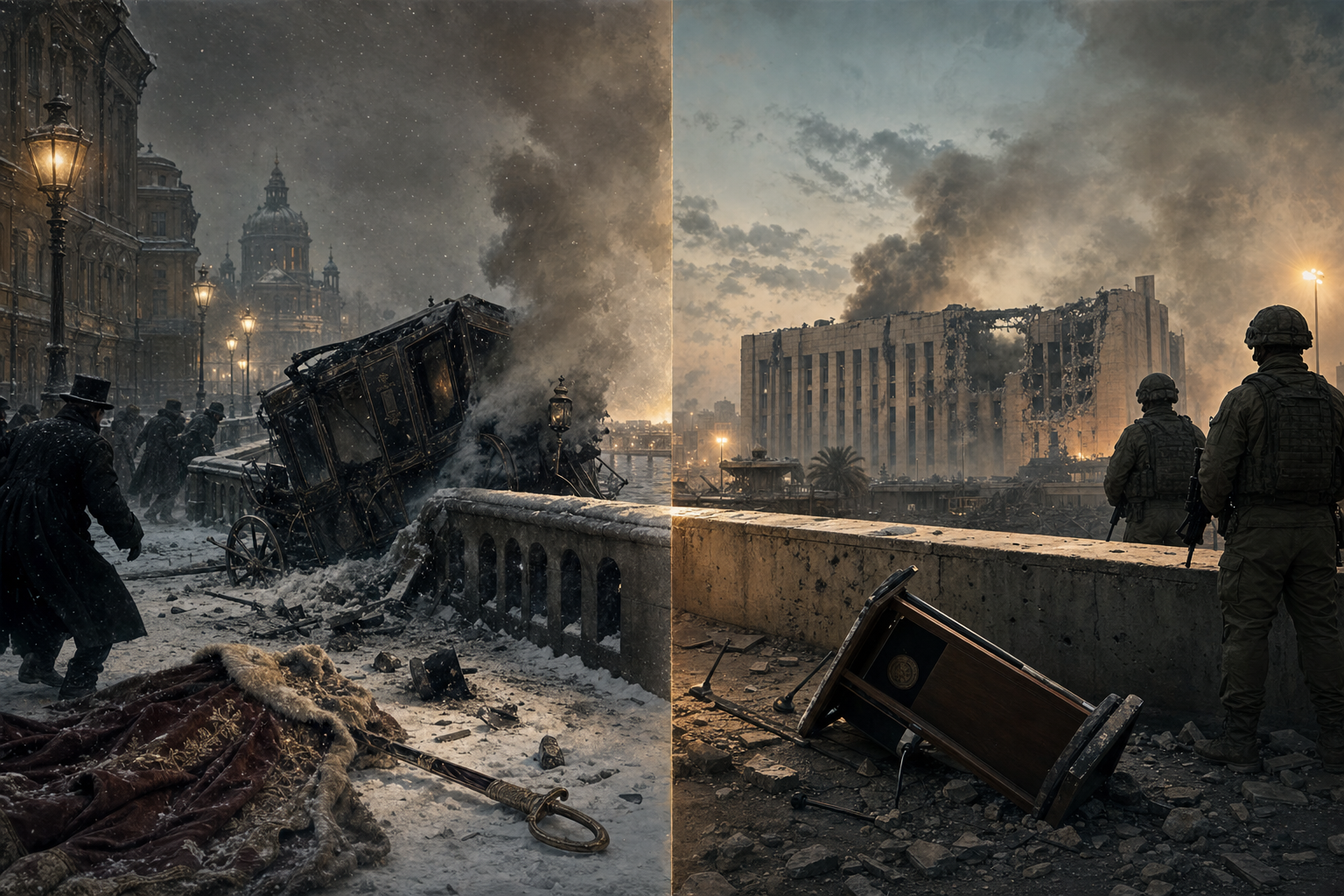
On a cold Sunday in March 1881, a young man stepped to the edge of a St Petersburg canal and threw a parcel wrapped in a handkerchief under the carriage of the most powerful reformer on earth. The explosion shredded the Tsar's escort and the back of his coach, but Alexander II climbed out unhurt. He should have driven on. Instead, being the kind of man he was, he turned back to help the wounded, and a second bomber, standing quietly at the railing, threw his charge straight down at the Tsar's feet. They both died of it. The man who had freed twenty-three million serfs bled to death on the floor of the Winter Palace as the snow came down.
The people who killed him called themselves the People's Will, and they were certain they were opening a door.
Alexander II was no tyrant. He was the Tsar Liberator, the man who in 1861 had abolished serfdom with a stroke of the pen, freeing more human beings at once than any ruler in history. He had reformed the courts, the army, and local government, and dragged a medieval empire halfway into the modern world. But for a small band of revolutionaries, halfway was an insult. The Narodnaya Volya believed that autocracy itself was the disease, and that one spectacular act, the killing of the autocrat, would shatter the system and let the people's liberation come flooding through the breach. They hunted him for two years. They dug tunnels and planted mines, they blew up a dining room in the Winter Palace itself, and finally, on the Catherine Canal, they got him.
Here is the detail that turns the story from tragedy into something closer to a curse. That very morning, after years of hesitation, Alexander II had signed a document drafted by his minister Loris-Melikov, a cautious plan to seat elected representatives in the work of government. It was modest, but it was a crack of daylight, the first faint beginning of a constitution in Russia. The thing the radicals claimed to be killing for was, on the day they killed him, already lying signed on his desk.
It did not survive him by a month. His son, Alexander III, was harder than his father and frightened by the blood, and he listened not to reformers but to his old tutor Konstantin Pobedonostsev, a man who regarded representative government as a lie. The reform was cancelled before it was ever published. In its place came a manifesto declaring autocracy unshakable, and then the machinery of reaction: an expanded secret police, tightened censorship, the rollback of local self-rule, a campaign of Russification against the empire's minorities, and a wave of anti-Jewish pogroms followed by laws that walled millions of Jews into the Pale of Settlement. The bomb meant to blow the door open had instead slammed it shut and bolted it. The repression bred fiercer revolutionaries than the gentle ones who threw the bomb, and it was their successors who would bring the empire down in fire in 1917. The People's Will got the opposite of its will, and Russia got forty years of the lash.
This is the law the canal teaches. Killing the man at the top does not deliver the future the killers imagine. The vacuum is filled by whoever is hardest and most afraid, and that is almost always the dead man's heirs and the men with the guns. You aim at liberation and you hit reaction.
Now look at what is unfolding this spring, a century and a half later, beside a different and far older throne.
On 28 February 2026, American and Israeli strikes opened a war on Iran whose stated purpose was regime change, and among the dead was the Supreme Leader himself, Ali Khamenei. The premise was the premise of the People's Will in modern dress: that removing the man at the apex of the Islamic Republic would crack the system open and let something freer pour through.
What has followed so far rhymes with St Petersburg almost line for line. The Revolutionary Guards did not wait. They pressured the Assembly of Experts into installing Khamenei's own son, Mojtaba, as the new Supreme Leader, a harder and more pliable figure, and in the process the real power has slid out of the hands of the clerics and into the hands of the military and security apparatus that runs the Guard. Observers who watch Tehran closely describe the regime that is emerging from the rubble not as softer but as less restrained and more hard-line, with the elected president sidelined and the generals making the decisions. A strike sold as the road to a freer Iran has, in its opening act, produced the dead leader's harder son and a more frightened, more militarised state. It is Alexander III in a turban, and the secret police in the uniform of the Guard.
Whether the rest of Iran's story tracks Russia's, the long reaction, the deferred explosion, the revolution that finally arrives a generation late and worse than anyone imagined, no one can say. History offers a pattern, not a prophecy. But the first frames of the tape are the same frames, and we have seen this film before. It did not end where the men who lit the fuse expected.
They threw the bomb to free a people. They got the son, the secret police, and the long winter.
The lesson of the canal is not that the Tsar was good or the regime was just. It is colder than that. It is that the surest way to empower a dead man's hardest heirs is to kill him.