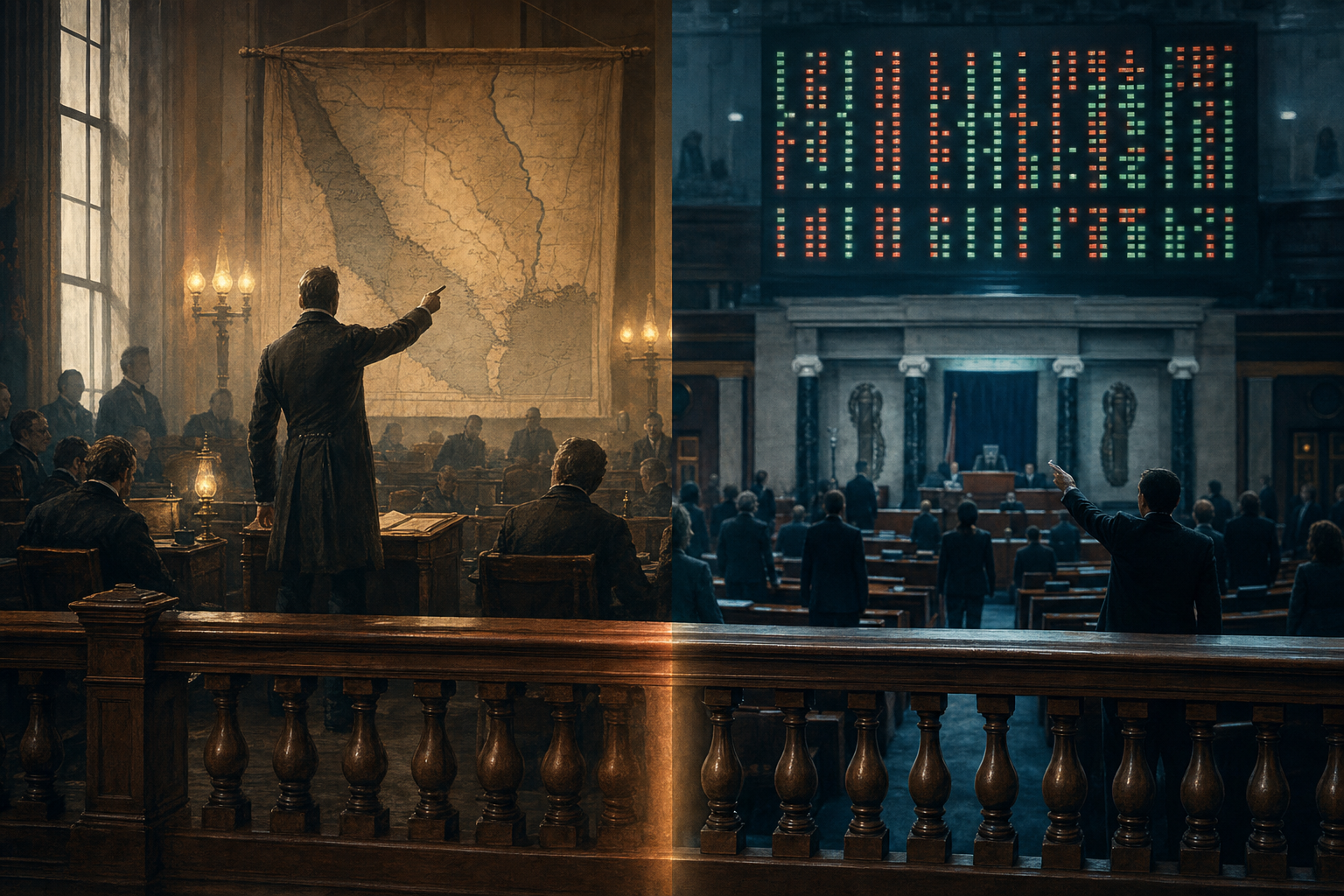
On the afternoon of December 22, 1847, a tall, awkward freshman congressman from Illinois rose in the House chamber to ask a question that would shadow him for the rest of his life. He had been in Washington barely two weeks. He had no allies of note, no committee of consequence, no reputation beyond the prairie circuit where he practiced law. And he wanted the President of the United States to point, on a map, to a single spot.
The President was James K. Polk, and eighteen months earlier he had taken the country to war with a sentence. "Mexico," Polk told Congress on May 11, 1846, "has passed the boundary of the United States, has invaded our territory and shed American blood upon American soil." It was a masterpiece of compression. War, in Polk's telling, had already begun; Mexico had started it; American soil had been violated; Congress had only to recognize the fact. Two days later the House declared war, 174 to 14, the dissenters shouted down as friends of the enemy.
The freshman did not believe the sentence. His name was Abraham Lincoln.
The trouble was the soil. The blood Polk invoked had been spilled in a thin ribbon of land between the Nueces River and the Rio Grande, a strip that Texas claimed and Mexico had never conceded. For generations the boundary of Mexican settlement had run along the Nueces. Polk had ordered General Zachary Taylor to march his army past it, down to the Rio Grande, into ground where no American government had ever collected a tax or kept a courthouse. When Mexican cavalry crossed the river and killed the men of an American dragoon patrol there in April 1846, Polk had his sentence. But was it American soil? Or had the President pushed soldiers into disputed land precisely so that the first shot would look like an invasion?
Lincoln framed the doubt as eight interrogatories. History would call them the Spot Resolutions, each one a polite scalpel. Was the spot where blood was shed inside ground that had long been the soil of Mexico? Had the people living there ever submitted to the government of Texas? Was the first blood shed among men who had fled their own homes at the approach of Taylor's army? He was not asking Polk to lose the war. He was asking Polk to prove the sentence.
Polk never answered. Presidents at war rarely do. But two weeks later, on January 3, 1848, the House did something extraordinary. By a margin of a few votes, 85 to 81, it amended a routine resolution honoring the army's generals to declare that the war had been "unnecessarily and unconstitutionally begun by the President of the United States." Lincoln voted yes. Then, on January 12, he rose again and took Polk's justification apart line by line, warning that a chief executive who could make war whenever he alone judged it necessary was a king in everything but name. "Allow the President to invade a neighboring nation, whenever he shall deem it necessary to repel an invasion," he wrote to his law partner that winter, "and you allow him to make war at his pleasure."
It cost him. The war was popular, the victories were glorious, and a congressman who quibbled over a spot looked, to voters back home, like a man fussing over geography while American boys bled in Mexico. Illinois Democrats christened him "Spotty" Lincoln, and the name stuck like tar. His own district turned. He had already pledged to serve a single term, and when it ended he went home to Springfield, to his law practice, to political oblivion. For five years Abraham Lincoln held no office and seemed fated to hold none again.
And the war? It ended on February 2, 1848, with the Treaty of Guadalupe Hidalgo. The United States paid Mexico fifteen million dollars and took more than half a million square miles: California, Nevada, Utah, most of Arizona and New Mexico, slices of Colorado and Wyoming. Polk had been right that the war would enlarge the republic beyond measure. Lincoln had been right that it began on a falsehood. Both things were true, and at the time only one of them seemed to count.
Now, a hundred and seventy-eight years later, the House of Representatives has tried again to point at the spot.
On June 3, 2026, by a vote of 215 to 208, the House passed a war powers resolution directing the President to end American hostilities with Iran. It was the sharpest congressional rebuke since the bombing of Iran's nuclear sites pulled the United States into a war that began in late February. Four Republicans, Thomas Massie, Brian Fitzpatrick, Tom Barrett, and Warren Davidson, crossed the aisle to do it. For the first time in more than three months of fighting, one chamber had voted, on final passage, to say that this was Congress's war to authorize, not the President's to wage.
It will almost certainly change nothing. The Senate has not passed its own version, a veto waits if it ever does, and the administration argues, as administrations have since 1973, that the War Powers Resolution is itself unconstitutional. The President dismissed the vote in a single word. "Meaningless," he wrote, complaining that "4 bad Republicans and all of the Dumocrats" had moved to limit his war powers "right in the middle of my final negotiations to end the War with the Islamic Republic of Iran."
He may be right that it is meaningless, in the way that Polk was right. The 1973 War Powers Resolution the House reached for was itself the child of an earlier President's war: Congress passed it over Richard Nixon's veto, enraged that he had bombed Cambodia in secret for fourteen months. Every generation the legislature grasps the same lever, and every generation the President calls it meaningless, and the wars go on.
But the Spot Resolutions were meaningless too. Nobody debated them. Polk ignored them. They cost their author his career. And thirteen years after Lincoln demanded that a President prove where the blood was shed, that same man sat in the White House and waged the largest war in American history, suspending habeas corpus and stretching the office further than Polk ever dreamed, having learned, perhaps, exactly how much a President can do once he decides the necessity is real.
History did not vindicate the spot. It vindicated the man who asked the question. The vote that looks meaningless today is sometimes only the first draft of the verdict.