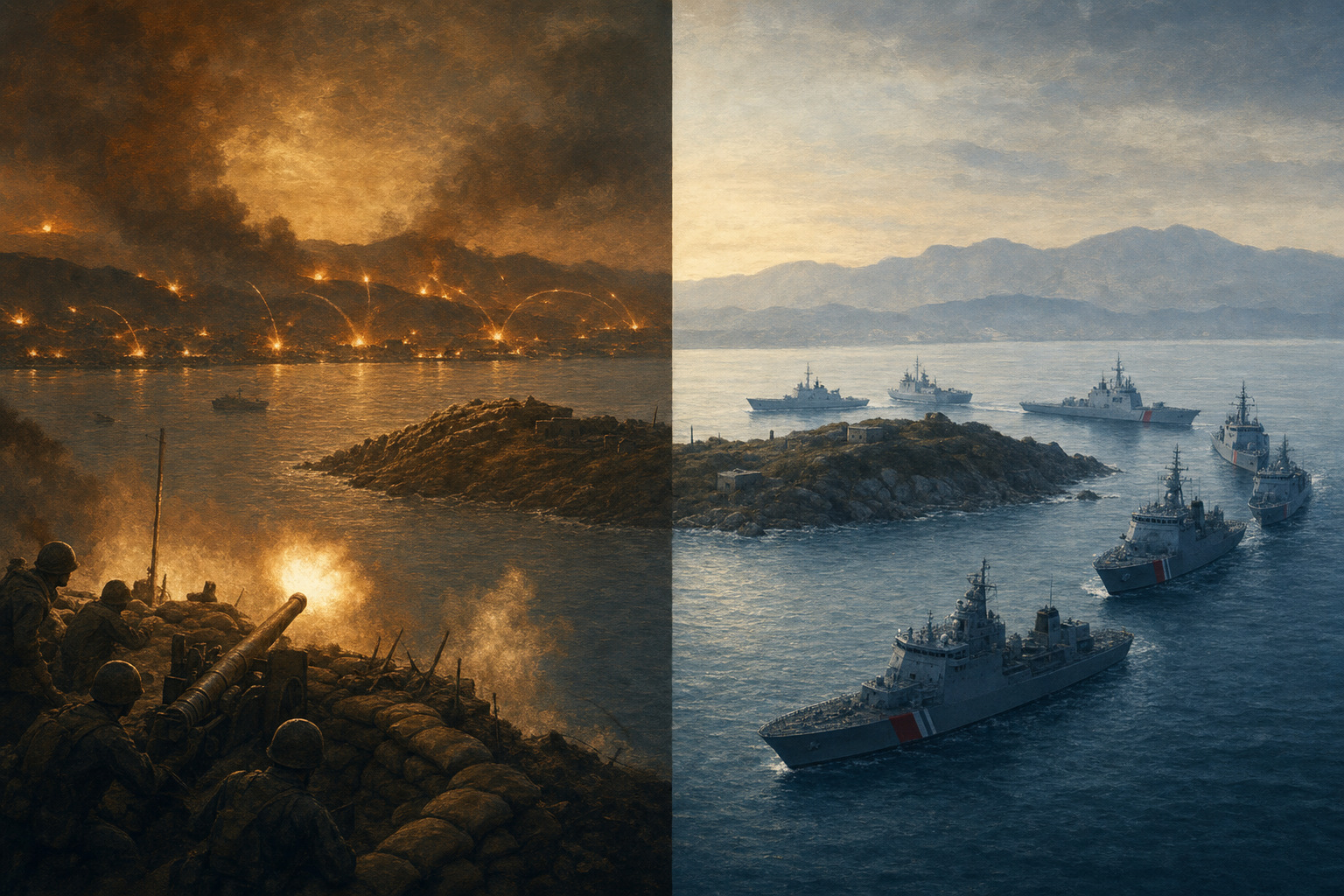
At a little after six in the evening on the twenty-third of August 1958, the hills of mainland China lit up. Hundreds of Communist artillery pieces opened fire at once on a small island two miles offshore, and in the space of a couple of hours tens of thousands of shells fell on a patch of ground smaller than many cities. The island was called Quemoy. Several senior Nationalist officers were killed in the opening barrage. And for a few weeks that autumn, the fate of the world seemed to hang on it, and on a second cluster of rocks to the north called Matsu.
The islands almost no one could find
To understand how a speck of land almost no one could find on a map nearly triggered a nuclear war, you have to see where it sat. When Mao Zedong's Communists won the Chinese civil war in 1949, Chiang Kai-shek's defeated Nationalists fled to the island of Taiwan, a hundred miles across the strait. But they kept a foothold almost on the mainland's doorstep. Quemoy lies barely two miles off the great Communist port of Xiamen. Matsu hugs the coast near Fuzhou. On a clear day the defenders could watch the enemy across the water through field glasses. The islands were militarily almost indefensible and politically impossible to give up, because they were the last shred of Chiang's claim to all of China.
Mao understood exactly what they were. By shelling Quemoy in 1958 he was not really trying to take a few square miles of granite. He was probing. He wanted to know whether the United States, which had signed a defense treaty with Chiang in 1954, would actually fight for these scraps, and he wanted to make himself the boldest figure in the Communist world. Nikita Khrushchev had flown secretly to Beijing only weeks before. The Middle East was in flames, with American marines just landed in Lebanon. Mao chose that moment to squeeze the trigger and watch Washington flinch.
Washington nearly did far worse than flinch. The 1954 treaty had been deliberately vague about whether it covered the offshore islands at all, an ambiguity meant to restrain Chiang as much as to warn Mao. Now President Eisenhower and his secretary of state, John Foster Dulles, had to decide in real time. The Joint Chiefs of Staff concluded that the islands could not be held with conventional weapons alone, and prepared plans to drop nuclear bombs on airfields deep inside mainland China. One later secretary of state called it the first serious nuclear crisis of the atomic age. Eisenhower, who had seen real war, refused to be stampeded into atomic strikes over two islands, but he would not abandon them either.
So he chose a third path, and it was a strange one. The US Navy escorted Nationalist supply convoys to Quemoy, but stopped its own ships exactly three miles out, at the edge of what it called territorial waters, so that no American vessel would fire the first shot. American crews handed the last leg to the Nationalists and watched. The United States rushed in giant eight-inch howitzers and, in the skies above, Nationalist Sabre jets fired the first heat-seeking air-to-air missiles ever used in combat, knocking Communist MiGs out of the sky. It was a war fought with one hand deliberately tied, precisely so it would not become the war everyone feared.
And then it dissolved into the absurd. On the sixth of October 1958, after forty-four days, Beijing announced a unilateral ceasefire. But the shelling did not stop so much as turn into theatre. The Communists declared they would shell Quemoy only on odd-numbered days. The Nationalists returned fire on even days. Before long both sides were largely firing shells stuffed with propaganda leaflets instead of explosives, on a fixed schedule, a ritual bombardment that everyone understood and no one was really meant to die in. This polite, scheduled artillery duel went on, unbelievably, for twenty years, until 1979, when the United States finally switched recognition from Chiang's government to Mao's and the guns fell silent. The crisis had been defused not by anyone winning, but by a shared, unspoken agreement to stop pretending the islands were worth a world war.
The Echo
Now look again at those same two islands today. Quemoy is spelled Kinmen on modern maps. Matsu still sits where it always did. And at the end of December 2025, when China staged its largest military exercises yet around Taiwan, a rehearsal it called Justice Mission, the Chinese coast guard sent patrols circling Kinmen and Matsu, closing to within a mile and a half of the rocks, while every one of the dozens of daily flights connecting the islands to Taiwan was suspended. Analysts watching the drills concluded their real aim was to practise a blockade, to choke off shipping and isolate Taiwan without firing a declared shot. The very specks of land that Mao shelled to test American nerve in 1958 are once again the place where the pressure is applied first.
The lesson of 1958 was not that the islands were worth fighting for. It was that a great power can probe a rival's resolve at the cheapest, smallest, most deniable point on the map, and that the side being tested has to answer there or risk being tested everywhere. Eisenhower found a way to answer without ending the world, through deliberate ambiguity and a navy that stopped three miles out. The danger now is that the smallest point on the map is the same one as before, and that the careful ambiguity that held for a generation is wearing thin.
Mao shelled Quemoy to ask a question. Sixty-eight years later, the coast guard circling Kinmen is asking it again. The unsettling part is not that history is repeating. It is that it has chosen the exact same two islands to repeat on.