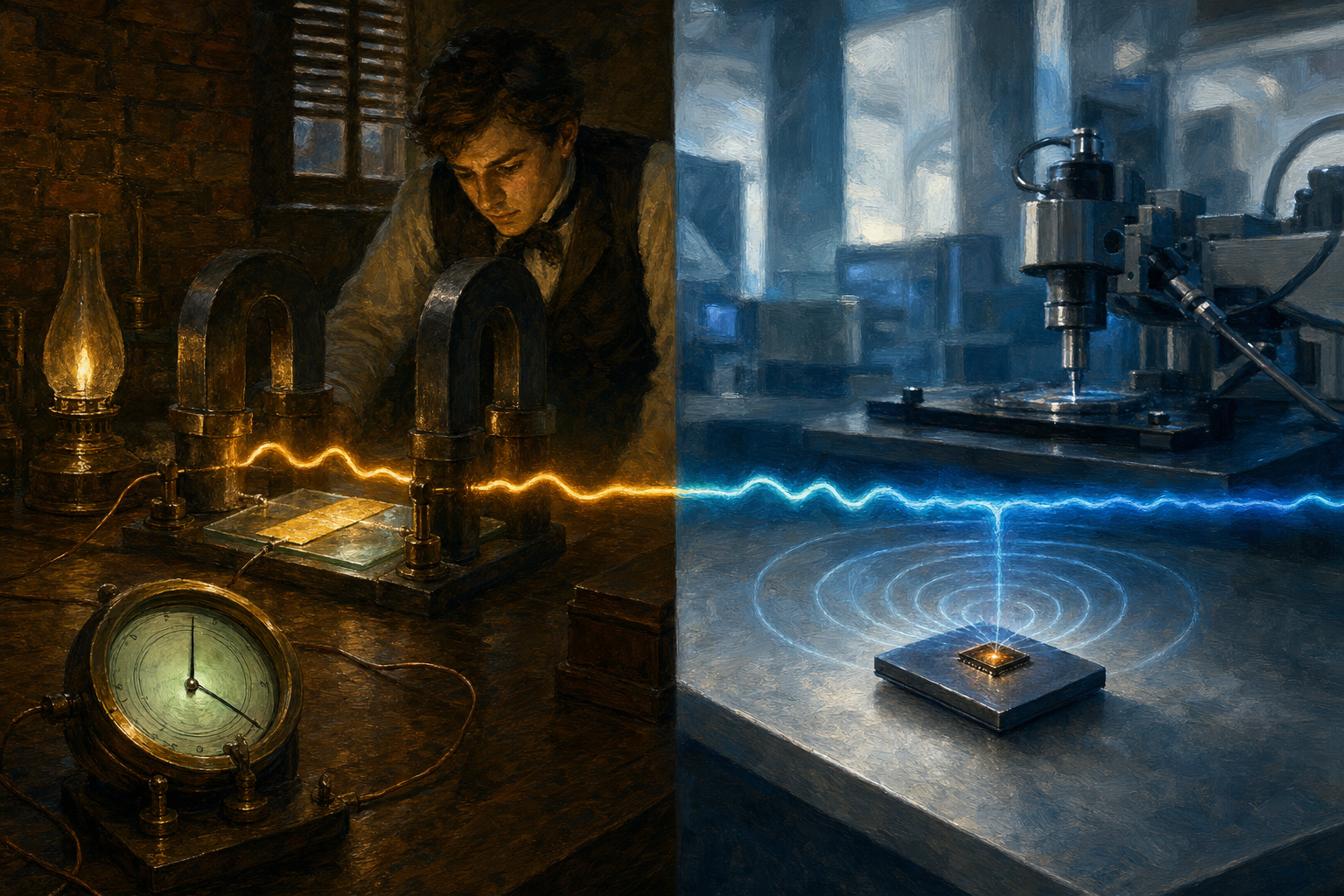
In a basement laboratory at Johns Hopkins in the autumn of 1879, a twenty-three-year-old graduate student watched a needle move that was not supposed to move.
Edwin Hall had laid a leaf of gold so thin it was almost transparent onto a plate of glass, run a current through it, and swung a magnet up against its face. A galvanometer wired across the gold flickered. A sideways voltage had appeared, at right angles to the current, exactly where the most important physics textbook in the world said nothing should happen.
That textbook was James Clerk Maxwell's A Treatise on Electricity and Magnetism, the founding scripture of the new science of electromagnetism. A year earlier, reading it for a class taught by his professor Henry Rowland, Hall had snagged on a single sentence. Maxwell had written, of a current-carrying wire in a magnetic field, that the mechanical force which urges a conductor across the lines of magnetic force acts "not on the electric current, but on the conductor which carries it."
The magnet pushes on the wire, Maxwell was saying, not on the electricity flowing through it. To Hall this felt wrong. If a magnet could shove a whole wire sideways, why would it ignore the current, the very thing that made the wire feel the magnet in the first place? And if the magnet did push on the moving charge, then that charge should pile up along one edge of the conductor, and the crowding should betray itself as a faint voltage across the width.
He took the worry to Rowland. To his surprise, his professor agreed. Years before, Rowland confided, he had doubted the very same sentence and tried a hasty experiment of his own. It had failed, and he had let it drop. Now he handed the problem to his student and told him to try again, and to do it properly.
The vanishingly small effect
The difficulty was that the effect, if it existed at all, would be tiny. In a thick copper bar the current had too much room, and any sideways crowding simply washed out. Hall's insight, guided by Rowland, was to make the conductor as thin as he possibly could, so the same current was crushed through a minute cross-section and the sideways push had nowhere to hide. Gold leaf, hammered to a fraction of the width of a human hair, was the answer. He gummed it to glass for support, fed it a current, set it between the poles of a powerful electromagnet, and connected a delicate galvanometer across its width.
The needle moved. Reverse the magnet, and it swung the other way. The voltage was real, it was steady, and it sat precisely at right angles to both the current and the field. On this one point, Maxwell was wrong. The magnet was reaching past the metal and bending the current itself.
What Hall could not know was how much that small voltage contained. The direction it pointed was a fingerprint of whatever was actually carrying the current. In most metals the sign said the moving charges were negative. This was 1879. The electron would not be found by J.J. Thomson for another eighteen years. Hall had, in effect, read the sign of a particle that nobody yet knew existed. Stranger still, in a handful of metals the voltage came out backwards, as though the carriers were positive, a paradox no one could explain until quantum mechanics and the strange idea of positive "holes" arrived half a century later.
The result was so clean that when the second edition of Maxwell's Treatise appeared, after Maxwell's own death, the editor added a quiet footnote conceding that Mr. Hall had discovered the effect, and that the offending sentence must now be regarded as "only approximately true." A graduate student had earned a correction in the most authoritative book in his field before he had even finished his thesis.
The thing Hall found has been working for us ever since. The Hall effect sits in the sensor that tells your car's engine where the crankshaft is, in the clamp meter that reads the current in a power line without touching the wire, in the little magnetic switch that knows when you have closed your laptop lid. Pushed to brutal cold and ferocious fields, it splits into the quantum Hall effect, so exact that it now helps define the international standard for electrical resistance, and it has produced two Nobel Prizes along the way. A young man's objection to one sentence had become one of the most useful measurements in all of physics.
The Echo
Now, in June 2026, the family grew again. A team led by Dongchen Qi at Queensland University of Technology and Xiao Renshaw Wang at Nanyang Technological University in Singapore reported, in the journal Newton, a careful study of something called the nonlinear Hall effect. And here is the twist that would have delighted the young man in the Baltimore basement. This version needs no magnet at all.
In an exotic crystal called bismuth telluride, the lopsided geometry of the material itself does the job the magnet used to do. Feed the crystal an alternating current and it answers with a sideways voltage that is direct current, steady and one-way, with no magnetic field and none of the usual diodes. The Qi and Wang team showed that this effect survives all the way up to room temperature, and they traced exactly how the imperfections and the trembling atoms inside the crystal control its strength, and can even flip its direction with heat.
That matters because it turns the Hall effect from a way of measuring the world into a way of powering it. A chip that converts stray alternating signals straight into usable direct current could harvest the energy already drifting through the air, the radio waves leaking from every router and phone, and run a small sensor with no battery at all. The headlines call it a path to battery-free electronics.
A hundred and forty-seven years apart, the same stubborn fact: a voltage that appears sideways, where the textbook swore it should not. In 1879 it took a magnet, and it revealed a particle nobody had named. In 2026 it takes no magnet, and it may quietly power the next thing you carry in your pocket.
Edwin Hall doubted one sentence in one book, and the universe answered him with a voltage. The lesson has not aged. The next correction to the textbook is probably sitting in a basement right now, waiting for someone young enough to take it seriously.