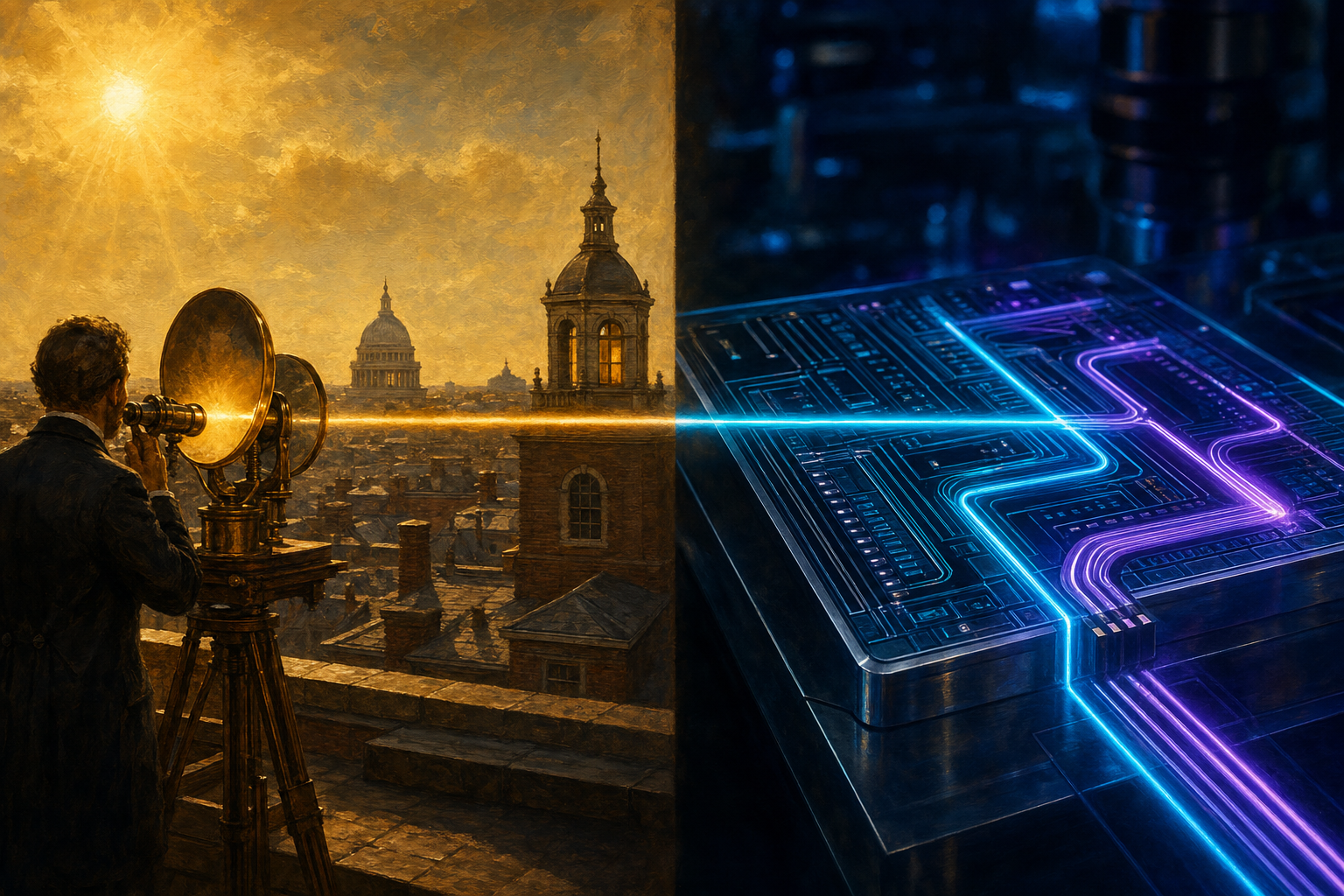
On a bright afternoon in Washington in the summer of 1880, a man stood on the roof of a school, speaking into a strange instrument aimed at the sun. Seven hundred feet away, at the window of a small laboratory, another man pressed his ear to a receiver and heard the first voice clearly. There was no wire between them. The words had crossed the open air riding on a beam of light.
The man at the laboratory window was Alexander Graham Bell. Four years earlier he had become world-famous for the telephone. But the machine he was testing that day was newer and stranger, and Bell thought it was better. He had built it with his assistant Charles Sumner Tainter, and he called it the photophone.
It did something that sounds, even now, slightly magical. It carried the human voice with no wire at all, not on electricity through copper, but on a ray of light through the air. It was, in effect, the first wireless telephone call, made four years after the telephone and decades before anyone sent a voice by radio.
The principle was beautifully simple. At the speaking end, Bell aimed a beam of sunlight onto a thin, flexible mirror. When he spoke at the mirror, his voice made it tremble, and as it trembled it bent the reflected light, brightening and dimming the beam in perfect step with the sound. His words were now written in flickers of light.
At the far end sat the secret ingredient: a small piece of selenium. Selenium is a curious element whose electrical resistance drops when light falls on it. As the flickering beam struck the selenium, it turned the dancing light back into a dancing electric current, and that current drove an ordinary telephone receiver. Light went in one end, and a human voice came out the other.
On the third of June 1880, Bell's assistant stood on the roof of the Franklin School and spoke across two hundred and thirteen metres of open air to Bell's laboratory on L Street. The sunlight carried every word. It was the first time in history a voice had travelled, wirelessly, on a beam of light.
Bell was overjoyed. He believed he had outdone himself. Many years later, near the end of his life, he told a reporter that the photophone was the greatest invention he had ever made, greater, he said, than the telephone.
And then, almost nothing happened. The world simply could not use it.
The problem was that Bell had the idea but none of the hardware. Sunlight is fickle. Clouds dim it, night kills it, fog and rain scatter it. There was no way to make a strong, steady, controllable beam of light, and no clean way to carry that beam reliably from one place to another. Selenium was slow and temperamental. The photophone worked as a miracle on a clear day across a courtyard, and failed as a technology everywhere else.
Bell had invented communication by light a full century before the world had the parts to make it work. He had glimpsed the future and could not build it.
So the photophone went into the drawer of beautiful dead ends. For decade after decade, the world's messages travelled the way they always had, first on copper wire, and then, when radio came, on invisible waves through the air. Not on light.
What Bell had been missing arrived, very slowly, in pieces. First, in 1960, came the laser, a way to make an intense, steady, controllable beam at last. Then came the optical fibre, hair-thin threads of ultra-pure glass that could carry a beam of light for thousands of kilometres without letting it leak away.
Because once those two pieces existed, Bell's beam quietly took over the world. Today almost everything you read, watch, and say online travels as pulses of light through glass fibres, including the great cables that cross the floors of the oceans. Bell was right. We just needed a hundred years to catch up.
But there was still one last barrier. To actually compute with that information, to think with it, the light has always had to be turned back into electricity first, exactly as the selenium did in 1880. Until now.
In June 2026, engineers at Monash University in Australia published in the journal Nature Photonics a chip that takes the next step. On a single sliver of material, it can generate a signal of light, steer it where it needs to go, and read it back out again, all in one integrated device. It is the first chip to do all three at once.
The team, led by Doctor Chi Li, did it by encoding information not just in the brightness of light, the way Bell flickered his sunbeam, but in a subtle quantum property of light called the valley, using sheets of material only a few atoms thick. The field even has a name now: valleytronics. And remarkably, the chip does it at room temperature.
The promise is enormous. Computing with light instead of electrons could be dramatically faster and use far less power, which is exactly what our enormous, energy-hungry artificial intelligence and quantum machines are desperate for. As Doctor Li put it, what they have built is a complete on-chip system that can create, route, and read this information with very high precision.
Now look at the shape of it. A hundred and forty-six years ago, Alexander Graham Bell trembled a mirror in the sunlight, put his voice on a beam of light, called it the finest thing he had ever done, and the world had no use for it whatsoever. Today, building machines that compute and communicate with light itself is the frontier that everyone is racing toward.
The invention that was too early has become the invention that is right on time. That is the quiet lesson Bell's beautiful failure keeps teaching. The right idea in the wrong decade looks exactly like a mistake. The photophone was not wrong. It was simply waiting for the rest of the world to arrive.
Bell put a voice on a sunbeam, and the world looked away. It has taken a century to build the rest of his sentence.