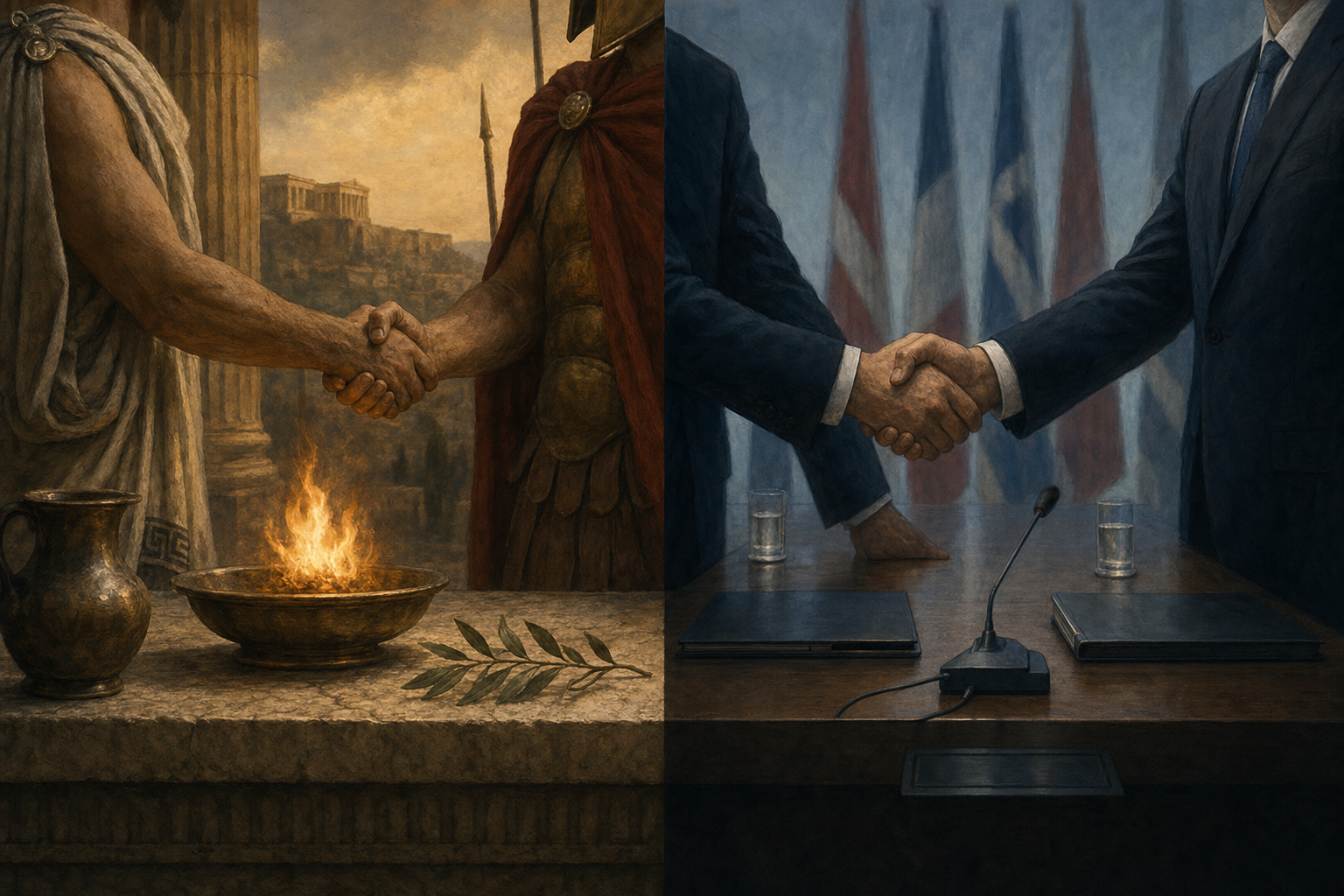
In the spring of 421 BC, two exhausted empires signed a peace that was meant to last fifty years. It lasted six. And those six years of peace did more to destroy Athens than the ten years of war that came before them.
For a decade, Athens and Sparta had torn the Greek world apart. The Spartans had the greatest land army in Greece, and every summer they marched into Athenian fields and burned them. The Athenians were masters of the sea, so they raided the Spartan coast and waited behind their walls. A plague swept through the packed city of Athens and killed perhaps a third of its people, including its great leader Pericles. After ten years, neither side could win, and both were bleeding.
Then, in 422 BC, at the northern city of Amphipolis, the war handed both sides a strange gift. In a single battle, the two men who wanted the war most were both killed. Cleon, the fiery Athenian who had built his whole career on fighting Sparta, died there. So did Brasidas, the brilliant Spartan general who had carried the war deep into Athenian territory. The two loudest voices for war fell silent on the same field.
With the hawks gone, the cautious men stepped forward. In Athens that man was Nicias: wealthy, devout, and careful to the point of timidity, a general who had never lost a battle because he almost never risked one. In Sparta it was the old king Pleistoanax, who longed to end the war that had nearly broken his city. Together they made the treaty that history would name after Nicias.
It was hollow from the very first day. Sparta had promised to hand the city of Amphipolis back to Athens. It never did. Athens had promised to give up the fortress at Pylos. It kept it. The two great powers had signed their names to terms that neither one actually carried out. The peace existed on paper, and almost nowhere else.
Worse, Sparta's own allies refused to sign. Corinth, Thebes, Megara, Elis: the cities that had done much of the fighting felt betrayed by a deal that gave them nothing. Sparta had made a peace that its own coalition rejected. The most powerful state in Greece could not deliver the very people fighting on its side.
Into that vacuum stepped a young, dazzling, reckless Athenian named Alcibiades. While Athens and Sparta were officially at peace, he stitched together an anti-Spartan alliance among the cities of the Peloponnese, in Sparta's own backyard. In 418 BC the armies met at Mantinea. It was the largest land battle of the entire war, and Sparta won it decisively. Athens and Sparta, supposedly at peace, had just fought each other through their friends and their proxies.
This was the truth of the Peace of Nicias. It was not peace. It was a pause that each side used to rearm, to maneuver, and to keep fighting by other means. Nobody trusted it. Everybody exploited it.
And then it produced a catastrophe. In 415 BC, Alcibiades persuaded the Athenian assembly to do something extraordinary: to send a vast fleet across the sea to conquer Sicily, a rich island hundreds of miles away that had never attacked them. It was a war of pure ambition, launched because the pause had convinced Athens that it was safe to go looking for a bigger prize.
One man stood up and argued against it. Nicias. The same cautious general who had made the peace warned that Sicily was folly, that Athens was gambling everything on a distant adventure. The assembly listened, and then it voted to send the expedition anyway. And it put Nicias in command of the very war he had begged them not to fight.
Sicily destroyed Athens. The expedition ended in 413 BC in total annihilation outside the harbour of Syracuse. The fleet was lost. The army was wiped out or worked to death in the stone quarries. Nicias surrendered, and the Syracusans executed him. The historian Thucydides, who lived through it all, wrote that Nicias least deserved such a fate, because he had ordered his whole life by virtue. The man whose name meant peace died in the disaster that the false peace had unleashed.
By then the war was fully on again, and the second half was worse than the first. Athens, gutted by Sicily, fought on for nine more bitter years. In 404 BC it surrendered. The walls came down. The empire was over. And it had all turned on those six years that everyone had called peace.
Now jump forward twenty-four centuries. On the eleventh of June, 2026, after months of open war, the United States and Iran announced a ceasefire. Sixty days, both sides said, to negotiate the hard questions and reach a final agreement.
Listen to what those hard questions are. One is the Strait of Hormuz, the narrow neck of water through which much of the world's oil must pass, and the question of who controls that chokepoint. Another is the war's proxies, with Iran tying any wider deal to what Israel does next in Lebanon. A truce between exhausted enemies who do not trust each other, whose allies and proxies are not bound by it, and who can use the quiet to rebuild.
That is the exact shape of the Peace of Nicias. Not an ending. An intermission.
The Greeks paid for the lesson in blood, so that we would not have to. The dangerous moment in a long war is not the fighting. It is the truce that everyone calls peace while quietly preparing for the next round. A ceasefire that the allies reject, that the proxies ignore, and that each side treats as breathing space, is not the close of a war. It is the overture to a worse one.
Athens was not destroyed in the ten years it spent fighting. It was destroyed in the six years it spent at peace, when it mistook a pause for an ending and went looking for a new war to win. The question hanging over 2026 is the one Nicias could not answer. When the guns fall silent, is that the end of the war? Or only the quiet before the worse half?