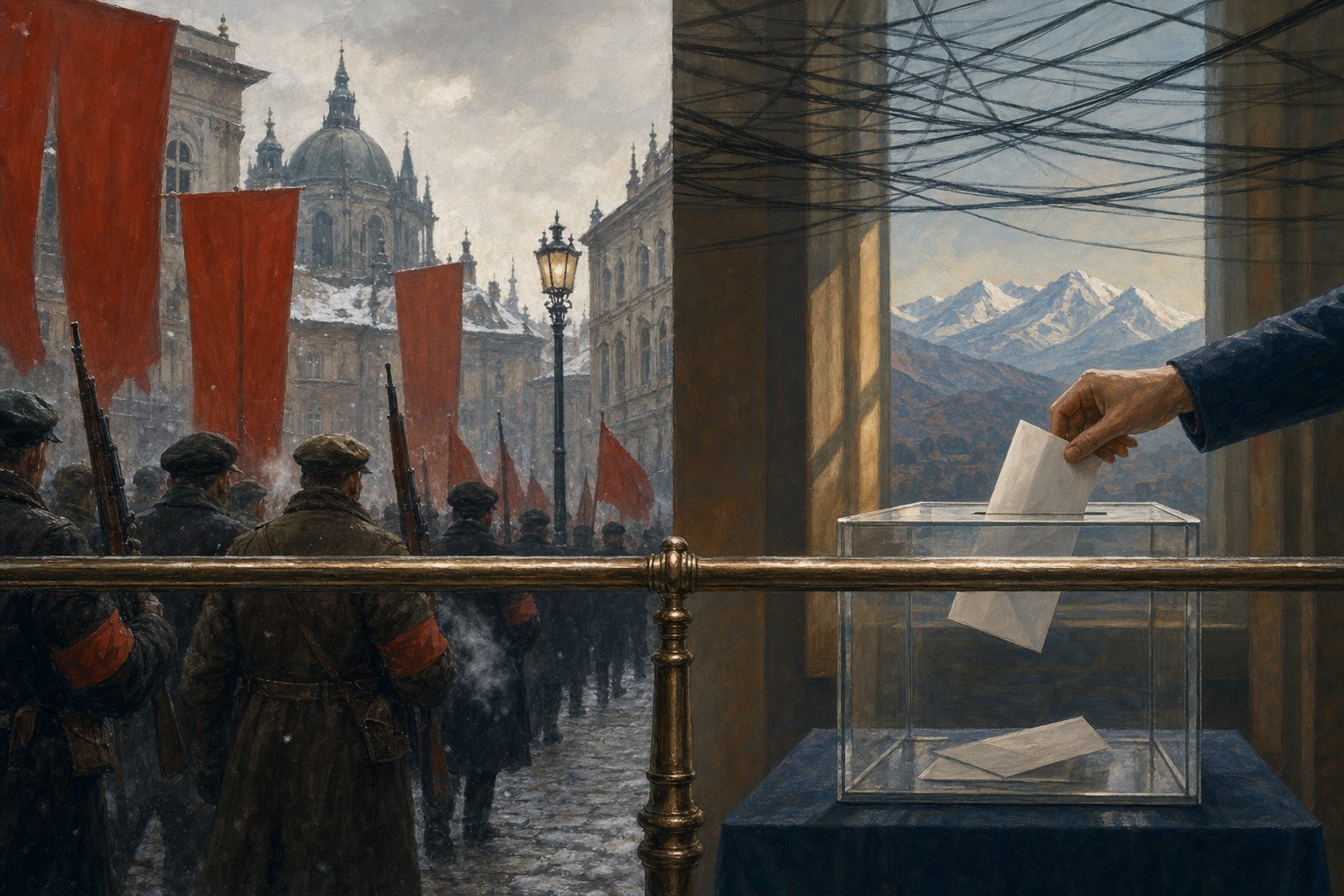
On the morning of the tenth of March 1948, the body of Jan Masaryk, the foreign minister of Czechoslovakia and the son of the country's founding father, was found in the courtyard below his bathroom window. The official verdict was suicide. Almost no one believed it. Two weeks earlier, the last working democracy in Eastern Europe had been swallowed whole, and the man at the window had been one of the few left standing in its way.
The bridge that could not hold
To understand how it happened, you have to understand what Czechoslovakia was trying to be. In the years just after the Second World War, it was the great exception. All around it, the Red Army had installed obedient governments. Czechoslovakia alone was attempting something almost impossible: a real democracy with free elections and a free press, sitting on the fault line between East and West, trying to be friends with both. Its Communist Party was genuinely popular and had won the largest share of a free vote. But it governed in a coalition, and the country still had courts, newspapers, and opposition parties that answered to no one in Moscow.
The bridge could not hold, because one side would not allow it. In 1947 Czechoslovakia was offered a share of the American Marshall Plan, the enormous programme to rebuild Europe. The government, hungry for the aid, voted to accept. Stalin summoned its leaders to Moscow and ordered them to refuse. They refused. It was a small, humiliating preview of the larger truth: a country in Moscow's orbit did not get to choose.
The reckoning came in February 1948. The Communist interior minister had been quietly packing the police with party loyalists. In protest, twelve non-Communist ministers resigned, gambling that President Edvard Beneš would reject their resignations, dissolve the government, and call fresh elections the Communists might lose. It was a catastrophic miscalculation. The Communist prime minister, Klement Gottwald, did not blink. Instead he flooded the streets of Prague with armed workers' militias and party action committees, while Soviet forces loomed across the border and a senior Soviet official arrived in the capital to watch. Beneš, an ageing and ailing man who had already lived through one German occupation and dreaded a civil war, looked at the militias in the streets and the army that might follow them, and he capitulated. On the twenty-fifth of February he accepted a government entirely under Communist control. The Communists called it Victorious February. The democracy was over without a single tank crossing the frontier.
Then Masaryk fell from his window, and the last ambiguity died with him.
The coup landed on the West like a bucket of cold water. Here was no backward borderland but the most advanced democracy in the region, the one everyone had hoped might prove that a country could be both independent and friendly with the Soviet Union, and it had been extinguished in three weeks by pressure, fear, and a refusal of choice. Within months the Western allies accelerated the Marshall Plan, and within a year they founded NATO. Czechoslovakia itself would remain a Soviet satellite for forty-one years, until the Velvet Revolution of 1989. The lesson the West drew was blunt: a small state on the edge of a great power's sphere does not leave that sphere just because its people vote to.
The Echo
Now move the map south and the clock forward to the seventh of June 2026, to a small mountainous republic on the southern edge of the old Soviet empire. Armenia, for a generation, was Russia's closest ally in the Caucasus, host to a Russian military base and a member of Moscow's security alliance. Then Russia stood aside in 2023 as Armenia lost the long war over Nagorno-Karabakh, and the bargain that had bound the two countries broke. Armenia's prime minister, Nikol Pashinyan, began steering his country away from Moscow and toward the European Union, the mirror image of Czechoslovakia's predicament, a small state trying not to be pulled in, but to climb out.
Moscow answered the way great powers answer. Ahead of the June election, Western intelligence officials and international observers described a broad Russian covert campaign: disinformation, money, and support for pro-Russian candidates, an effort to deny Pashinyan his majority and pull Armenia back into the fold. This time, the pressure did not work as it had in Prague. Pashinyan's party won nearly half the vote and a comfortable majority of seats, and he claimed a mandate to keep tilting west. But he fell short of the two-thirds he needed to lock in the constitutional changes a lasting peace with Azerbaijan would require, and the country remains caught in the same vice that crushed Czechoslovakia: hemmed in by a stronger, angrier neighbour that does not accept the right of a small state to choose its own friends.
The two stories run in opposite directions, and that is exactly what makes them rhyme. In 1948 a democracy on the seam between empires tried to keep its freedom and was pulled in, and the door stayed shut for forty-one years. In 2026 a democracy on the seam between empires is trying to climb out, against the same kind of pressure, the same disinformation, the same looming neighbour, the same insistence that a country in the orbit does not get to choose.
Czechoslovakia learned that an election is not a guarantee, that you can vote for independence and still lose it to forces that never appear on a ballot. Armenia has just voted the other way. Whether it gets to keep that vote, where Czechoslovakia could not, is the question the next few years will answer. The men who flooded the streets of Prague never needed to fire a shot. The pressure on the small country at the edge of the empire rarely arrives as an invasion. It arrives, as it did in February 1948, as a choice quietly taken away.