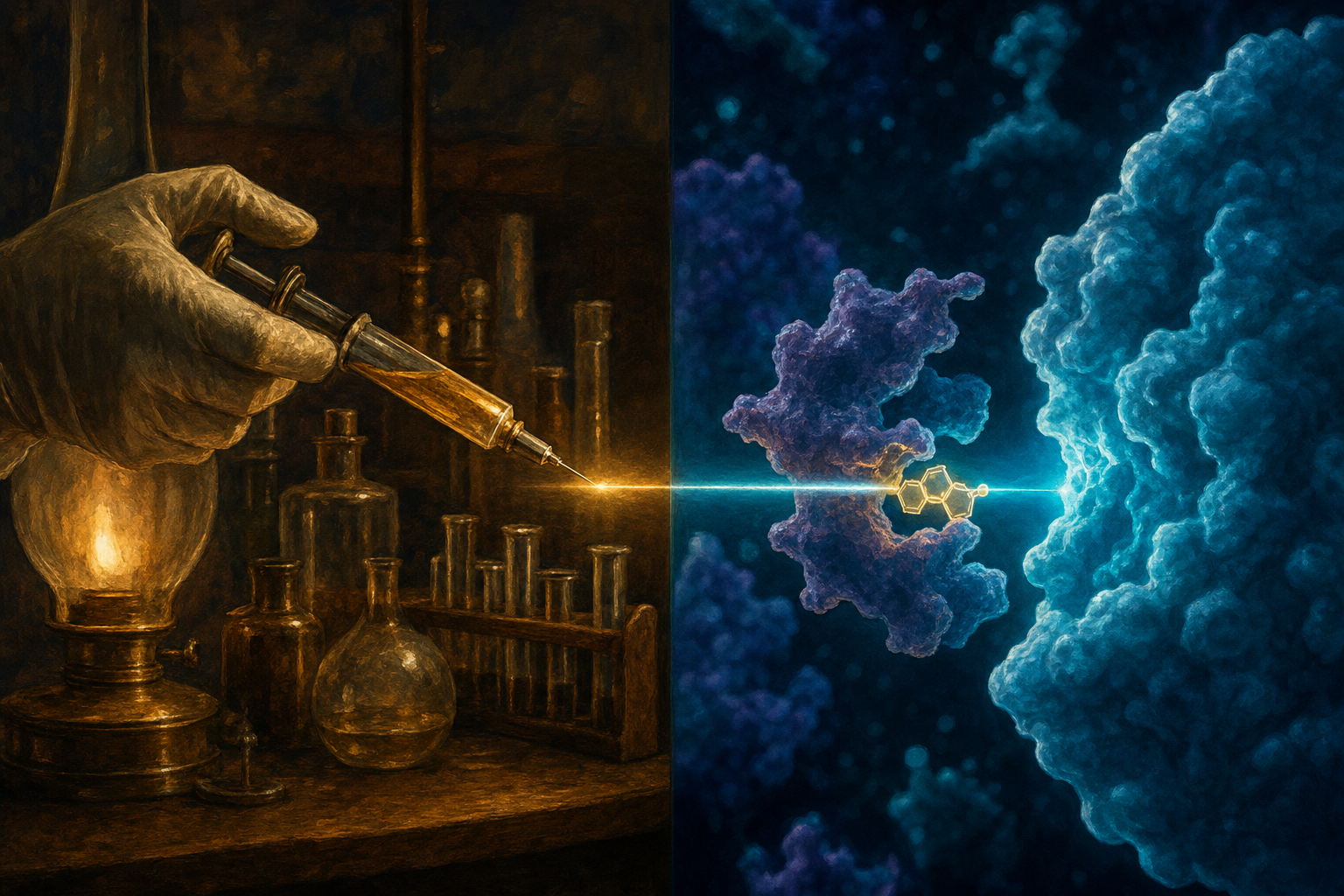
In a laboratory in Frankfurt, in 1909, a young Japanese scientist injected a rabbit with the six hundred and sixth compound in a long numbered series of poisons. It was a compound that his colleagues had already tested, declared useless, and set aside two years earlier. By the next morning, the rabbit's syphilis sores had begun to vanish. A single dose. The most feared disease of the age, retreating in front of a chemical that had been left to gather dust on a shelf.
The man who had dreamed of that moment was Paul Ehrlich. Ehrlich had an idea that most of medicine considered a fantasy. He called it the magic bullet. A chemical that you could send into the human body, one that would hunt down the specific microbe causing a disease, kill it, and leave the patient unharmed. In 1909 this was close to science fiction. Medicine in that era could ease pain and set bones, but it could cure almost no infection at all. The idea that you could fire a chemical at a disease the way a marksman fires at a target was, to most doctors, a dream.
The target Ehrlich chose was the cruelest one available. Syphilis was the incurable terror of the nineteenth century, a disease that worked through the body for years and ended in madness and death. It was caused by a corkscrew-shaped bacterium called Treponema pallidum, a spirochete. The only treatment was mercury, a poison that often did as much harm as the disease itself. The grim joke of the age was that a night with Venus meant a lifetime with Mercury.
Ehrlich's method was not a flash of genius. It was patience, multiplied by failure. His laboratory worked like a factory. They would synthesize a chemical, give it a number, test it, and move on. Then synthesize the next one. Hundreds of variations on arsenic, each one a numbered preparation in a long, grinding series. It was tedious, unglamorous work, and his rivals sneered at it. Real science, they thought, was about brilliant ideas, not about grinding through one compound after another.
In 1907, his chemist Alfred Bertheim synthesized the six hundred and sixth preparation in the series. Ehrlich's assistants tested it, decided it did nothing useful, and shelved it. Number 606 was a failure, one more dead end among hundreds.
Two years later, Ehrlich hired a young bacteriologist from Japan named Sahachiro Hata, and gave him a painstaking task: take the whole library of arsenic compounds and test them again, properly, in rabbits deliberately infected with syphilis. Hata worked his way through the series. And when he reached the compound that everyone had already written off, number 606, he watched it do the impossible. One injection cleared the infection. The failure was a cure.
They called it Salvarsan, and they announced it to the world at a medical congress in Wiesbaden in 1910. It was the first time in history that a synthetic chemical had cured an infectious disease. Ehrlich had a name for what he had done. He called it chemotherapy. The magic bullet was real. And the principle behind it, that you could design a single molecule to seek out one target in the body and shut it down, would become the foundation of modern medicine.
Now jump forward more than a century, to one of the hardest targets medicine has ever faced. In 1982, scientists identified a gene that, when it mutates, drives cells to grow and divide without ever stopping. They called it KRAS. It turned out to be one of the most important cancer genes there is. It is mutated in more than nine out of ten pancreatic cancers, which is among the deadliest diagnoses a person can receive, and in huge numbers of lung and colon cancers too.
And for forty years, KRAS was the target that could not be hit. The protein it makes is almost perfectly smooth. It has no deep pocket, no crevice, no obvious place for a drug molecule to grab hold. Company after company tried to design a drug against it and failed. KRAS earned a nickname in cancer biology: the undruggable target. The white whale. The thing everyone agreed simply could not be done.
Then, in 2026, it was done. At the world's largest cancer conference in late May, and in the pages of the New England Journal of Medicine, researchers reported the results of a drug called daraxonrasib. In patients with advanced pancreatic cancer who had already run out of options, it nearly doubled survival, from about six and a half months on chemotherapy to more than thirteen. For a disease that has barely moved in decades, oncologists stood up and cheered.
And the way it works is pure Ehrlich. The drug does not try to force a key into a lock that is not there. Instead it grabs a helper protein already floating inside the cell, a molecule called cyclophilin A, and uses it to clamp down onto the active KRAS protein and switch it off. A molecular glue. An indirect, clever route to a target that everyone had said was unreachable. It is a magic bullet aimed at the smoothest wall in cancer, and it found a way in.
A hundred and sixteen years separate Salvarsan from daraxonrasib, the spirochete from the oncogene. But the logic is identical. Design a molecule that finds one specific thing in the body and stops it, and then keep going, long after the experts have declared the target impossible.
Because here is the thing that the phrase magic bullet always hid. Ehrlich's bullet was numbered 606, which means there were six hundred and five before it that did not work. Cancer biology spent forty years failing at KRAS before it finally gave way. The bullet was never magic. It was the refusal to stop firing after everyone else had called the target impossible to hit. That is the discovery, in 1909 and again in 2026, that keeps repeating. Who gets to decide that a thing is impossible? And who keeps going anyway?