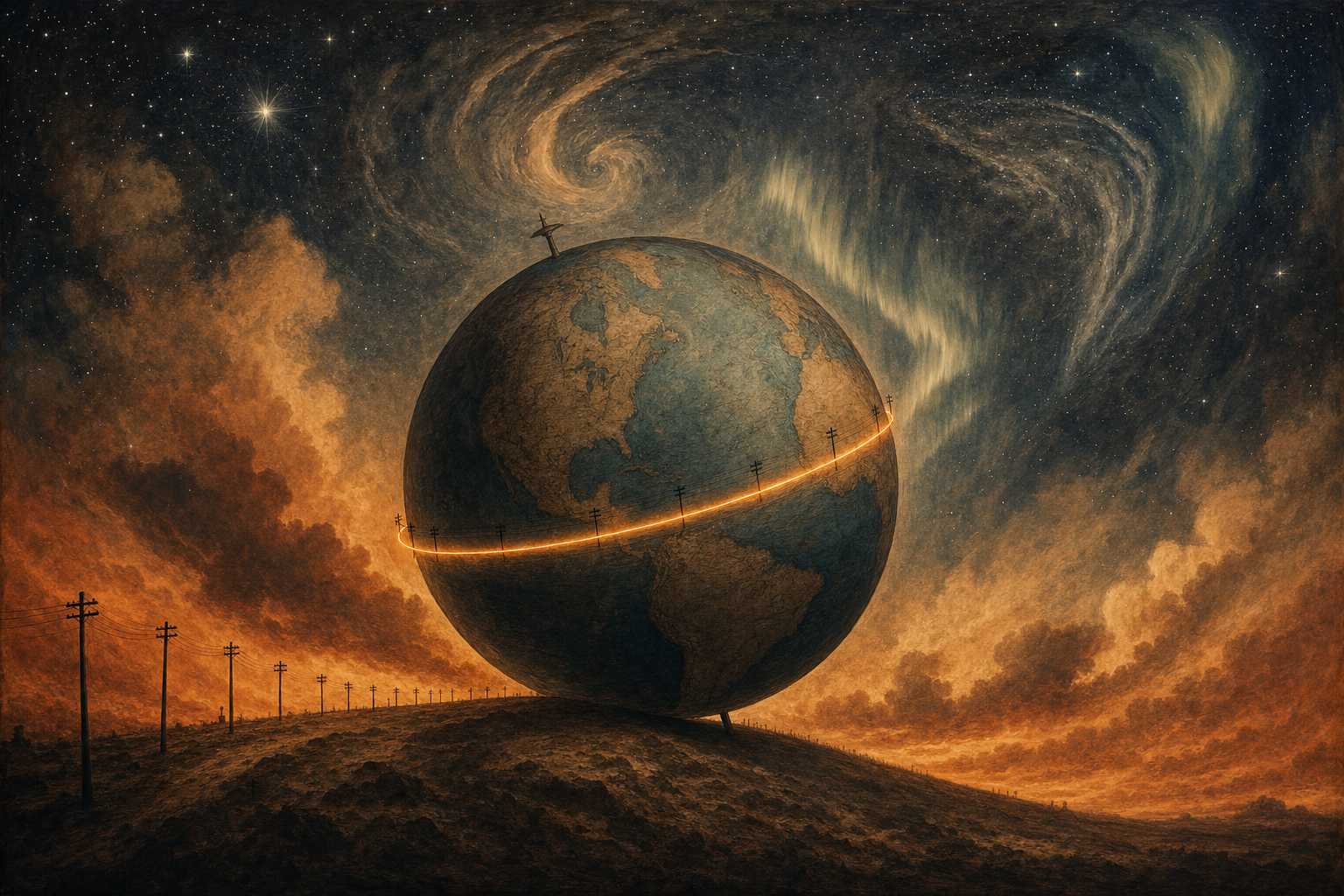
On the nineteenth of February, 1881, the New York Times sat down to explain, in calm and measured prose, exactly how the telegraph was going to destroy the solar system.
The danger was this. Soon the earth would be girdled with one continuous line of telegraph wire. Electric currents would run along it without pause. The natural currents that move inside the planet, on their way between the poles, would be interrupted, and then seduced. Before long, every current that now flows between the poles would be lured into flowing along the plane of the equator instead. Once that habit set in, the poles of the earth would shift, and the equator would shift with them. One pole would end up in Africa, the other in the Pacific Ocean. The axis of the planet would tilt to a new angle. And the ecliptic, the paper warned, would at once resent this behavior. A revolution would take place in the solar system, the disastrous and far reaching effects of which could not even be imagined.
Here is the part worth holding onto. The Times was being sarcastic. It was mocking the warning of what it called an esteemed scientific contemporary, a rival publication that had floated the prophecy in earnest. Even in 1881 there were two camps: the people certain the new machine would end the world, and the people rolling their eyes at them. The argument we are having about artificial intelligence right now is not new. It is one of the oldest arguments there is.
Start at the beginning. The first recorded panic about a new information technology is about two thousand four hundred years old, and it was about writing itself.
In Plato's Phaedrus, Socrates tells the story of an Egyptian king named Thamus, to whom the god Theuth presents his new invention: letters, written language. Theuth promises it will make people wiser and sharpen their memory. The king is appalled. Writing, he says, will do the opposite. It will produce forgetfulness in the souls of those who learn it, because they will stop exercising their memory and trust instead to marks made by other people. Worse, he says, it gives only the appearance of wisdom, not the reality. People will read much, understand little, and think themselves clever for it.
Hold that thought, because Socrates was not entirely wrong. We did hand our memory over to the page. But notice the shape of the complaint, because you are going to hear it again and again for the next two thousand years.
Move forward to 1545. The printing press is about a century old, and books are multiplying faster than anyone can read them. The Swiss naturalist Conrad Gessner, trying to catalogue every book in existence, throws up his hands at what he calls the confusing and harmful abundance of books. Information overload, denounced by name, four hundred and eighty years ago. He begged kings and princes to do something about it.
Then come the machines of the nineteenth century, and the prophecies turn apocalyptic.
The railways, doctors warned in the 1830s, would drive passengers out of their minds. Speed itself was the threat. The human body, they said, was never built to move faster than a galloping horse, and railway madness entered the medical vocabulary as a genuine diagnosis. Then the telegraph arrived, with the cosmic catastrophe the Times was laughing at. In Sicily, the villagers in Giovanni Verga's novel of 1881 believed the wires overhead were stealing the rain, pulling the weather out of the sky and carrying it off somewhere else. In New York, in the autumn of 1889, a Western Union lineman named John Feeks was electrocuted on a pole above a crowded street at the lunch hour, and the city tipped into open panic. The papers warned that any wire, any railing, any doorknob, might now carry instant death. People tore the telephones out of their own homes and threw them into the street.
The telephone got no gentler a welcome. To many in its early years it was, quite literally, the instrument of the devil, a thing that might draw evil spirits, or lightning, into the house. Others were sure the wires carried sickness, that the germs of consumption and smallpox crept out of the mouthpiece and into your mouth while you spoke.
In 1906 John Philip Sousa, the most famous bandmaster in America, published an essay called The Menace of Mechanical Music. Recorded sound, he warned, would be the death of the human soul. Nobody would bother to learn an instrument once a machine could play for them. The very organs would wither from disuse. What of the national throat, he asked. Will it not weaken. The vocal cords, he predicted, would in time vanish from the human body altogether, as the tail had vanished when man came up from the ape.
And the warnings never stopped. In the 1890s, doctors warned women that riding a bicycle would leave them with a permanent haggard grimace they named bicycle face. In 1936 a music magazine fretted that radio was disturbing the balance of children's excitable minds. Every generation, handed a machine that changed how people thought or talked or moved, produced a chorus of respectable, credentialed, deadly serious people announcing the end of the mind, the body, the social order, or the planet.
Now it is artificial intelligence, and the register is exactly the same. Only the stakes have been turned up to the maximum setting.
In October 2025, more than two thousand people signed a public statement calling for a ban on the development of superintelligence until it can be proven safe. The signatories were not cranks. They included Geoffrey Hinton and Yoshua Bengio, two of the men who built the technology and won its highest honors, alongside figures like the Apple co-founder Steve Wozniak. Hinton now puts the odds that AI drives humanity to extinction within thirty years at somewhere between ten and twenty percent. Bengio warns that the race to build ever smarter machines may hand them survival goals of their own. The new thing, once again, will not merely disrupt us. It will end us.
So here is the uncomfortable part, the part that makes this more than a parade of people who looked foolish later.
Most of these prophecies were not just wrong. They were spectacularly, cosmically wrong. The poles did not move. The throat did not wither. The bicycle deformed no one's face. But a few of the worriers were partly right, and that is the trap. Writing really did change human memory. The telegraph really did wire the world into a single nervous system. The lesson of history is not that fear of technology is always foolish. It is that the specific genre of total catastrophe, the planet tipping off its axis, the species snuffed out, is almost always wrong, while the quieter prediction, that this will change us in ways we cannot yet picture, is almost always right.
The pole shift crowd of 1881 and the extinction crowd of today are making the same kind of claim, in the same apocalyptic key, with the same air of scientific certainty. Last time, the planet stayed exactly where it was. The real question is not whether today's prophets are cranks. It is which kind of prophet they are.
In 1881 the warning was that a wire would tip the earth off its axis. The earth is still here. The wire became the nervous system of the world. Every age is certain its machine is the one that ends everything. So far, the machine has just become the furniture.