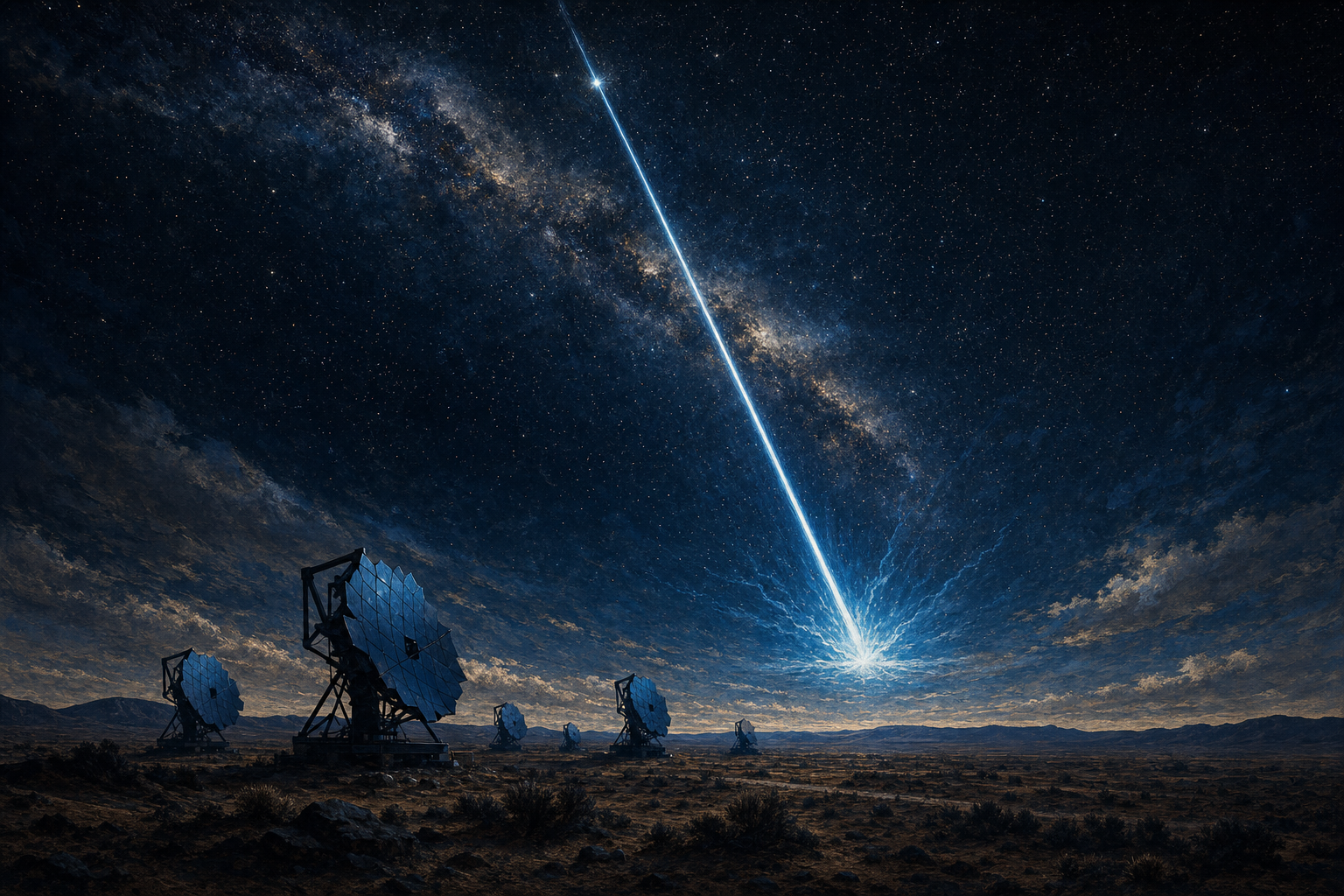
On a clear night in October 1991, over the Utah desert, something invisible slammed into the top of the sky carrying the energy of a fastball. Not the energy of a thrown baseball spread across a baseball. All of it, packed into a single subatomic particle far smaller than an atom. The physicists who recorded it did not believe their instruments. When they did, they gave it a name that has stuck ever since: the Oh-My-God particle. And thirty-five years later, nobody can explain where it, or its rare cousins, come from.
Start with what was already known. The Earth is bathed, constantly, in a faint rain of particles from space called cosmic rays. We learned this in 1912, when the Austrian physicist Victor Hess took electrometers up in a balloon and found that the radiation grew stronger the higher he rose, not weaker. It was coming from above, from the cosmos, and the discovery won him a Nobel Prize. Most cosmic rays are modest little things, flung out by the sun or by ordinary stars. But every so often, something monstrous arrives.
On the fifteenth of October 1991, a detector called the Fly's Eye, watching the desert sky for the faint blue flash a cosmic ray makes when it hits the atmosphere, caught one carrying about three hundred and twenty billion billion electron volts. In ordinary terms, that is roughly fifty joules of energy, enough to light a household bulb for a second, the energy of a bowling ball dropped on your foot, all carried by one particle smaller than an atom. It was travelling so close to the speed of light that in a year-long race with a beam of light, it would have fallen behind by less than the width of a human hair. The most powerful particle accelerator humanity has ever built, the Large Hadron Collider, pushes particles to less than one ten-millionth of that energy.
And here is the problem: it should not have been able to reach us at all. Back in the 1960s, three physicists, Greisen, Zatsepin and Kuzmin, worked out that the universe has a kind of cosmic speed limit. Space is filled with the faint afterglow of the Big Bang, a sea of microwave radiation, and a particle moving above a certain colossal energy should crash into that radiation and bleed away its strength within a few hundred million light years. This is called the GZK limit. The Oh-My-God particle was well above it. Which means it could not have travelled far. Which means its source should be close, in cosmic terms, a near neighbour. So astronomers looked back along the precise direction it came from, expecting to find some violent engine, an exploding galaxy, a giant black hole. They found nothing. Empty sky.
It was not a one-off freak. In 2021 another detector in Utah, the Telescope Array, caught a second giant, nearly as powerful, which researchers named the Amaterasu particle after the Japanese sun goddess. And it, too, pointed back toward a stretch of almost empty space, a great void with nothing obvious in it capable of such a feat.
That deepening mystery has come roaring back in 2026. New analysis is trying to trace the Amaterasu particle's path to a nearby star-forming galaxy after all, arguing the empty space was a mirage of our incomplete maps. Other physicists are making a stranger case: that these record-breakers are not lone protons at all, but ultra-heavy atomic nuclei, which would rewrite the entire calculation of where they can come from and how they survive the journey. Next-generation observatories are being designed for the sole purpose of finally cornering the answer.
But strip away the competing theories and the plain fact remains, and it is genuinely staggering. Somewhere out in the universe, there is a natural particle accelerator so violent that it dwarfs everything humanity has ever built by a factor of tens of millions. It is switched on right now. It is flinging single particles across the cosmos with the punch of a thrown baseball. And we do not know what it is, or, with real confidence, even where it is.
We tend to think of ourselves as the makers of powerful machines. We dig vast rings out of the rock under Geneva and feel, reasonably, that we are pushing matter to its limits. And then a single speck arrives out of the dark, unannounced, carrying ten million times more energy than our greatest machine can muster, passes clean through the planet, and is gone, leaving only a flash of blue light and a question.
The most powerful accelerator in the universe is out there, running, and after thirty-five years of looking we still cannot point to it. Every clear night, the sky is doing physics we cannot do, and cannot yet explain. All we can do, for now, is stand in the desert, watch for the flash, and wonder what on earth is throwing them.