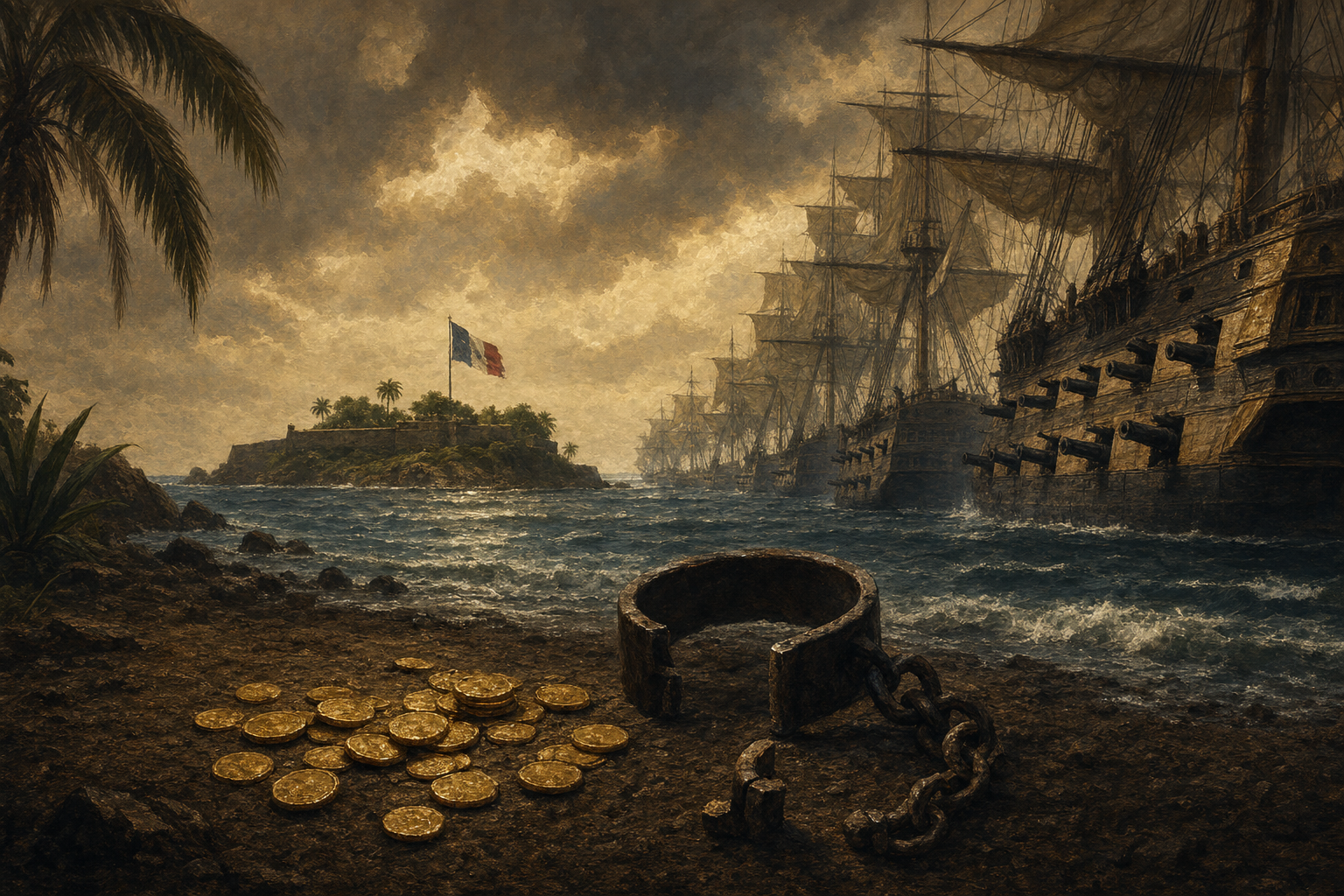
In 1804, the enslaved people of a French sugar colony did something the world had said was impossible. They overthrew their masters, defeated the army Napoleon sent to re-chain them, and founded a free nation: Haiti, the first Black republic, born from the only large slave revolt in history that actually won. Twenty-one years later, France sent fourteen warships to make them pay for it. Not as a figure of speech. An actual bill, for their own freedom, that would take a hundred and twenty-two years to settle. Haiti is collapsing on the news this week, and the roots of that collapse run straight back to the ransom.
Start with how the world treated a free Black nation in 1804. It treated it as a threat to be quarantined. France refused to recognize Haiti's independence. The United States, itself a slaveholding country terrified that the example might spread, refused too. Haiti was boxed out of trade and diplomacy, a pariah for the crime of having freed itself.
Then, in 1825, France made its move. King Charles the Tenth sent a baron named Mackau across the Atlantic, and behind him a squadron of fourteen brigs of war carrying more than five hundred cannons, into Haitian waters. The ultimatum was blunt. Haiti could pay an indemnity of one hundred and fifty million gold francs to compensate the former French colonists for their lost property, and that property included the very people who had freed themselves, or it could face the French navy and the real threat of re-enslavement. The Haitian president, Jean-Pierre Boyer, with no fleet to answer the guns, signed. The sum was about ten times what the United States had just paid France for the entire Louisiana Purchase.
Haiti could not possibly pay it. So it did the only thing it could: it borrowed the money from French banks to pay the French government. This is the part that turns a robbery into a strangling. Haiti now owed the ransom, and it owed the loans it had taken out to pay the ransom, at heavy interest. Historians call it the double debt. In 1838 the headline figure was cut, and the original indemnity was nominally cleared by 1883, but because of the cascade of loans taken to service the loans, Haiti was still making payments to foreign creditors, including American banks, until 1947.
Sit with that. For the first hundred and twenty-two years of its existence as a free country, a huge share of everything Haiti earned was shipped back across the ocean to the descendants of the people who had enslaved it, and to the bankers who financed the deal. A 2022 investigation by the New York Times tried to total the cost, and estimated that the debt drained something between twenty-one billion and one hundred and fifteen billion dollars in lost growth from the Haitian economy. Money that did not build roads. Did not build schools. Did not build hospitals, courts, a functioning state. It built the comfort of Paris instead.
Which brings us to this week. In the middle of June 2026, the Secretary-General of the United Nations, Antonio Guterres, visited a Haiti in near-total collapse. A coalition of armed gangs now controls around seventy percent of the capital, Port-au-Prince. More than two thousand three hundred people have been killed across the country this year, and around one and a half million have been driven from their homes, more than one Haitian in ten. There has been no president since the last one was assassinated in his own bedroom in 2021. A new international force, cobbled together from a handful of countries, is only now preparing to try to take the capital back.
It is very easy to look at Haiti today and see only the gangs, the chaos, the failure, and to treat it as a country that somehow could not get its act together. But ask why the state is so weak that gangs could simply walk into the vacuum. A nation has no deep institutions, no resilient infrastructure, no reservoir of public wealth to fall back on, in part because for the first century and a quarter of its life it was being financially bled, by treaty, at gunpoint, as the price of being allowed to exist. You cannot build a country while you are busy paying for your own freedom.
None of this is the whole story. There was a brutal American occupation, there were dictators and coups and earthquakes. But the double debt is the foundational wound, the reason Haiti began its life as a free nation already a century behind, and never got to start even.
Haiti paid for its freedom twice. Once in blood, in the revolution. And then, for a hundred and twenty-two years, in gold. We are quick to call it a failed state. It might be more honest to call it a robbed one.