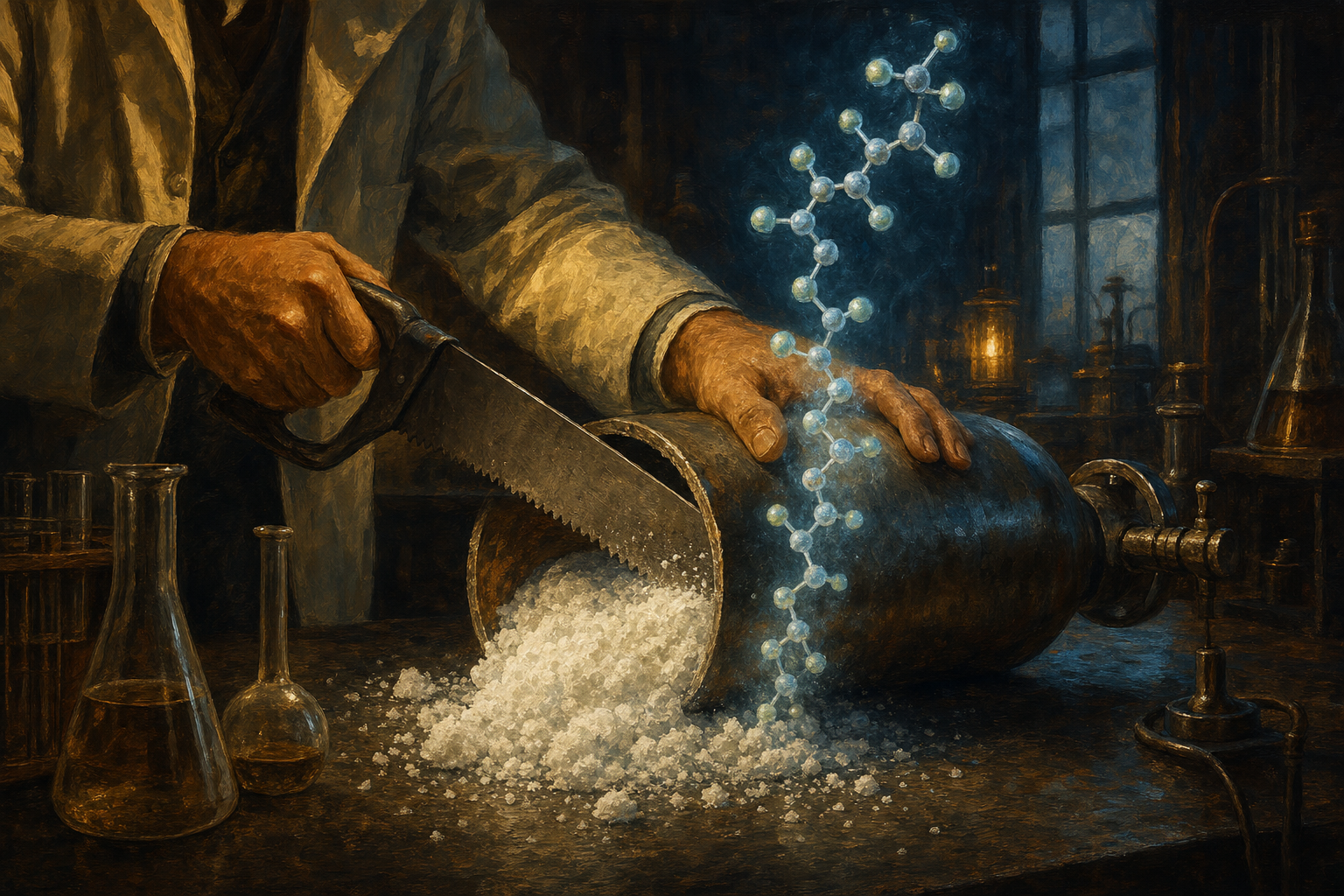
On the morning of the sixth of April, 1938, a young chemist opened a gas cylinder that should have been full, and got nothing. The valve hissed empty. But the cylinder still weighed as much as a full one. Puzzled, he and his assistant sawed it open, and found the inside coated with a strange white waxy powder. He had just accidentally invented one of the most useful materials of the twentieth century, and one of the most indestructible. Eighty-eight years later, the family of chemicals he started is in the rain, in the soil, and in the blood of very nearly every human being alive, and it will not break down.
The chemist was Roy Plunkett, twenty-seven years old, working at a DuPont laboratory in New Jersey. He was not trying to change the world. He was trying to make a better refrigerator. He was working on new cooling gases, the chlorofluorocarbons, and he had stored a quantity of one gas, tetrafluoroethylene, in cylinders packed in dry ice. When the gas refused to come out but the weight had not changed, Plunkett did the thing that makes a scientist rather than a technician: instead of throwing the dud cylinder away, he cut it open to see what had happened.
The gas inside had spontaneously turned solid. The molecules had linked themselves into long chains, polymerised, helped along by the iron of the cylinder walls, into a substance called polytetrafluoroethylene. We know it as Teflon.
It was a marvel. Almost nothing would stick to it. No acid attacked it, no solvent dissolved it, and it shrugged off heat that would destroy ordinary plastics. It was the slipperiest solid anyone had ever measured. And the reason for all of it was a single fact of chemistry: the bond between carbon and fluorine is one of the strongest in the whole of nature. Teflon was, for all practical purposes, indestructible. Nothing in the everyday world had the strength to take it apart.
That indestructibility made it priceless, and its first job was a secret one. During the Second World War, Teflon was classified, because it was one of the few materials that could withstand the savagely corrosive uranium gas used to build the atomic bomb. Only later did it reach the public, trademarked in 1945, and only in the 1950s did a French engineer think to bond it to a frying pan and give the world non-stick cooking. Soon its chemical relatives, the whole family known as PFAS, were everywhere: in waterproof fabrics, food packaging, firefighting foam, cosmetics, carpets, wiring.
And every one of them carried Plunkett's gift, and Plunkett's curse: that unbreakable carbon-fluorine bond. The very stability that made these chemicals so wonderfully useful meant that, once made, they essentially never go away. Nature has no tool to digest them. So they accumulated. They washed into rivers and groundwater. They drifted in the atmosphere and came down in the rain, even over Antarctica. They moved up the food chain and into us. Today these forever chemicals are measurable in the blood of almost every person on the planet, and a growing weight of evidence links them to cancers, immune problems, and developmental harm. The companies that made them have paid out billions of dollars in settlements. The miracle had a receipt, and we are only now reading it.
But this month, June 2026, came the first real crack in the word forever. In the journal Environmental Science and Technology, a research team reported a hidden weakness in these supposedly invincible molecules. The key turned out to be something called a hydrogen radical, an extraordinarily reactive fragment that can be split out of ordinary water by intense ultraviolet light. Those radicals, the team showed, attack the PFAS molecule and begin prying the fluorine atoms off it one by one, breaking the unbreakable chain into smaller, weaker, mortal pieces. No exotic additives. Just water and high-energy light.
It is not a finished cure. The process is still slow, and it can leave half-broken fragments behind that need dealing with in turn. But it overturns the old assumption about how these chemicals can be destroyed, and for the first time it points a credible path toward unmaking what Plunkett accidentally made.
Here is the echo worth sitting with. The thing we celebrated about Teflon, that nothing could ever break it, is the exact same thing that turned it into permanent pollution in our own bodies. The miracle and the curse were never two different properties. They were one property, admired for decades before anyone thought to ask what indestructible would mean once the stuff was loose in the world.
We are extraordinarily good at inventing the future. A bored chemist cuts open a cylinder and hands us eighty years of non-stick pans and waterproof coats. We are much slower, always, at reading the bill that comes with it, and slower still at paying it. Plunkett's white powder is the whole story of modern chemistry in miniature: a genuine wonder, embraced at once, and a consequence that took the better part of a century to fully understand and may take another century to undo.
The good news, this month, is that undo may finally be on the table. The lesson is the one we keep relearning. When something seems too good to break, that is exactly the moment to ask what happens when we cannot get rid of it.