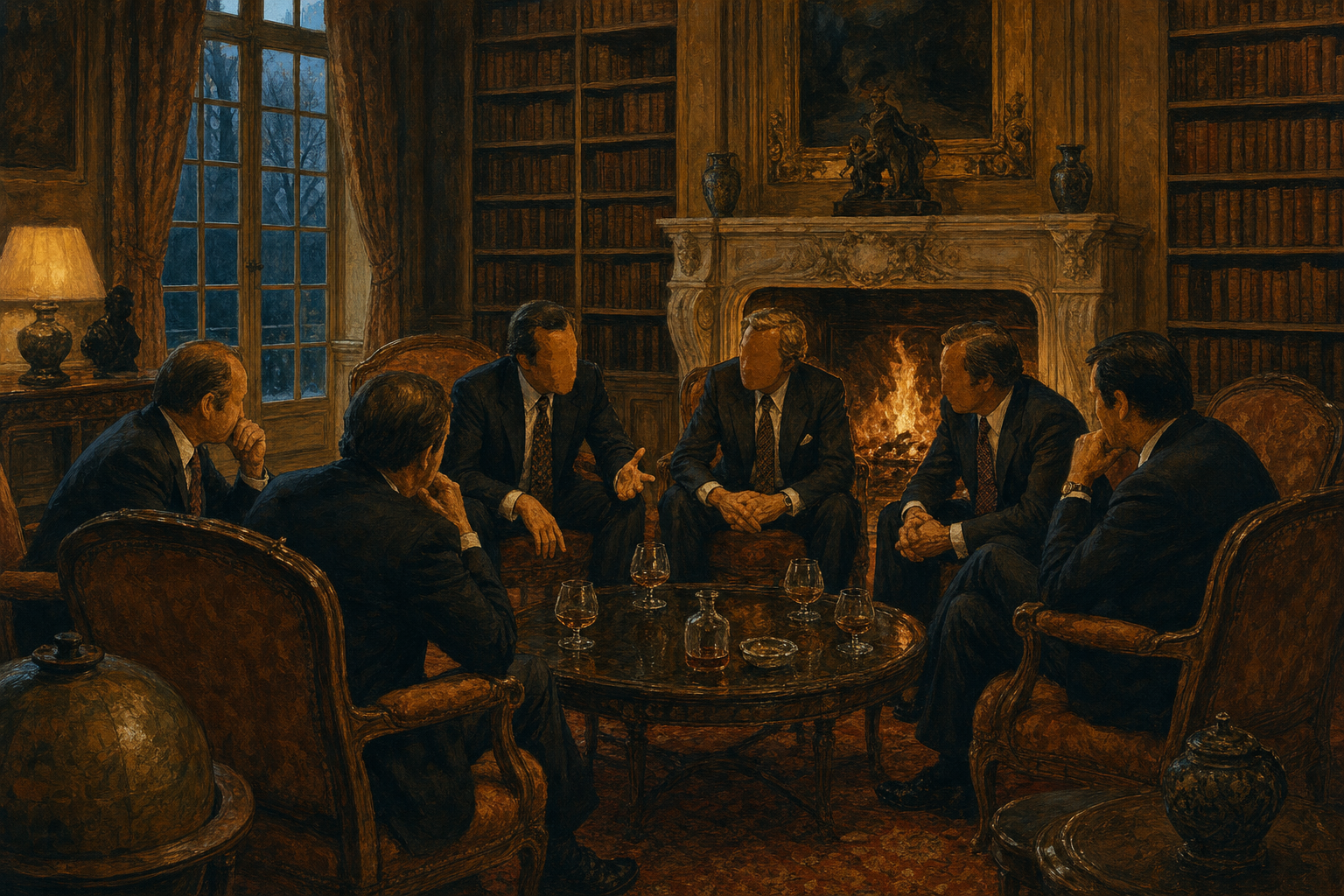
In November 1975, six men sat down by a fire in a French château, with no aides in the room, and tried to save the world economy. Almost by accident, they founded the most exclusive club on earth. This week, fifty-one years later, almost to the day, their successors are back in France, and the club they built is straining at the seams.
To understand why those six men gathered, you have to understand how broken 1975 felt. The comfortable postwar order was coming apart all at once. In 1971 the United States had cut the dollar loose from gold, ending the fixed-exchange system that had governed money since the Second World War. In 1973 the oil-producing states had turned off the taps, and the price of crude quadrupled almost overnight. The result was something economists had said could not even happen: stagnation and inflation at the same time. Factories idled while prices soared. It was the worst downturn since the Great Depression, and there was no mechanism on earth for the leaders of the big democracies to actually sit down together and deal with it.
So two men invented one. Valéry Giscard d'Estaing, the president of France, and Helmut Schmidt, the chancellor of West Germany, were friends, and both had been finance ministers. They were sick of summits drowned in bureaucracy and scripted communiqués. Their idea was radical in its simplicity: skip the machinery, put the leaders themselves in a room, no vast delegations, and just talk, frankly, the way finance ministers talked.
They chose the Château de Rambouillet, an old royal hunting lodge southwest of Paris that served as a retreat for French presidents. From the fifteenth to the seventeenth of November 1975, six leaders came: Giscard of France, Gerald Ford of the United States, Schmidt of West Germany, Harold Wilson of Britain, Aldo Moro of Italy, and Takeo Miki of Japan. They sat by the fire. They argued about floating currencies, about oil, about trade, about how to climb out of the recession. And at the end they issued a short statement, the Declaration of Rambouillet, promising to coordinate rather than turn on each other with tariffs and currency wars, the way the world had in the 1930s.
It was supposed to be a one-off. A single fireside crisis meeting, and then back to normal.
It never ended. The next year, 1976, Canada was invited, and the Group of Six became the Group of Seven. It became an annual event, then an institution, then the closest thing the Western world had to a steering committee. For decades the G7 was where the global economy was actually managed: currencies stabilised, debt crises wrangled, the rules of trade quietly set. Russia was let in to make a Group of Eight in the optimistic 1990s, and then thrown back out in 2014 after it seized Crimea. Through all of it, the fireside format held: a handful of leaders, in a room, trying to keep the system from flying apart.
Which brings us to this week. Right now, as this is published, the G7 is meeting again in France, at Évian on the shore of Lake Geneva, the fifty-second summit of the club, fifty-one years almost to the day after Rambouillet, and on the very same dates of the month.
But the room is not what it was. When those six men met in 1975, their countries made up most of the world's economy. Today the G7's share has shrunk dramatically, as China, India and others have risen, and a rival club, the larger and looser grouping of major emerging economies, openly positions itself as the alternative. Worse, the trust that made Rambouillet work is fraying from the inside. The summit is unfolding amid tariff fights between the members themselves, a war involving the United States, Israel and Iran, and an American administration openly at odds with its closest allies. The club that was invented so that friends could coordinate is now a table where the friends are not sure they agree on anything, sometimes struggling even to produce the joint statement that was once routine.
Here is the thing worth holding onto about Rambouillet. It did not work because of its rules, or its size, or its communiqué. There were no rules. It worked because six people trusted each other enough to sit by a fire without their advisors and speak plainly. The institution they accidentally created has outlived every one of them. The trust that made it function is the part that does not automatically renew.
Every age builds clubs to manage its crises, and the clubs almost always outlast the crisis that made them. The danger is not that the G7 disappears. It is that it keeps meeting, in beautiful French towns, on the anniversary of its own founding, long after the thing that gave it its power, the simple ability of its members to trust one another in a room, has quietly drained away.
The fire is still lit at Évian. The question is whether anyone in the room is still really talking.