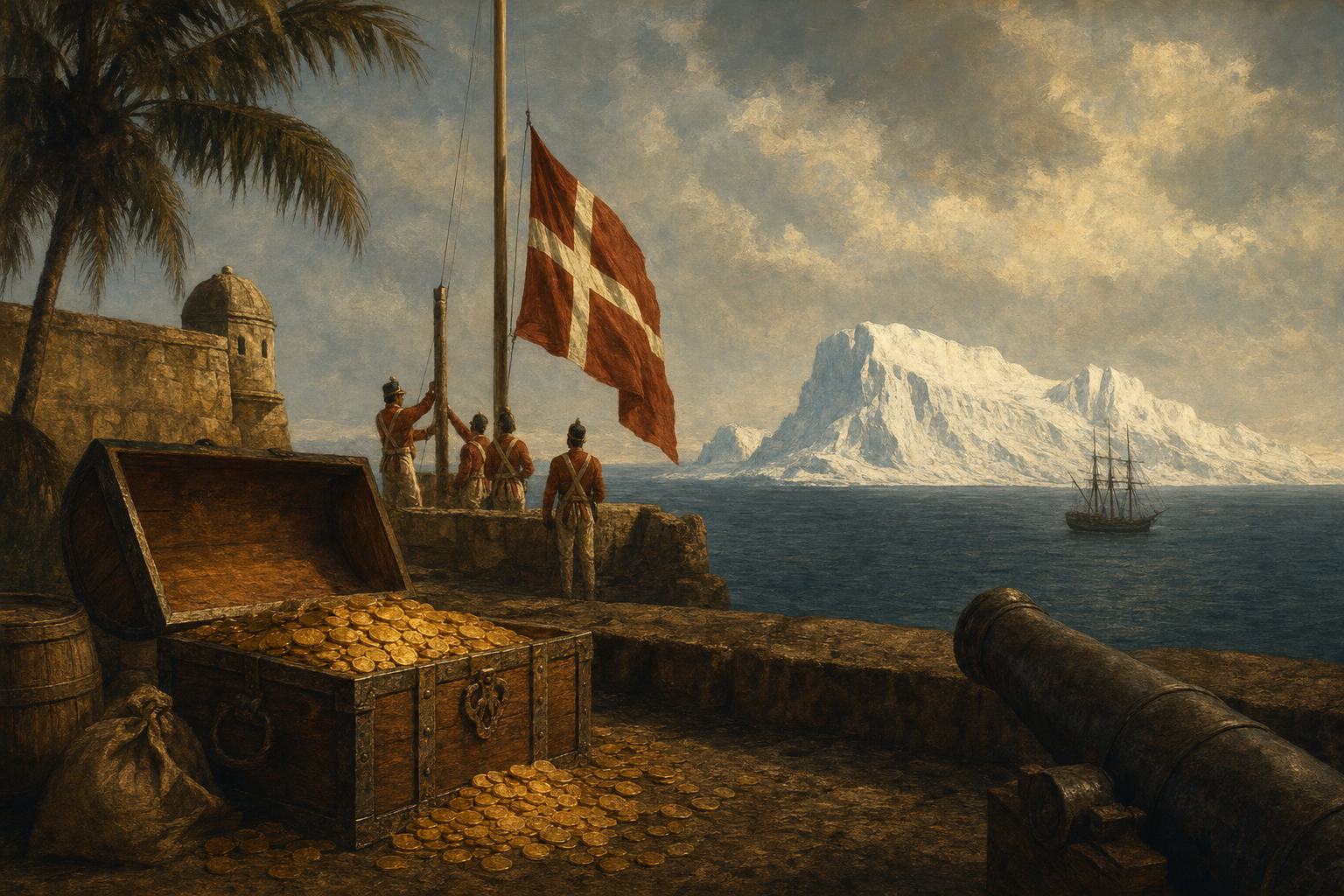
In 2026, an American president says he wants to buy Greenland, and the world reacts as if this is something bizarre and unprecedented. It is not. The United States has bought Danish islands before. It paid for them in gold. And the reason it wanted them then is exactly the reason it wants Greenland now: not the land itself, but keeping a rival off it.
Go back to 1917. In the middle of the First World War, the United States paid Denmark twenty-five million dollars in gold for three small Caribbean islands, the Danish West Indies, which you now know as the United States Virgin Islands: Saint Thomas, Saint John, and Saint Croix.
Why would America want them? Not for money. Their sugar economy was in long decline, and nobody bought them as an investment. They wanted them for where they sat. President Woodrow Wilson and his Secretary of State, Robert Lansing, were afraid that Germany might overrun neutral Denmark, and then use the Danish islands as a base, right beside the shipping lanes of the Caribbean and the approaches to the Panama Canal. The islands were valuable purely as a place to deny to an enemy.
And it was not really a friendly sale. Lansing made it quietly clear to the Danes that if they would not sell, the United States might simply take the islands anyway, to keep Germany from getting them first. A neutral country was pressured into handing over its territory under the implied threat that the alternative was seizure. The tactic worked. The islands were transferred on the thirty-first of March, 1917, and the roughly thirty thousand people living on them changed countries without being asked.
This was not even a new idea in 1917. The United States had been angling for those islands for half a century. William Seward, the same Secretary of State who bought Alaska from Russia in 1867, negotiated a treaty to buy the Danish West Indies that same year, and the Senate killed it. Buying cold or strategic real estate to lock out a rival is one of the oldest moves in the American playbook.
And Greenland itself? Also not new. In 1946, secretly, the administration of Harry Truman offered Denmark one hundred million dollars in gold for Greenland. The Cold War was beginning, and American planners wanted the island for Arctic air bases and the polar routes that bombers and missiles would fly between the superpowers. Denmark said no. The offer was kept secret for decades, and only came to light when a Danish newspaper exposed it in 1991. Instead of selling, Denmark allowed the United States to build a vast air base in the Greenland ice at Thule, and American forces have been stationed on the island ever since.
Which brings us to now. In 2026, an American president is back, and this time he is saying it out loud: that the United States will acquire Greenland, that he will not rule out economic pressure, that this is about keeping Russia and China out of an Arctic that is melting open into a new arena of shipping lanes, minerals, and military reach. Denmark and Greenland have called their sovereignty a red line. America's closest allies are alarmed, and NATO, the alliance built to hold them all together, is strained by the demand of one member to absorb the territory of another.
Strip away the noise, and the logic has not changed in a hundred and sixty years. The United States does not really want Greenland for Greenland, any more than it wanted those Caribbean islands for their sugar. It wants the location, and above all it wants to make sure a rival cannot have it. In 1917 the rival was Germany and the prize was the Panama Canal. In 1946 and again in 2026 the rival sits in Moscow, and now Beijing too, and the prize is the top of the world.
There is one real difference, and it matters. In 1917 a great power could lean on a small neutral nation and buy an inhabited colony over the heads of the people who lived there, and those people were simply informed which flag they now lived under. In 2026 Greenland has its own government, its own elected voice, and it is using that voice to say, clearly and repeatedly, no. The strategic appetite is identical. What has changed is that the island is no longer a thing to be sold. It is a people who can answer back.
America has bought Danish islands before, in gold, out of fear of somebody else. It tried to buy this one, and was refused, eighty years ago. The map of great-power hunger looks almost exactly the same as it did a century ago. The only thing that has really changed is that this time, the islands can talk back.