In December 1930, one of the cleverest physicists alive sat down to confess a sin. Wolfgang Pauli could not attend the physics meeting in Tübingen, because he had a ball to go to in Zurich, so he sent a letter instead. It began, not "Dear colleagues", but "Dear Radioactive Ladies and Gentlemen". And in it he proposed, as he put it, a desperate remedy. He had invented a new particle. He was almost ashamed of it. Years later he is said to have lamented that he had done a terrible thing, that he had postulated a particle that could never be detected. He even bet a case of champagne that no one ever would.
Last week, nearly a hundred years on and almost half a mile underground in southern China, the largest detector ever built measured that same particle more precisely than anyone in history.
To understand why Pauli felt he was committing a crime, you have to understand the problem that drove him to it. It was called beta decay. Certain radioactive atoms throw out an electron and transform into a different element. The bookkeeping should have been simple. Energy can be neither created nor destroyed, so the electron should always come flying out carrying exactly the same fixed amount of energy, every single time.
It did not. When Lise Meitner and Otto Hahn measured these electrons, and James Chadwick confirmed it, they found the energy came out smeared across a whole range, from almost nothing up to the expected maximum. Energy seemed to be vanishing. The accounts did not balance. The situation was so dire that Niels Bohr, one of the founders of quantum theory, was willing to consider throwing out the law of conservation of energy itself.
Pauli refused. He would rather invent a new piece of reality than give up the most sacred rule in physics. So he proposed that alongside the electron, beta decay also fired out a second particle, one nobody had ever seen. It had to be electrically neutral, so it left no track. It had to be almost weightless. And it had to barely interact with anything at all, which is exactly why it had escaped every experiment, and exactly why Pauli feared it could never be caught. It would carry off the missing energy like an invisible thief, and the books would balance again.
The Italian physicist Enrico Fermi took the ghost seriously. He built a complete and beautiful theory of beta decay around it, and he gave it the name it still carries: the neutrino, the little neutral one. When Fermi submitted that theory to the journal Nature, it was rejected as too remote from reality.
And then the neutrino simply hid. For twenty six years it was pure mathematics, a particle that existed only because the equations would not work without it.
It took a nuclear reactor to flush it out. In the 1950s two American physicists, Frederick Reines and Clyde Cowan, set out to catch the uncatchable. They aimed their detector at the intense flood of neutrinos pouring out of a reactor at the Savannah River nuclear plant in South Carolina. They called it, only half joking, Project Poltergeist, because they were hunting a ghost. And in 1956, they caught it. On the fourteenth of June they sent a telegram to Pauli in Zurich, telling him his impossible particle was real. Pauli, by accounts, interrupted the meeting he was in to read it aloud, and wired back a short reply: thanks for message. He had lost his champagne bet, and he had lived just long enough to win the argument.
But the neutrino was not done surprising people. It turned out there were three different types, and in a discovery that earned the Nobel Prize in 2015, experiments deep under a mountain in Japan and in a mine in Canada showed that neutrinos shapeshift in flight, morphing from one type into another as they travel. That sounds like a curiosity. It is not. For neutrinos to change like that, they must have a tiny sliver of mass, and the reigning theory of particle physics, the Standard Model, flatly insisted they had none. The particle Pauli apologized for had just punched the first real hole in physics' most successful theory.
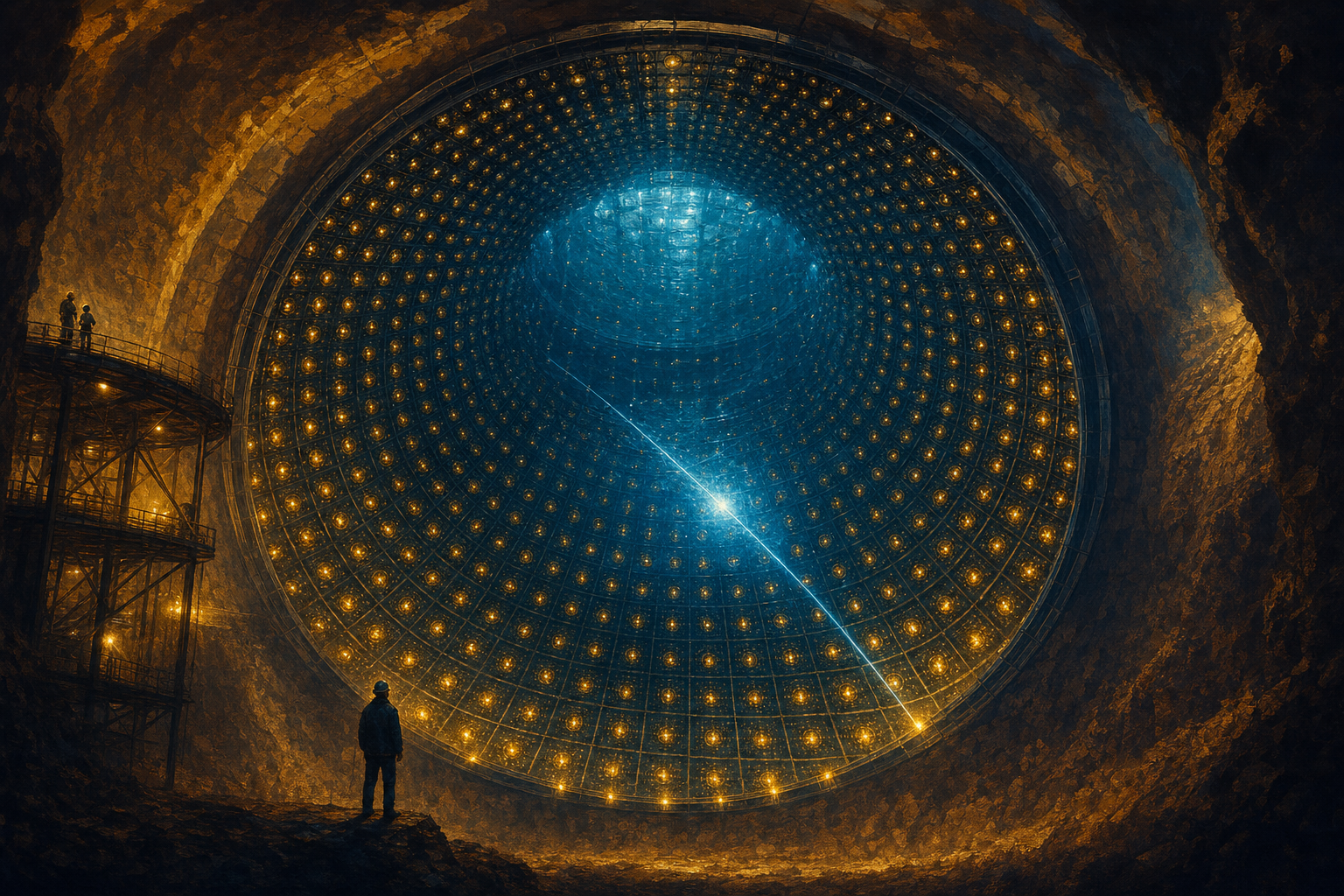
Which brings us to last week, and to a hillside in Guangdong province in southern China. There, seven hundred metres underground, sits JUNO, the Jiangmen Underground Neutrino Observatory: a vast sphere holding twenty thousand tonnes of clear liquid that flashes faintly whenever a neutrino happens to collide with it, watched by tens of thousands of light sensors in the dark. It is the largest detector of its kind ever built.
In June 2026 the JUNO team published its very first result in the journal Nature. From just fifty nine days of data, they measured two of the numbers that govern how neutrinos oscillate to roughly one and a half times the precision of every previous experiment on Earth combined. And that is only the warm up. JUNO was built to answer one of the last great questions about the ghost: its mass ordering, which of the three types is heaviest and which is lightest. The answer feeds into the deepest mystery of all, the question of why the universe is made of matter at all, rather than nothing.
Think about the journey. A particle invented in a single letter by a man who thought he was disgracing himself. A particle he was certain no one could ever find. And now humanity digs cathedrals out of solid rock, fills them with twenty thousand tonnes of fluid, and waits in the dark for that ghost to whisper, because it may hold the secret of why there is something rather than nothing.
Pauli called it a desperate remedy. It turned out to be a door. Every time we have managed to corner the neutrino, it has handed us a piece of physics we did not have before, and there are still at least three of its secrets left to take. The most reluctant invention in the history of science has become the most promising thing in it.
The lesson the neutrino keeps teaching is a strange and hopeful one. Sometimes the idea a genius is most embarrassed by, the patch he reaches for only because the alternative is worse, is not a patch at all. It is the loose thread that unravels the whole picture, and shows you a deeper one underneath.