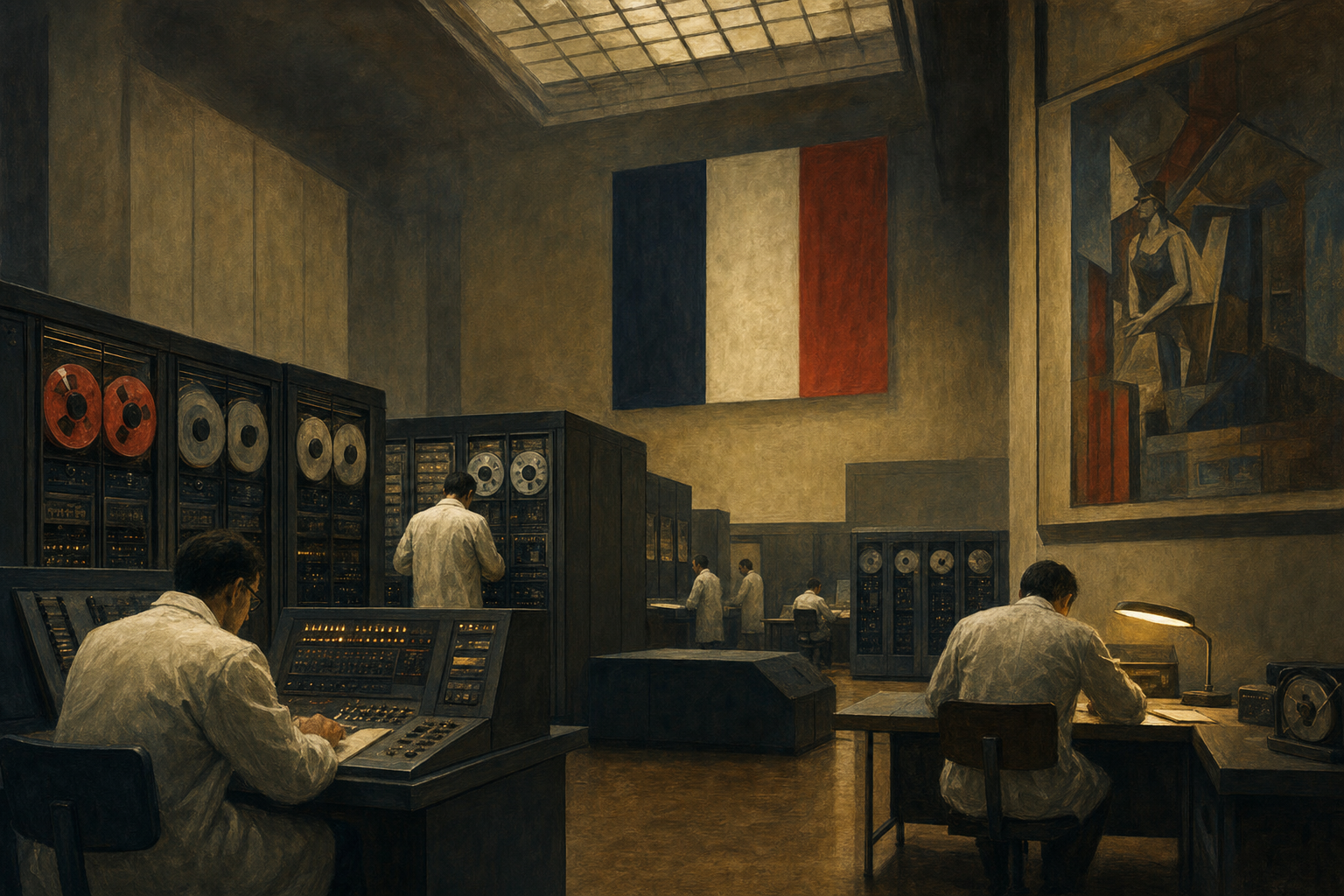
In 1966, Charles de Gaulle decided that France would build its own computer. Not because he loved machines, but because the Americans had just refused to sell him one. Sixty years later, Europe is making exactly the same vow, for exactly the same reason, and discovering that it is exactly as hard.
To understand de Gaulle's fury, you have to know what France was trying to do. It was building its own nuclear deterrent, the force de frappe, so that it would never again depend on Washington or London for its survival. But to design a hydrogen bomb, you have to simulate the physics, and that takes a very powerful computer. The best in the world was American, the Control Data 6600. And in the mid-1960s the United States refused to grant a licence to export it to France's atomic energy commission, precisely in order to slow down the French bomb.
Then came the insult on top of the injury. In 1964, the American giant General Electric had quietly bought control of the Compagnie des Machines Bull, the largest computer maker in France, the national flagship. So France now found itself in a humiliating position: its own leading computer company was American-owned, and the one machine its scientists most needed was under an American embargo. De Gaulle drew the obvious conclusion. A country that runs on someone else's computers is not fully sovereign.
So in July 1966 his government launched the Plan Calcul, a national crusade to build a French computer industry that could stand up to the Americans, and above all to IBM. A new agency reporting straight to the prime minister was created to run it. A national champion was assembled, the Compagnie Internationale pour l'Informatique, known as CII. A state research institute was founded that would later become INRIA, France's great centre of computer science. And the money poured in.
And here the ironies begin to stack up. To get started, the proud new French champion built its first machines under licence from an American company. It never came close to catching IBM, whose head start and engineering depth were simply too great. And in 1975, to survive at all, CII was merged into a new company, CII-Honeywell-Bull, in partnership with the American firm Honeywell. The sovereign French champion, created to escape the Americans, had ended up marrying one. One magazine summed up the whole adventure with a single headline: goodbye to a chimera. As a bid for technological independence, the Plan Calcul had failed.
It did leave something real behind. France kept a deep pool of computing talent, and INRIA went on to become one of the finest computer-science institutes in the world. The dream of independence died. The seedbed it planted survived. But the central lesson was harsh: you cannot simply decree a world-beating technology into existence, however much money and pride you throw at it, when someone else already has a ten-year lead and the best engineers on earth.
Now it is Europe's turn, almost word for word. This month, in June 2026, the European Commission unveiled what it calls its Technological Sovereignty Package: a new chips act, a cloud and artificial-intelligence act, an open-source strategy, and, for the very first time, an official European definition of digital sovereignty. France and Germany have their own joint task force driving it. And the fact that frightens them is stark: the European Union depends on suppliers outside its borders for more than eighty percent of its key digital products, services and infrastructure, overwhelmingly American, and increasingly Chinese.
The argument is precisely de Gaulle's, scaled up to a continent. You cannot be a sovereign power, the reasoning goes, if your chips, your cloud, your software and your artificial intelligence all belong to someone else, someone who could one day throttle your access, or simply refuse to sell, exactly as Washington once refused de Gaulle his supercomputer.
And the difficulty is precisely de Gaulle's too. The Plan Calcul is a sixty-year-old warning about how hard this actually is. Building a champion by government decree, against entrenched giants with enormous head starts, is a fight that money and patriotism do not easily win, and the country trying to escape its dependence has a habit of ending up partnered with the very power it meant to escape. Europe is far larger and richer than de Gaulle's France, and the stakes today reach into every phone and data centre on the continent. But the shape of the problem has not changed at all.
De Gaulle wanted a French computer. What he got, in the end, was a French-American one, and a lesson. Sovereignty is one of the easiest things in the world to declare, and one of the hardest things in the world to actually build. Especially when the thing you are trying to free yourself from is the very thing you cannot yet do without.