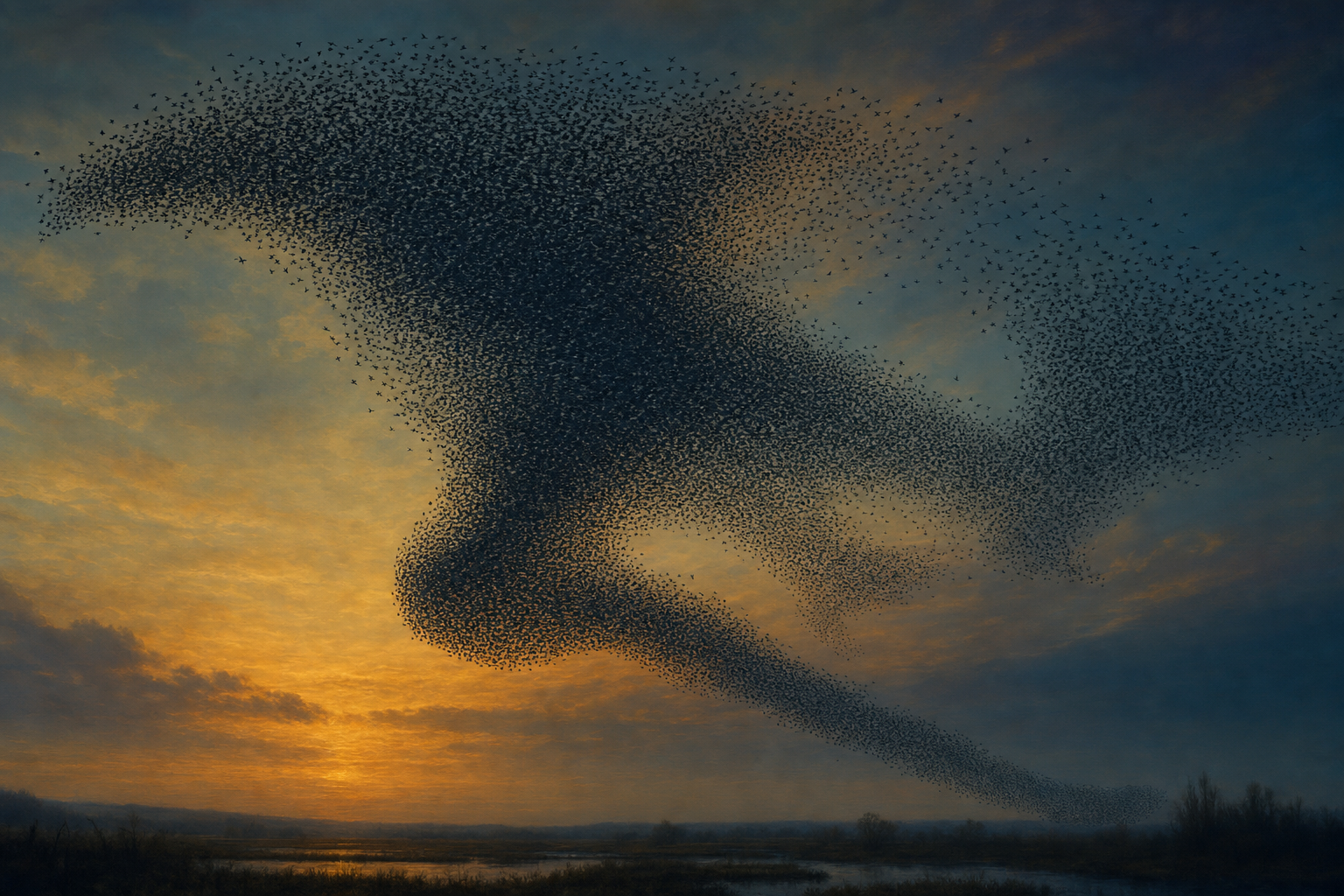
For three hundred and thirty-nine years, one rule has been the bedrock of physics. Every action has an equal and opposite reaction. Push on the world, and the world pushes back, exactly as hard. It is Isaac Newton's third law, and it has never been broken. Except that a flock of starlings appears to break it constantly. So does a swarm of bacteria, and a crowd of people, and the cells in your own body. And this month, physicists finally explained how, and found a whole new kind of physics hiding in the gap.
First, the law itself. Newton set it down in 1687, in the Principia: to every action there is always an equal and opposite reaction. It is why a gun recoils when it fires, why a rocket flies forward by throwing gas backward, why you cannot lift yourself off the ground by pulling on your own shoelaces. Beneath it sits one of the deepest principles in all of science, the conservation of momentum. For most of the universe, the dead and passive universe of billiard balls and planets and falling apples, the law is flawless.
But there were always hints of trouble at the edges. In the nineteenth century, physicists studying electricity found that two moving electric charges could push on each other with unequal force, an apparent violation of the third law. The puzzle was only resolved when they accepted something strange: that the invisible electromagnetic field between the charges carries momentum of its own. The books still balanced, but only if you counted the field as a player in the game.
The living world breaks the law far more brazenly. Picture a single starling inside one of those vast, swirling flocks. It watches the birds ahead of it and beside it, and adjusts to them. But it pays no attention to the birds behind it, the ones it cannot see, and those birds are busy reacting to it. So this bird influences the birds behind it far more than they influence it. Action and reaction are no longer balanced. Physicists call these one-sided interactions non-reciprocal, and once you start looking, they are everywhere life organizes itself: schools of fish, swarms of bacteria, flowing crowds, the cells knitting together in a healing wound or a growing tumour.
Now, this does not truly overturn physics. These flocks and swarms are open systems, constantly burning energy, and the momentum that seems to go missing leaks out into the surroundings. The universe still balances its books. But the effective forces between the individual agents really are one-sided, and that one-sidedness turned out to be fiendishly difficult to capture in the mathematics. It also produces genuinely new behaviour, strange travelling waves and self-organizing patterns that simply have no equivalent in ordinary, reciprocal, well-behaved matter.
And this month, June 2026, a team of physicists in Dresden, working with the theorist Roderich Moessner, published a way to finally tame it, in the journal Nature Physics. Their solution is elegant, and a little bit funny. To model a system in which the forces refuse to balance, they add what they call imaginary partners: mathematical phantom agents that restore, on paper, the hidden symmetry the real system lacks. With those ghosts added to the equations, they can simulate flocks and crowds and living tissues with an accuracy nobody could reach before.
This matters well beyond birdwatching. The physics of self-driven stuff, what researchers call active matter, is the physics of everything that moves under its own power: the swarming of cells as a wound heals or a cancer spreads, the surging of a panicked crowd through a stadium exit, the coordinated drift of a school of fish, even the design of swarms of tiny medical robots. Getting the mathematics of non-reciprocity right means getting all of that right.
But the deeper lesson is about the law itself. Newton's third law was never wrong. It simply has a kingdom, and that kingdom is the passive world, the world of objects that only ever react. The moment matter begins to drive itself, to consume energy and choose, in some primitive sense, where to go, the neat old symmetry quietly bends, and a richer and stranger set of rules takes over. The most fundamental law we have turns out to mark a border, and on the far side of it lies the physics of living things.
For more than three centuries we assumed the third law held everywhere. It turns out it stops, politely, at the edge of anything that can decide which way to face. The starlings were not defying Newton. They were showing us where his world ends and another one begins.