1878-79 Imperial Germany
The Marriage of Iron and Rye
Berlin, March 1878. Brussels, April 2026. The same letter.
Every day, we find the historical story hiding inside the headlines. Riveting narratives that connect the past to the present, and make you wonder what happens next.
You'll receive one email per topic, per day. Pick as many as you like.
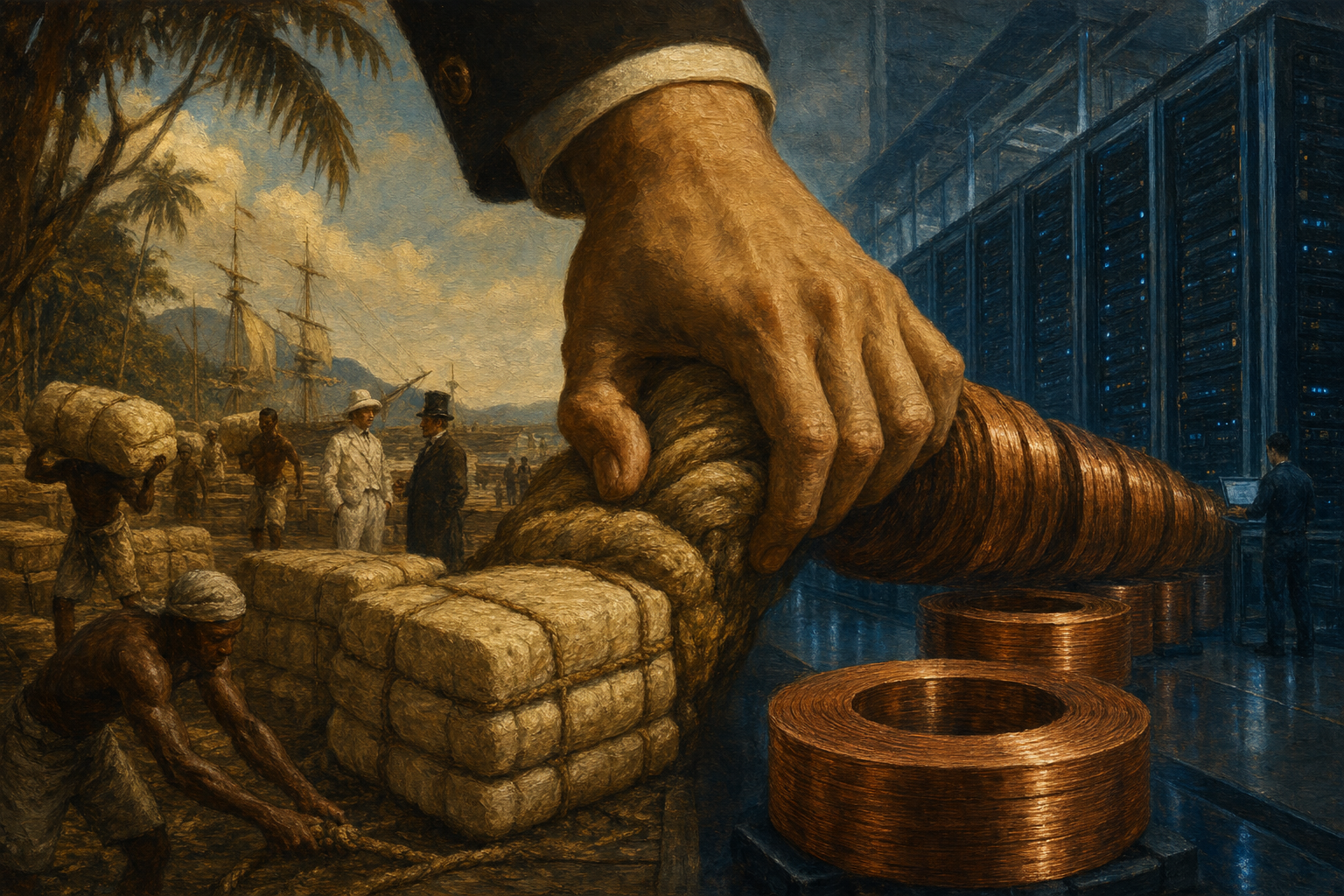
In 1925 the most valuable thing in America was a milky sap from trees on the far side of the world. Rubber ran every car, factory and phone line, Britain's colonies grew about three quarters of it, and Britain had just choked the supply: the Stevenson Plan restricted exports to drive the price from around thirteen cents a pound past a dollar. America, which bought most of the world's rubber, did not just pay. Commerce Secretary Herbert Hoover funded a global hunt for new supply, Harvey Firestone planted a million acres of Liberia, chemists chased synthetic rubber, and the cartel collapsed when the Dutch refused to join and flooded the market. Squeeze a customer hard enough and you do not make him pay; you teach him to never need you again. A century later it is copper for AI data centres and China's grip on rare earths, and the same scramble has begun.
Queen and worker bees hatch from identical eggs, yet one lives for years and lays a million eggs while the others live for weeks and never breed. For a century the textbook answer was a single food: royal jelly. In 2026 a team at UC Riverside showed the real answer is grander. Specialised worker bees build the queen a palace: a peanut-shaped 'royal crib' of custom wax with its own chemistry, and they cluster to keep it warm. Raise a would-be queen in ordinary wax instead and she develops poorly and often dies. The jelly feeds her; the crib crowns her. We love a story with one secret ingredient. Nature almost never works that way.
Berlin, March 1878. Brussels, April 2026. The same letter.
In 1229 a monk in Jerusalem scraped Archimedes off a parchment to make a prayer book. In 2005 a particle accelerator at Stanford read what he had erased. In 2026 the same machine read 66-million-year-old blood vessels inside a T. rex's broken rib.
In 421 BC Athens and Sparta agreed a peace that was supposed to last fifty years. It lasted eighteen months. The breathing room was used by both sides to make their next war worse. This week, eight years into a different total peace, dozens of bombings preceded a presidential election in Colombia.
In 1864 a Civil War physician at Turner's Lane Hospital in Philadelphia took seriously the pain his amputee patients reported in limbs that no longer existed. He coined the term phantom limb. He could not explain it. This week, in the Journal of Neuroscience, a team at the University of Colorado Boulder has found the brain circuit that does.
In June 1939 a British king ate his first hot dog at Hyde Park, three months before the world went to war. This week, his grandson is in Washington at another moment when London and Washington need to be photographed liking each other.
In August 1071 the Byzantine emperor brought a polyglot army to defend Anatolia. The hired half walked away the night before the battle. The empire never recovered. This week, a similar exit happened on a different continent.
In 1914 a public-health doctor named Joseph Goldberger figured out what pellagra was. It took twenty-three more years to discover what was missing. This week, after a century of antidepressants, scientists in Montreal pinpointed two specific brain cells that go wrong in major depression. The pattern is older than either disease.
In 1912 a German meteorologist proposed that the continents had once been joined and were drifting apart. The geological establishment ridiculed him for fifty years. He died alone on the Greenland ice cap in 1930. This week, in the place where humanity first stood up, scientists confirmed his prediction in real time.
Four hundred and four years ago this week, a Persian shah hired a Western fleet to break a Western tollkeeper's grip on the Strait of Hormuz. The strait is in the news again.
In October 1903 the New York Times said powered flight was a million years away. Sixty-nine days later, two bicycle mechanics proved them wrong. This week, a robot did it again.