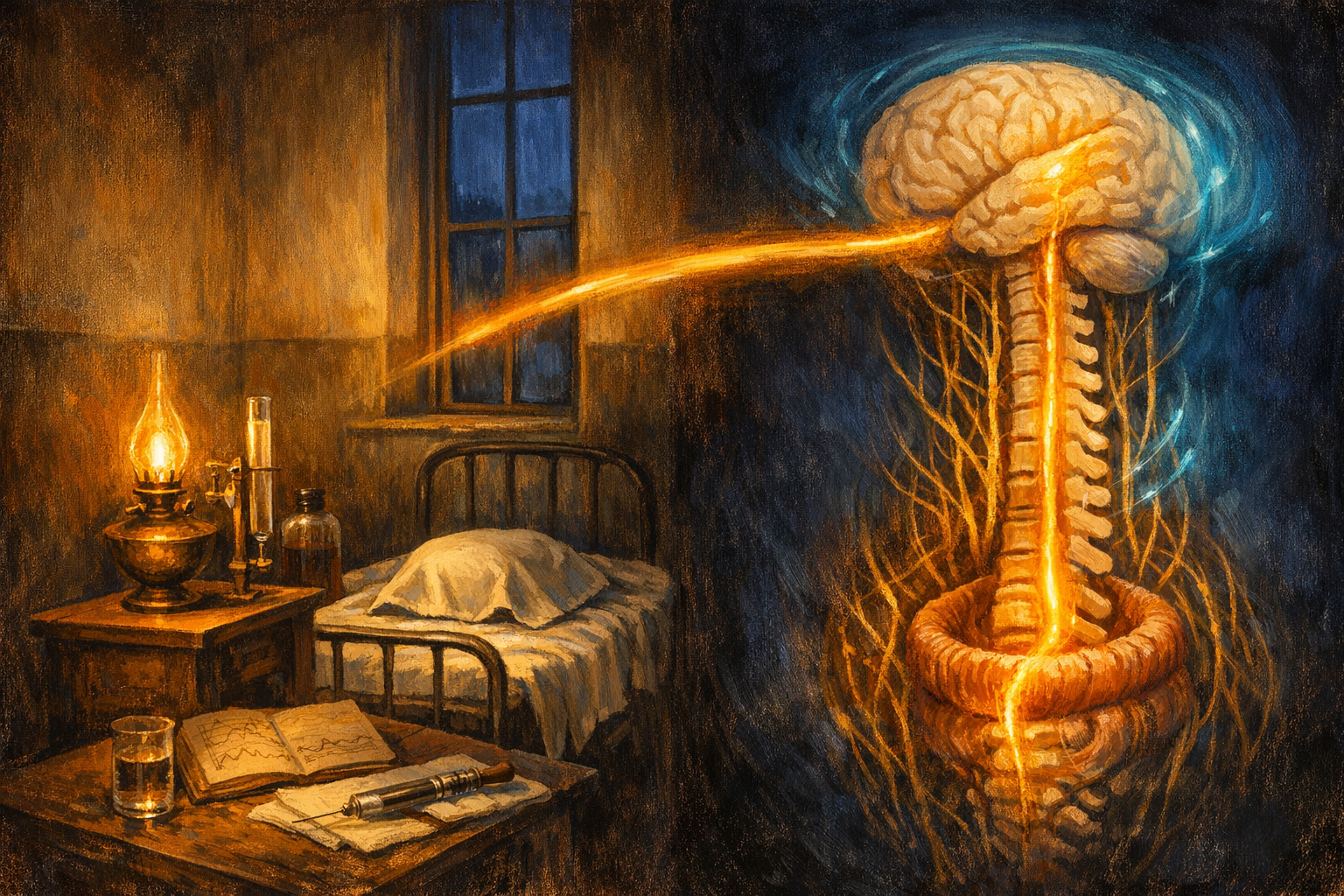
In a children's ward of the medical clinic at the University of Kiel, on a winter afternoon in 1888, a forty-six-year-old German physician named Heinrich Quincke leaned over the bed of a twelve-year-old boy with hydrocephalus. The boy's head was swollen with the fluid pressing his soft skull outward. He could no longer sit up. He drifted in and out of consciousness. The skull-and-needle treatment of the previous century, drilling a hole straight into the cranium, had killed more children than it had helped.
Quincke had been studying the cerebrospinal fluid in dogs for eight years. He had become convinced, against the medical orthodoxy of his time, that the fluid in the ventricles of a brain was continuous with the fluid in the spinal canal. If he was right, you did not need to drill the skull. You could reach the brain's pressure cooker through the spine.
He took a fine hollow needle from his bag and slipped it between the boy's third and fourth lumbar vertebrae. Clear fluid began to drip from the needle. He measured the column of liquid against a glass tube. The pressure was nearly twice normal. He let several teaspoons drain. The boy slept that night for the first time in a week.
Quincke had invented the lumbar puncture. He had also, almost incidentally, demonstrated something every neurologist takes for granted today: cerebrospinal fluid is not a still pond. It has pressure. The pressure varies. The fluid moves.
This is the story of how, for one hundred and thirty-five years after Quincke's needle, neurologists asked what made the fluid move, and how, last week, a postdoctoral researcher in Pennsylvania looked at a mouse and answered: the abdomen does.
The cerebrospinal fluid (CSF) had been quietly waiting for someone to notice it for almost the whole history of medicine. The Egyptian surgeon Imhotep, in the second millennium BC, had observed clear fluid leaking from broken skulls. The Venetian anatomist Niccolò Massa, in the sixteenth century, had described it as the watery part of the brain. But the rigorous demonstration that there is a continuous fluid filling the ventricles of the brain, the central canal of the spinal cord, and the subarachnoid spaces around both, came from Domenico Cotugno, a young anatomist in Naples, in 1764, in a small monograph titled De Ischiade Nervosa Commentarius. Cotugno performed his dissections vertically, with the cadaver upright, so the fluid did not drain out unobserved as it did in the customary supine position. He found a clear, water-like liquid filling the spaces around the brain and the spinal cord, in continuous communication. The fluid was, for a hundred years afterwards, called liquor cotunnii.
The French physiologist François Magendie, working at the Hôtel-Dieu in Paris in 1842, gave the fluid its modern name. Cerebrospinal fluid. He also showed, with a series of injections of coloured liquid into the cisterna magna of dogs, that the fluid circulated. It went somewhere. He could not say where, or why.
Quincke's lumbar puncture, in 1891, gave the rest of the medical profession the means to study the fluid in living humans. He published the technique in a paper titled Die lumbalpunction des hydrocephalus in 1891 and presented it at the Congress of Internal Medicine in Wiesbaden on the eighth of April that year. By 1900 the procedure was standard at every teaching hospital in Europe. By 2026 it is performed roughly five million times a year worldwide. Every neurologist in training does several. The CSF that drips from the patient's spine is sampled for protein, sugar, white cells, bacteria, viruses, oligoclonal bands. The pressure is measured. The fluid is precious.
What no neurologist could explain, in all that time, was what made it flow.
The candidate answers were many. The cardiac pulse: each heartbeat sends a small wave of arterial expansion through the brain, displacing CSF as it goes. True, but not enough. The respiratory cycle: the chest's expansion and contraction was thought to draw CSF up the spinal cord on inspiration. True, but not enough. The crucial discovery of the past decade was the glymphatic system, a network of perivascular channels around brain arteries that the Danish-American neuroscientist Maiken Nedergaard described in 2012. The glymphatic system, she showed, opens at night and washes the brain during sleep. True, but not enough.
Each was a partial answer. None was the answer. The brain has no lymphatic system in the conventional sense. It cannot drain itself. For waste to leave the brain, fluid must move through it; for fluid to move through it, something has to push.
On the twenty-seventh of April twenty twenty-six, in Nature Neuroscience, a postdoctoral researcher named Spencer Garborg in the laboratory of Patrick Drew at the Pennsylvania State University reported the missing piece. Drew is a professor of engineering science and mechanics, biology, and biomedical engineering at Penn State, with an affiliation to the Department of Neurosurgery. He runs his lab at the Huck Institutes of the Life Sciences. Garborg had spent two years using two-photon microscopy and microcomputed tomography to track the position of the brain inside the skull of a living mouse, second by second.
The brain rocks. Gently, but visibly. With every contraction of the abdominal muscles. With every step the mouse takes. With every deep breath. With every brace of the core before standing.
The mechanism is the vertebral venous plexus, a network of large valveless veins that connects the abdominal cavity to the spinal column and the cranium. The vertebral venous plexus has been known anatomically since the eighteenth century but has been treated for two hundred years as a passive conduit. It is not. When the abdominal muscles contract, they compress the inferior vena cava and push blood up into the vertebral venous plexus. The plexus, in turn, transmits the pressure to the spinal column. The spinal cord shifts a fraction of a millimetre. The brain, mechanically coupled to the cord, shifts with it. The cerebrospinal fluid, displaced, flows. The waste molecules, lifted by the flow, are washed out.
To verify the mechanism, Garborg lightly anaesthetised mice and applied a blood-pressure-cuff-style external pressure to the abdomen. The brain shifted. Without any movement of the body. Without any cardiac change. Without any breath. The abdomen was the pump.
The arc closes. Heinrich Quincke spent his career asking where the pump was. The answer, one hundred and thirty-five years later, was waiting in the same place his needle had pointed: in the patient's own body, contracting around the spine, with every step, every breath, every brace of the core.
Aristotle's school in Athens was called the peripatetic school because Aristotle taught while walking. Kant walked the same path through Königsberg every afternoon. Wordsworth composed poetry while walking the Lake District. Nietzsche, twenty-three years before his collapse, wrote that only thoughts conceived while walking have any value.
They were not being romantic. They were pumping their brains.
Quincke would, one suspects, have approved.