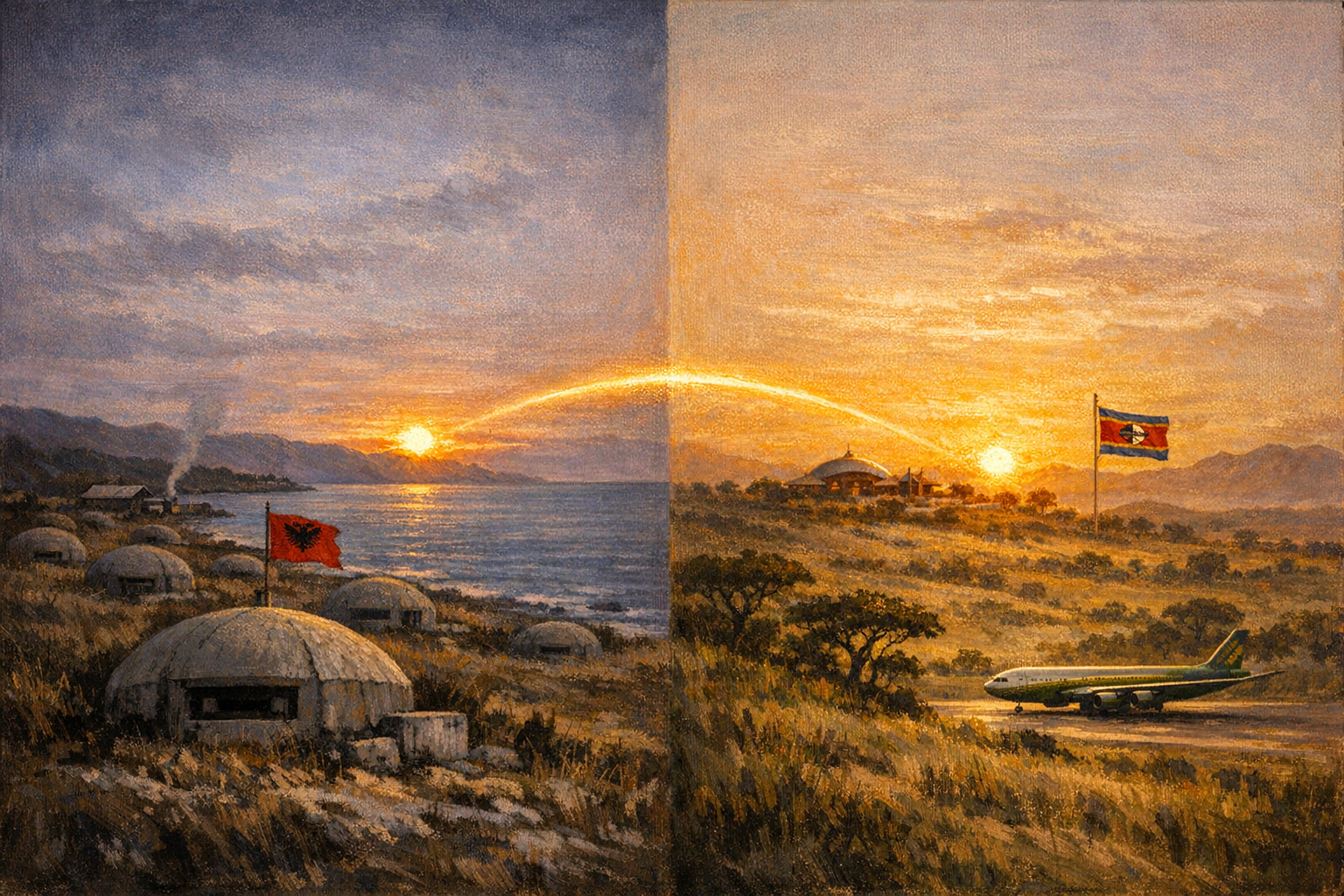
A few minutes after one in the afternoon on Tuesday 5 May 2026, three Taiwanese F-16V fighters lifted off from a coastal air base, climbed to thirty thousand feet over the Taiwan Strait, and turned south to meet a wide-body civilian airliner inbound from southern Africa. The airliner was an Airbus A340-300 belonging personally to King Mswati III of Eswatini. The aircraft had been built for the Taiwanese flag carrier China Airlines, delivered new to Taipei in 2001, flown for fourteen years on the Asia-Pacific routes, retired by China Airlines in 2015, and sold to the Kingdom of Eswatini in 2016 for around twelve million United States dollars. King Mswati had used it as his personal royal jet for the previous decade. On board now, on its return leg, was the President of Taiwan, Lai Ching-te, returning from the first overseas trip of his presidency. (Taiwan's government in Taipei still uses, as its formal legal name, the Republic of China; it is the same Republic of China that lost its United Nations seat to the People's Republic in 1971.)
The plane that brought him home was, in a sense, also coming home.
The F-16Vs formed up on the airliner's wingtips, escorted it through Taiwan's air-defence identification zone, and brought it home.
The optics were the entire point. Lai was supposed to have flown out of Taipei the previous Wednesday. Three Indian Ocean countries had, the day before his departure, withdrawn the overflight clearances they had previously granted Taiwan. The reason given was either weather or scheduling, depending on the country. The actual reason, according to the Taiwanese foreign ministry, was that the People's Republic of China had asked them to revoke the clearances and they had complied. Lai had been forced to fly south on a longer route: down through southeast Asia, across the Indian Ocean, into southern Africa from the east. King Mswati had sent his own aircraft to pick the President up.
Lai's destination was the fortieth-anniversary celebration of King Mswati III's accession to the throne of Eswatini. His purpose was to be photographed there.
Eswatini is the only country on the African continent that still recognises Taiwan (under its formal name the Republic of China) as the legitimate government of China. The Kingdom of Eswatini and Taiwan have maintained formal diplomatic relations since 16 September 1968, the year Eswatini (then Swaziland) became independent from Britain, and the year before Taiwan's expulsion from the United Nations. Fifty-eight years on, twelve countries still recognise Taiwan: the Vatican, eleven small states scattered across the Caribbean, Central America, the Pacific, and southern Africa. Eswatini is the African one.
The relationship has not been quiet for some time. The People's Republic has been applying pressure to Eswatini for decades: through visa restrictions on Swazi citizens, through diplomatic isolation in African Union forums, through targeted economic offers to specific ministers and ministries. Burkina Faso, the previous African holdout, flipped to Beijing in May 2018. Solomon Islands and Kiribati flipped in 2019. Nicaragua flipped in 2021. Honduras flipped in 2023. Eswatini has not flipped.
The reason it has not flipped is not heroic. It is mechanical. King Mswati III is the absolute monarch of a small kingdom of one and a quarter million people. He owns the airline. He chairs the parliamentary council. The Taiwanese aid programme has been continuous since 1968: agricultural extension, irrigation engineering, scholarships at Taiwanese universities, a teaching hospital outside Mbabane staffed by Taiwanese physicians. None of this is decisive on its own. What makes it decisive is that there is no domestic interest group inside Eswatini that benefits from a flip to Beijing. The Chinese investment offer, when it arrives in Mbabane, has nowhere productive to land. So it does not.
That is the situation Lai flew out to celebrate, and the situation King Mswati flew his own aircraft north to escort.
It is a familiar position.
There has always been one small country, somewhere in the world, that does the rhetorical and procedural work for a giant patron that the patron cannot quite do for itself. The American legal status of the People's Republic of China inside the United Nations, for example, is the work of one very small, very poor European country in the autumn of 1971.
In the early 1960s the Albanian First Secretary Enver Hoxha, who had governed Albania since 1944 with the personal blessing of Stalin, decided that he could no longer live with Nikita Khrushchev. The point of crisis, in Hoxha's mind, was Khrushchev's reconciliation with Tito's Yugoslavia after 1955: Tito was, in the Albanian reading, a Western traitor, and Khrushchev's openness to him was proof that Moscow had abandoned the revolution. By the end of 1961, Albania had broken with the Soviet Union. Hoxha withdrew his diplomats from Moscow. Khrushchev cancelled all Soviet aid. Soviet engineers and technicians left Tirana within months.
Albania did not have anywhere else to go. Its eastern frontier abutted the Warsaw Pact. Its western coast looked across the Adriatic at NATO. Its northern frontier was Yugoslavia, the heretic. Its only remaining sympathiser was the People's Republic of China, which had broken with Khrushchev for its own reasons over the same period.
For the next seventeen years, the People's Republic of China and the People's Socialist Republic of Albania ran what was, at its founding, the strangest alliance in the world: a small Balkan country of two million people on the Adriatic, locked into ideological lockstep with a continental civilisation of nine hundred million on the other side of Asia. Mao Zedong called Albania "a great beacon of socialism in Europe." Beijing built Albania's chrome refineries, its hydro-electric plants, the Kombinat Metalurgjik at Elbasan, and most of the apartment blocks of suburban Tirana.
Albania paid back the favour at the United Nations.
On 25 September 1971, the Albanian delegation at the United Nations was the lead sponsor of a draft resolution co-sponsored by twenty-three states (including a handful of Beijing's African and Caribbean clients) calling for "the restoration of the lawful rights of the People's Republic of China in the United Nations." The resolution was numbered A/L.630. It came to a roll-call vote on the General Assembly floor on 25 October 1971. Seventy-six countries voted in favour. Thirty-five voted against. Seventeen abstained.
Taiwan's delegation walked out of the General Assembly hall before the result was formally announced. By 15 November 1971 the People's Republic of China was sitting in the seat. The vote is referenced today, by the Beijing foreign ministry, as the legal basis for the One-China principle in international affairs. It is known formally as Resolution 2758 (XXVI).
Resolution 2758 was Albania's resolution. It was the work of perhaps a dozen Albanian officials in New York, on a budget that probably did not exceed a few thousand US dollars, in service of a Chinese diplomatic priority that Beijing would not have been able to drive itself from outside the chamber.
Beijing repaid the work. Between 1967 and 1985 China financed and equipped the Albanian government's policy of "bunkerisation": the construction across Albania of more than seven hundred thousand reinforced concrete fortifications, designed to fight a defensive war against any combination of NATO, the Warsaw Pact, and Yugoslavia. The bunkers ate, at peak years, around twenty percent of Albanian GDP. They cost, in real terms, twice as much as the French Maginot Line. None of them was ever used in combat.
The bunkers existed because the alliance existed.
The alliance ended on 7 July 1978 when the Chinese government formally cut all economic and military aid to Albania. The trigger had not been Soviet pressure, or Yugoslav revisionism, or any of the crises Hoxha had spent two decades preparing for. The trigger had been Beijing's pivot: Richard Nixon's visit to Beijing on 21 February 1972, the death of Mao Zedong on 9 September 1976, the rise of Deng Xiaoping to effective leadership in late 1978, and the Chinese decision that the relationship with the United States now mattered more than ideological purity. Albania was unceremoniously discarded as a relic of Mao's late and embarrassing romanticism.
Hoxha did not flip. He turned even further inward, declared Albania the only true socialist state on Earth, and ruled an increasingly hungry country alone until his death in April 1985. By the early 1990s the Communist Party had collapsed. The bunkers, all 700,000 of them, are still standing in the fields and on the beaches of contemporary Albania. They are now used as small holiday cottages, mushroom-growing sheds, and graffiti canvases. They are the most visible legacy of the seventeen-year alliance.
The lesson Albania left behind is a structural one. When a small state ties its diplomatic identity to a giant patron, the relationship survives the rival's pressure. It does not survive the patron's pivot. The threat to a small ideologically-aligned client state does not come from the larger neighbour or rival ideology. It comes from the patron's own change of mind.
The Echo
King Mswati III's Airbus A340 landed at Taoyuan International Airport at half past one in the afternoon, three F-16Vs in formation. President Lai descended the steps, posed for the photographs, and went back to work.
The pressure on Eswatini from the People's Republic of China is real and continuous. Beijing has revoked overflight clearances, restricted Swazi visas, and made clear that diplomatic recognition of Taiwan is incompatible with full participation in the African Union's emerging economic architecture. Mswati has held the line.
What Mswati cannot affect is the politics inside Taiwan itself.
Taiwan has, for most of its history, treated diplomatic recognition of Taipei as a matter of existential identity. Twelve allies are not many, but twelve allies are enough to keep the government in Taipei a state under international law. The risk to Eswatini is not the obvious one. It is the deeper one. If the political consensus in Taiwan ever shifts toward formal accommodation with Beijing, or toward a managed reunification, or toward the abandonment of the diplomatic-recognition strategy in favour of de facto presence at the WHO and the WTO, then Mbabane will find itself holding open a door that no longer leads anywhere.
Albania survived the Soviets. Albania survived Yugoslavia. Albania survived NATO. What Albania did not survive was Beijing's decision, in 1978, that the United States was now more useful as a partner than the Adriatic was as a beacon.
Last time, the smallest ally was abandoned by its own patron, not by its rival.
Eswatini's bunkers are not concrete. They are the diplomatic recognition of a state of twenty-three million people on a different continent. They are doing exactly what Albania's were doing in 1971: holding open a door for someone larger.
This time, what comes next?