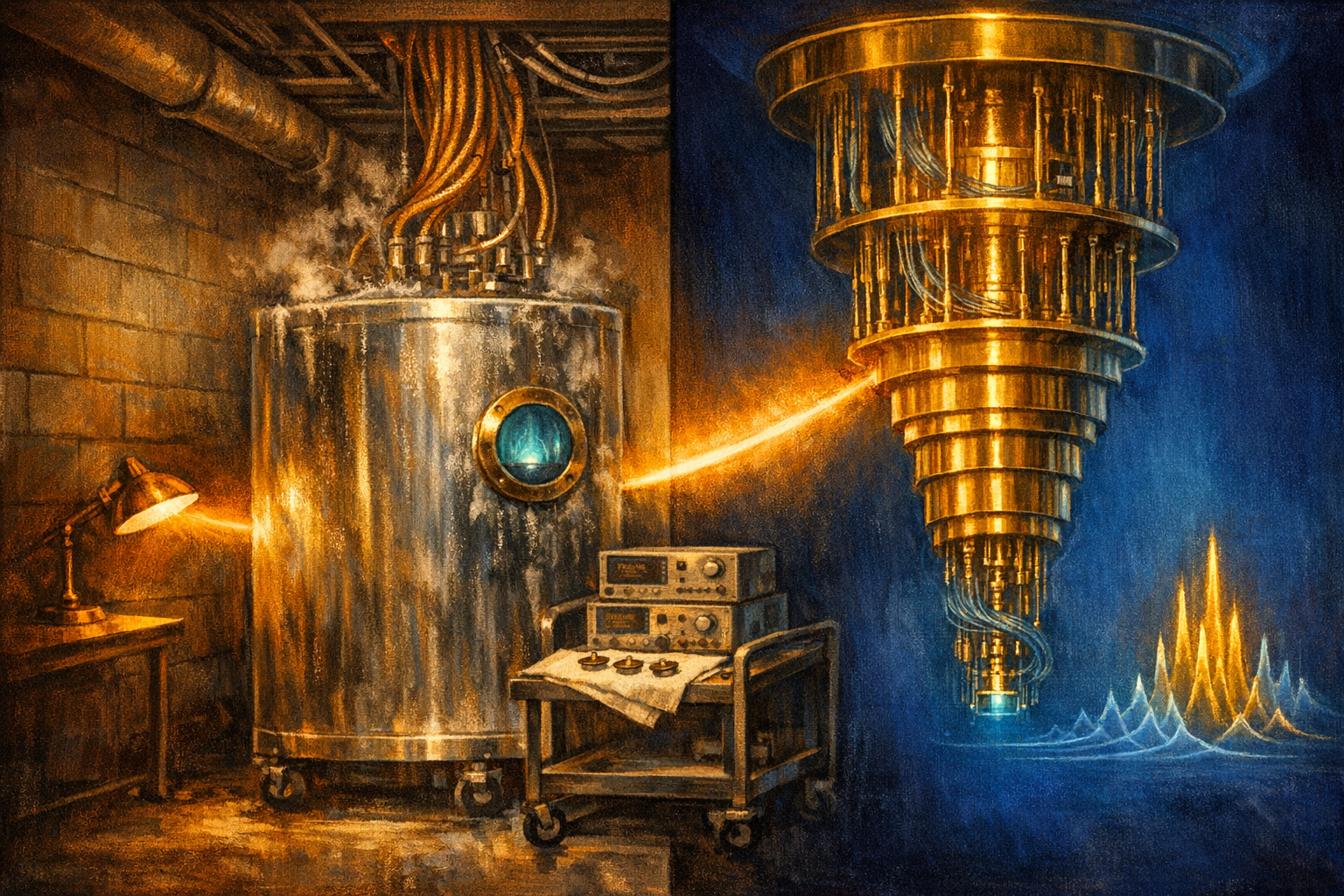
In a low-ceilinged basement laboratory at the Thomas J. Watson Research Center in Yorktown Heights, New York, on a winter afternoon in early 1980, the IBM physicist Wilhelm Anacker stood in front of a refrigerator-sized cryostat. Inside, at four degrees above absolute zero, a small chip of niobium-aluminium oxide circuits was supposed to be switching faster than any silicon transistor on Earth.
Anacker had been managing IBM's Josephson Computer Technology project for over a decade. The goal of the project, as IBM understood it, was to build the world's fastest general-purpose computer.
The chips were Josephson junctions. The effect they used had been predicted in 1962 by a twenty-two-year-old Cambridge graduate student named Brian Josephson, who proposed that a thin insulating barrier between two superconductors would allow electron pairs to tunnel through it without resistance. Josephson won the Nobel Prize in Physics for the prediction in 1973. The junction switched in picoseconds. It dissipated almost no heat. On paper, it was the perfect computing element.
In practice, it had to live at four kelvin. The cryostat that held Anacker's chip was a refrigerator. The next-generation prototype machine the project was working toward in 1980 would have been roughly the size of a Volkswagen, with most of that volume devoted to keeping the actual computing element cold.
This is the story of why IBM cancelled the project in 1983, and why, almost exactly forty-three years later, the same kind of cryostat in the same kind of laboratory just produced what the people who built it are calling the first practical demonstration that a quantum computer can beat a classical one on a useful problem.
IBM's Josephson programme had been running since 1967. By 1983 it had cost about three hundred million dollars in then-money and employed more than a hundred researchers across Yorktown, Zurich, and Tokyo. Juri Matisoo had demonstrated subnanosecond Josephson logic at IBM in 1966. Wilhelm Anacker had taken over the engineering effort in 1969. The roadmap, repeatedly published in the IBM Journal of Research and Development, was for a complete cryogenic mainframe by the late 1980s.
The bottleneck, fatally, was the memory.
The Josephson logic worked. The Josephson memory cells did not, at least not at the densities and reliabilities that a useful computer needed. Each cell was a tiny superconducting loop and behaved well in isolation; in dense arrays, the loops trapped stray flux and lost their state. By 1982 IBM had been chasing the memory problem for a decade and the projected delivery date for a working machine had slipped past the projected delivery date for the silicon machine that would render it obsolete.
In September 1983 IBM cancelled the project. The journal Science reported the decision under the headline "IBM Drops Superconducting Computer Project: Problems with a high-speed memory chip would delay a Josephson junction computer long enough for semiconductors to catch up." The Yorktown laboratory was reassigned. Anacker continued to publish from IBM Research, but on different topics. Most of the team moved on. The Japanese government, which had been watching closely, picked up the work. The bulk of the field went quiet.
Silicon had won.
In the late 1990s a handful of physicists at Yale, Delft, Saclay, and a few other places began to do something strange with Josephson junctions. They did not try to use them for classical computing. They tried to use them for quantum computing.
The idea was Richard Feynman's, from a 1982 lecture, and David Deutsch's, from a 1985 paper. A computer that used quantum superposition and entanglement, instead of classical zeros and ones, ought to be able to simulate quantum systems exponentially faster than any classical machine could. By 2000 the theory was clear. The hardware was missing.
The Yale group around Robert Schoelkopf and Michel Devoret showed that a Josephson junction with a particular set of capacitances could behave, under certain conditions, as a quantum two-level system. The "transmon" qubit, named in 2007, was the result. By 2014 transmons could be wired together into small processors. By 2019 Google's Sycamore demonstrated, controversially, that a 53-qubit transmon array could perform a specific contrived task no classical supercomputer could match in any reasonable time.
The cryostats had got colder. The refrigerator that held a transmon chip ran at fifteen millikelvin, two thousand times colder than Anacker's 1980 cryostat. The chips were still Josephson junctions. The labs were still, in many cases, Yorktown.
On the sixth of May twenty twenty-six, the Sydney-based quantum-control company Q-CTRL announced that, working on an IBM 120-qubit superconducting quantum processor and using its own error-suppression software, it had simulated a non-trivial Fermi-Hubbard model in two minutes. The same simulation had taken more than a hundred hours on the best available classical methods running on a contemporary supercomputer. The speed-up was approximately three thousand times.
The Fermi-Hubbard model is the physicists' standard theoretical description of how electrons interact in materials. It is the heart of any attempt to understand high-temperature superconductors, transition-metal oxides, or the catalysts in a lithium-ion battery. The model is, deliberately, easy to write down and brutally hard to solve. Q-CTRL described the result as the first demonstration of practical quantum advantage on a problem of real industrial value.
The platform on which they did it was a fleet of IBM superconducting processors. Each processor sat inside a dilution refrigerator at fifteen millikelvin. The active elements on the chip were Josephson junctions in niobium and aluminium. The senior author of the IBM hardware, in many of the relevant papers, works in the same building Wilhelm Anacker did.
The arc closes. IBM was right in 1983 that silicon would win the classical-computing race. It was wrong that this meant Josephson junctions had no future. The architecture had been holding the correct answer for the wrong question. It just had to wait forty-three years for the question to be asked.
The cryostats came back. Wilhelm Anacker, who chased them through fourteen years of memory chips that never quite worked, would, one suspects, have approved.