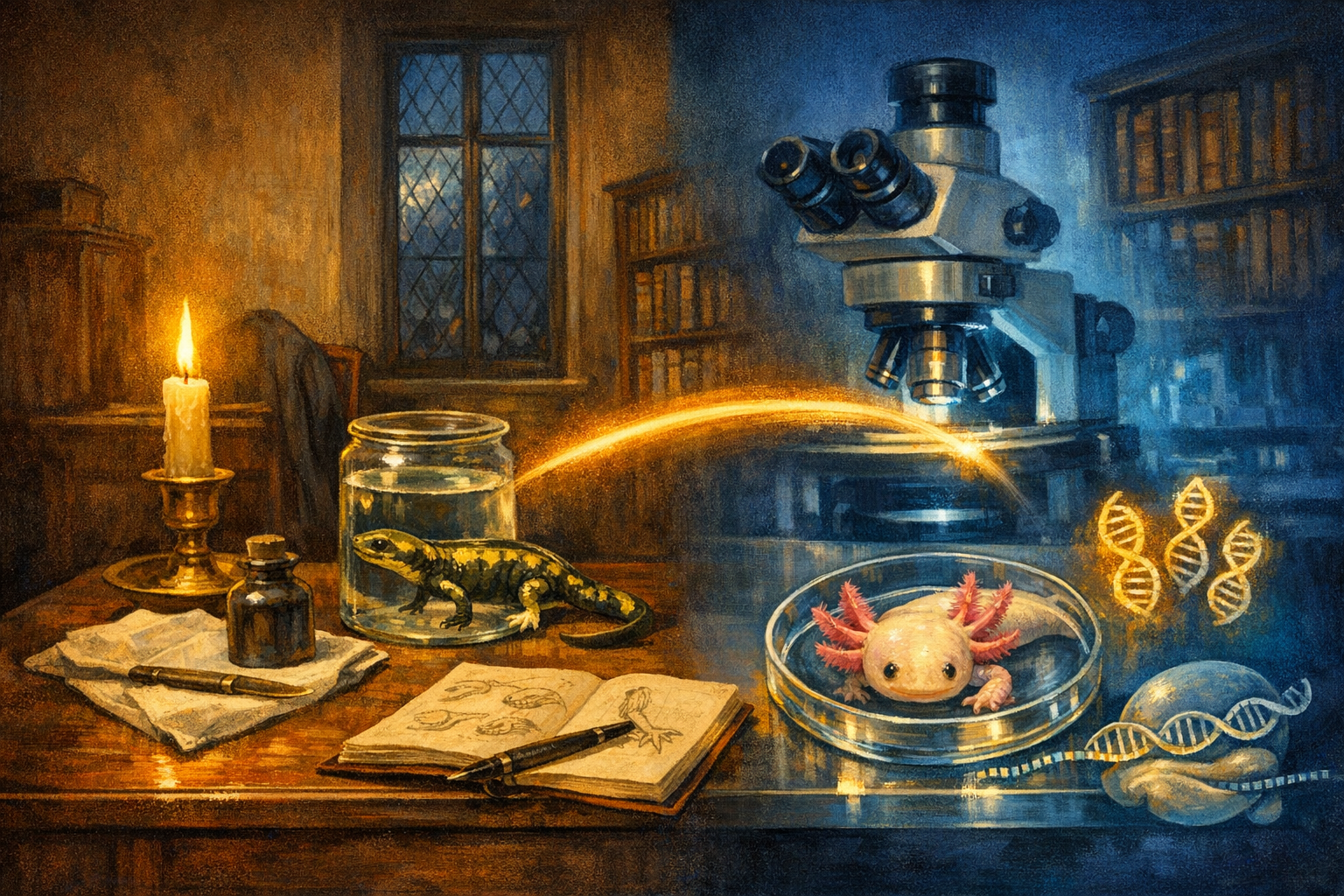
In a high-ceilinged study at the Università di Pavia, on a cool October afternoon in 1768, the Italian priest and natural philosopher Lazzaro Spallanzani lifted a small terrestrial salamander out of a glass jar of water and set it on a tray on his desk. Six weeks earlier he had carefully amputated its right hind leg.
The leg was back. Skin, muscle, bone, tendon, the small black-and-yellow toe pads, all of it. The animal was apparently unbothered.
Spallanzani had performed the same operation on dozens of newts, frogs and tadpoles. Most regrew the missing parts; some did so several times in succession when he kept removing them. He was thirty-nine years old, a tonsured priest with a sharp pen and a habit of testing things, and he was about to publish a small pamphlet titled Prodromo di un opera da imprimersi sopra le riproduzioni animali. The pamphlet contained the first systematic experimental demonstration that vertebrates could regrow limbs.
It also contained the question that has, in one form or another, shadowed regenerative medicine for the next two hundred and fifty-eight years.
Why us, and not them? Why does a salamander regrow a leg, and a man does not?
Aristotle had noticed something like this with lizard tails around 340 BC. Spallanzani made it scientific. He showed the regrowth was complete, repeatable, bilateral, and that it occurred in adult animals as well as juveniles. He performed the equivalent of careful surgical experiments long before the language of biology had words for what he was watching. The pamphlet circulated in Italian, French and English. The question went into the long file of biological mysteries that the field would eventually need a molecular vocabulary to answer.
It took the field a while.
The Mexican axolotl, the salamander that has become the iconic regeneration model, did not arrive in Europe until 1864, when Auguste Duméril at the Paris Museum bred the first captive colony from a small shipment from a lake bed near Mexico City. The axolotl regrows limbs, tails, jaws, sections of spinal cord, parts of its retina and parts of its heart. It does so as an adult. It does it again, dozens of times, in the same individual.
By the late twentieth century the field had grown. Zebrafish were shown to regrow fins and to regenerate damaged cardiac tissue. Mexican axolotls were sequenced in 2018, revealing a genome ten times the size of the human one and full of duplicated developmental genes. Mammalian fingertips were shown to regrow, partially, in young children when the wound is left to heal naturally. Mice, surprisingly, regenerate parts of their toes.
The hypothesis took shape: maybe mammals had not lost the regenerative machinery. Maybe they had simply stopped switching it on.
If so, the question Spallanzani asked in 1768 became answerable in principle. You only had to find the switches.
This is the story of how, last week, three separate laboratories on two continents put their data side by side and found two switches that all three species share, and showed that turning them on partially restores regeneration in mice.
Josh Currie at Wake Forest University in North Carolina has spent his career on the Mexican axolotl. David A. Brown, a plastic surgeon at Duke, has spent his on the partial digit regeneration that occurs in adult mice. Kenneth D. Poss at the University of Wisconsin-Madison has spent his on the zebrafish, which regrows pectoral fins, caudal fins, and parts of its heart. The three laboratories have, for years, been cataloguing the genes their respective animals turn on at the wound site immediately after amputation.
When they laid the lists alongside one another, two genes appeared in all three. Not in the dorsal muscle of the wound, or in the bone, but in the regenerating skin: the layer that closes over the stump within the first hours of injury. The two genes are called SP6 and SP8. They encode transcription factors, regulatory proteins that turn other genes on and off. They were already known to be involved in the development of fingers and toes in the embryo. They had not been known to play a role in adult regeneration.
The team disabled SP8 in axolotls. The animal still healed the wound, but the bone underneath did not regrow. They disabled both SP6 and SP8 in mice. The fingertip closed normally, but the small bone that mice can ordinarily regenerate did not. Then they did the more interesting experiment. They borrowed a regulatory pattern from the zebrafish and used a gene therapy to put SP6 and SP8 into a slightly different on-state in adult mouse fingertips. Partial regeneration returned. Not a full finger. Not Spallanzani's salamander. But more than the mouse would have done unaided.
The paper appeared in the Proceedings of the National Academy of Sciences in mid-April 2026, with the broader scientific press picking it up through May. The result is not a clinical therapy. The result is the first molecular ingredient in an answer to the question Spallanzani put on paper in 1768.
The conserved toolkit is in us. The salamander has it. The zebrafish has it. The mouse has it. The human almost certainly has it. The question is no longer whether the genes exist; the question is what mammals do, in their normal development, to keep these particular switches off.
The arc closes. Spallanzani thought regeneration was a property of certain animals and not of others. The 2026 work suggests it is a property of certain wound-response programmes that some animals use and others have stopped using. Whether the switch can be safely flipped in adult humans is the work of the next several decades. The molecular biologists doing it now are working on a question raised by an Italian priest who was, at the time he raised it, also writing about why bats can fly in the dark.
Spallanzani figured out the bats twenty-five years later, in 1793, with help from Louis Jurine of Geneva. He had suspected the bats were using their ears, and he was right. The reply on the salamanders is taking longer.
He would, one suspects, have rather enjoyed the news.