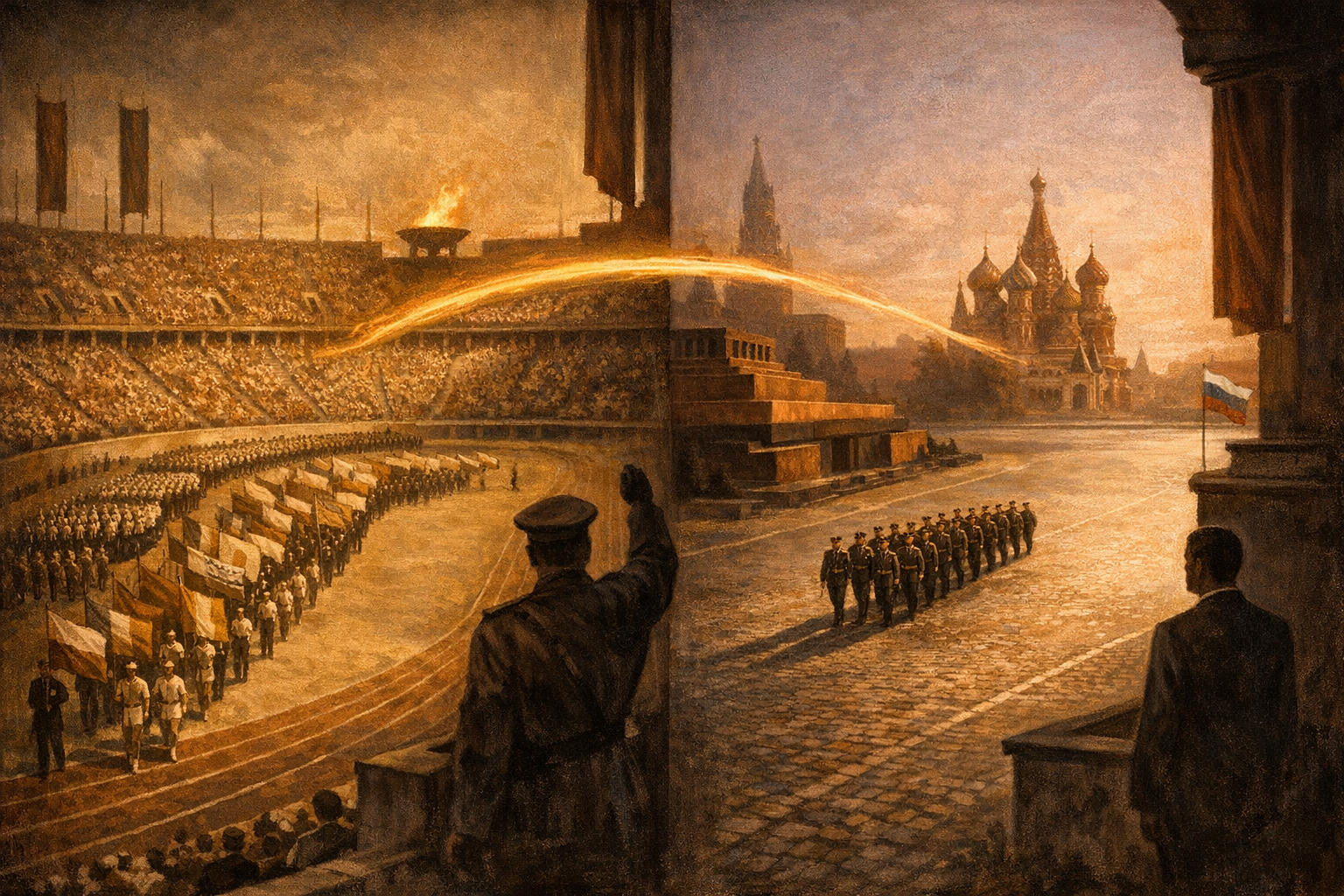
On the morning of 9 May 2026, Vladimir Putin walked out onto Red Square to review the smallest Russian Victory Day parade of his twenty-six years in power. There was no military hardware on display. No tanks, no missile launchers, no jets overhead. It was the first such parade in nearly two decades. The reviewing stand held five foreign leaders: the king of Malaysia, the presidents of Laos, Kazakhstan and Uzbekistan, and Belarus's Aleksandr Lukashenko. A year earlier the same stand had held Xi Jinping and twenty-six other heads of state, with eleven and a half thousand troops marching past and a Chinese People's Liberation Army honour guard. The parade was possible because Donald Trump had announced the night before, from the Oval Office, a three-day ceasefire between Russia and Ukraine running from 9 to 11 May, with a thousand-for-thousand prisoner exchange. The ceasefire bracketed the parade.
The convention being honoured had originated in Greece in the ninth century BC. Three kings, Iphitos of Elis, Cleisthenes of Pisa and Lycurgus of Sparta, signed a treaty inscribed on a bronze discus and stored at the temple of Hera at Olympia. The treaty established the ekecheiria, the Olympic truce. From seven days before the Olympic Games to seven days after, all war among Greek city-states was suspended. The treaty had teeth. The Spartans were once fined two thousand minae for assaulting the small city of Lepreum during the truce period. The convention was honoured, with rare violations, for over a thousand years. The last ancient Olympic Games were held in 393 AD. The Roman emperor Theodosius I abolished the festival as part of his suppression of pagan worship.
On the morning of 1 August 1936, Adolf Hitler walked into the new Berlin Olympic Stadium. Forty-nine national flags lined the stands. Forty-nine national teams marched past the dictator. It was the largest Games in Olympic history. Hitler's opening speech had been written for him, sentence by sentence, by the IOC President Henri de Baillet-Latour, a Belgian count who had threatened to move the Games elsewhere if Hitler turned the speech into a propaganda address. The president of the German organising committee was Theodor Lewald, who was half-Jewish. He had been retained only because Baillet-Latour had told Berlin that the IOC would move the Games elsewhere if Lewald were dismissed.
The Olympic flame arrived in the stadium that evening. Carl Diem, the chief Berlin organiser, had invented a new ritual for the occasion: a torch lit from the sun's rays at Olympia and carried by relay through Greece, Bulgaria, Yugoslavia, Hungary, Austria and Czechoslovakia to Berlin. Three thousand runners. Two thousand miles. The first Olympic torch relay. Goebbels filmed everything. The pageantry, in classical form, was Diem's idea; the political utility was Goebbels's.
The Olympic Truce concept had been invoked. The international Olympic movement, unable to retract its 1931 award of the Games to Berlin, had compromised: Hitler would tone down the public antisemitism for the duration of the Games, and in exchange the world would attend. Hitler complied. The yellow-and-black signs reading Juden Verboten outside Berlin's parks, public swimming pools and shop windows had been quietly removed for the duration. Anti-Jewish newspaper material was suppressed. The street violence of the SA was kept out of the foreign press's view.
The world attended. Forty-nine national teams, more than any previous Games. Tens of thousands of foreign tourists. The American team, despite a vigorous boycott campaign at home, sailed for Bremen with the African American track star Jesse Owens on board. The Spanish Civil War had broken out fifteen days earlier, on 17 July 1936. The People's Olympiad in Barcelona, planned for 19 July as an anti-fascist counter-Olympics, had collapsed when the Nationalist coup arrived in the city. Athletes who had travelled to Barcelona to boycott Berlin found themselves with no Games to attend. Berlin opened on schedule.
For sixteen days Berlin was a city of flags and athletic spectacle. Owens won four golds. Hitler reviewed the parades. The IOC declared the Games a triumph. Leni Riefenstahl filmed everything and turned it into Olympia, the most ambitious documentary film ever made.
The closing ceremony was held on 16 August 1936. The flags came down. The next morning the Juden Verboten signs went back up across Berlin.
Three years and sixteen days later, on 1 September 1939, Germany invaded Poland.
At 1000 hours Moscow time on 9 May 2026, ten hours after the start of a US-brokered ceasefire, Putin walked across Red Square. The IOC had compromised with Hitler in 1936 because it could not retract a 1931 award to Berlin. Donald Trump had compromised with Putin in 2026 because the alternative was a Victory Day disrupted by Ukrainian drone strikes that would humiliate the Russian president on his most symbolic day of the year. The compromise produced the spectacle the autocrat wanted, on terms set by an outside power, in exchange for nothing more than a temporary pause.
Putin told the crowd he believed the war was nearing its end. At the close of 11 May, with the foreign delegations already on their flights home, the ceasefire would expire and the Russian strikes against Ukrainian cities would resume.
Hitler's compromise in 1936 lasted sixteen days. Putin's lasted three. Both produced exactly what was bargained for. The Olympic Truce in 1936 did not delay the war by an hour. The May 9 ceasefire in 2026 did not change the trajectory of any front in Ukraine.
The ekecheiria the three Greek kings signed in the ninth century BC suspended war so athletes could travel. Hitler used it for forty-nine flags. Putin used it for one parade with no tanks. The truce shrinks each time. The thing it brackets does not.