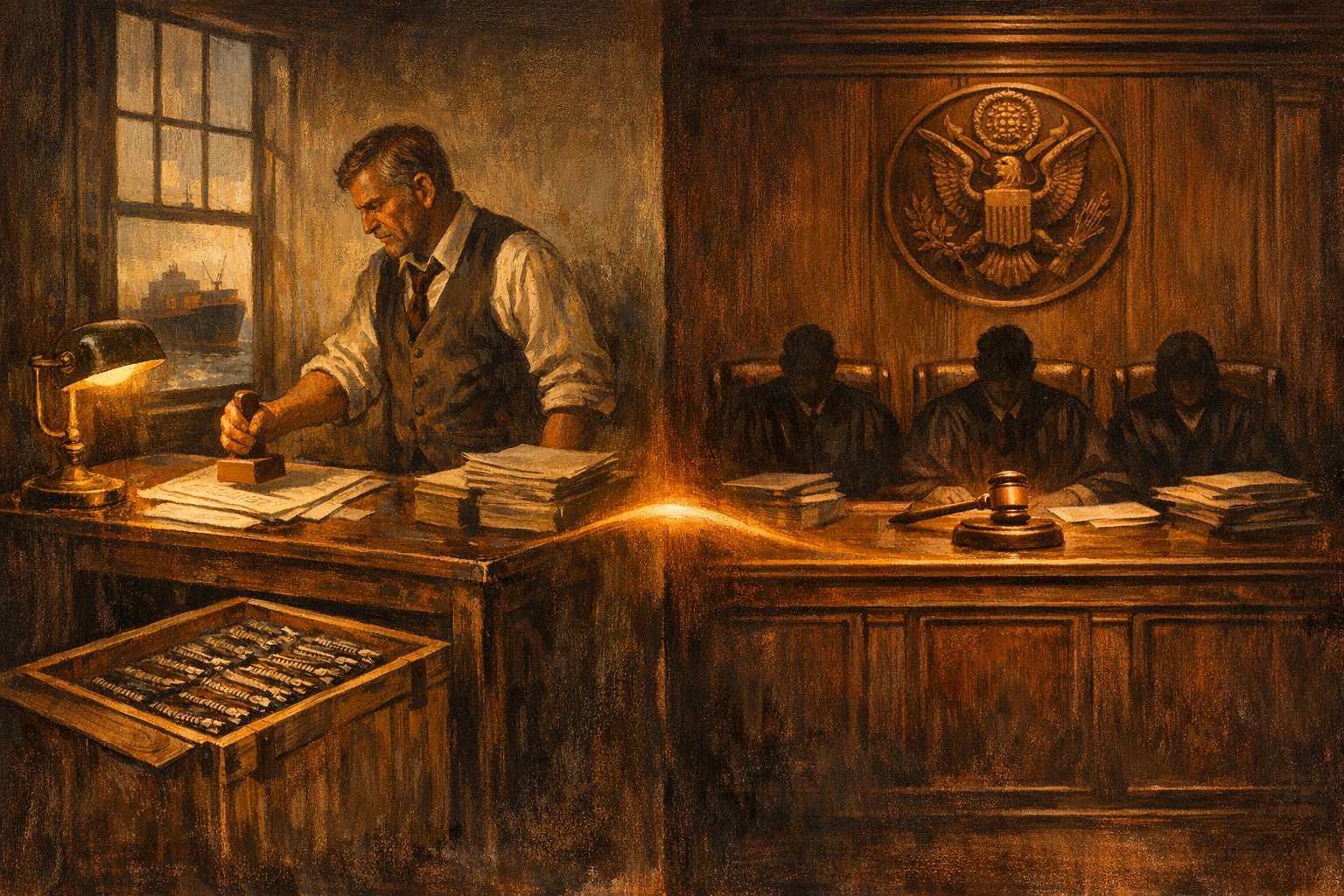
On the morning of 17 August 1971, a customs officer at the port of New York stamped a shipment of metal zippers from Yokohama. The zippers belonged to Yoshida Kogyo K.K., better known by the three letters embossed on the back of every pair of jeans you have ever owned: YKK. The customs officer charged a 10 percent surcharge that Richard Nixon had announced from the Oval Office two nights earlier. YKK paid. Then it sued. The case it filed, Yoshida International v. United States, would crawl through the courts for four years, and its final paragraph would sit in legal silence for half a century before, on 7 May 2026, it returned to strike down a tariff for the second time.
The story begins on a Friday afternoon at Camp David. On 13 August 1971, Nixon helicoptered out of Washington with his senior economic team. The retreat was kept strictly secret. No press, no calls out, no aides who were not in the room. Treasury Secretary John Connally, the silver-haired three-term governor of Texas who had survived being shot in the front seat of John F. Kennedy's limousine in Dallas eight years earlier, had a list of demands. He wanted Nixon to close the gold window, ending foreign governments' ability to redeem their dollar holdings for American gold at the Bretton Woods rate of 35 dollars an ounce. He wanted a 90-day freeze on wages and prices, the first peacetime wage controls in American history. And he wanted a 10 percent surcharge on every dutiable import. By Sunday night the three policies had a name. The Nixon Shock.
At nine in the evening on 15 August 1971, Nixon went on television and explained. The gold window was closed. Wages and prices were frozen for ninety days. And the 10 percent surcharge, the president told the country, would remain until "the unfair treatment" of American products had ended. Four months later, Connally would put the same point more bluntly at the G-10 finance ministers' meeting in Rome. "The dollar is our currency," he told his European counterparts, "but it is your problem."
Tokyo's market opened that Monday morning to a freefall. The Nikkei lost nearly eight percent on the first day of trading. The Bank of Japan spent the next two weeks buying up dollars to defend the yen at the Bretton Woods peg of 360 to the dollar, accumulating roughly four billion dollars in reserves before giving up and letting the currency float on 28 August 1971. By December the major industrial powers had agreed at the Smithsonian Institution in Washington to revalue their currencies upward against the dollar. Nixon, announcing the deal on 18 December, called it "the most significant monetary agreement in the history of the world." Two days later he announced the surcharge would be lifted. It had lasted just over four months.
Yoshida's lawsuit kept going.
The legal question Yoshida had raised was simple. The president had cited the Trading With the Enemy Act of 1917, a wartime statute, as the source of his tariff power. There was no war. The 1917 statute said the president could "regulate" foreign commerce in an emergency, but Yoshida's lawyers argued, and the Customs Court agreed in 1974, that "regulate" did not mean "tax." Proclamation 4074 had exceeded the president's delegated powers. The surcharge had been illegal.
The government appealed. On 6 November 1975, the United States Court of Customs and Patent Appeals reversed, narrowly. The appellate court accepted that "regulate" could in some circumstances cover tariffs, when the surcharge was "appropriately and reasonably related" to a real national emergency. But the judges left a warning, in a sentence that has been quoted in nearly every tariff case since. To uphold the specific 1971 surcharge, the court wrote, "is not to approve in advance any future surcharge of a different nature, or any surcharge differently applied or any surcharge not reasonably related to the emergency declared."
In other words: the president gets to swing the hammer once, briefly, in a real emergency. Not forever. Not at scale. Not at his convenience.
Congress was already listening. While Yoshida was on appeal, the Trade Act of 1974 was moving through committee. In Section 122, lawmakers wrote out a tariff power they were prepared to give a future president for balance-of-payments emergencies. They capped it: 15 percent maximum, 150 days maximum, and only when a real balance-of-payments deficit could be demonstrated. Three years later, in 1977, Congress replaced the Trading With the Enemy Act's peacetime provisions with the International Emergency Economic Powers Act, or IEEPA. IEEPA was scoped to sanctions, asset freezes, and embargoes. It said nothing about tariffs.
The architecture was finished by 1977. After Nixon, Congress did not want any future president to slap a surprise tariff on every imported good from every country and dare the courts to stop him.
Forty-eight years later, on 2 April 2025, President Trump did exactly that. He invoked IEEPA to impose a 10 percent surcharge on every dutiable import from nearly every country, with higher rates added for designated trading partners. The percentage was Nixon's. The legal foundation, IEEPA, was the post-Nixon statute Congress had specifically scoped not to include this power.
Two small importers sued. V.O.S. Selections, a wine merchant in New York, filed in April 2025. Learning Resources, an Illinois educational-toy company, filed separately. On 20 February 2026, the Supreme Court ruled 6-3 in Learning Resources, Inc. v. Trump that IEEPA does not authorize tariffs. The Federal Circuit issued its mandate in V.O.S. Selections in March 2026, opening the door to roughly 175 billion dollars in refunds.
The administration tried again. This time it cited Section 122, the post-Yoshida statute Congress had written precisely to permit a Nixon-style move under hard limits. Same 10 percent. Different statute. On 7 May 2026, the Court of International Trade ruled 2-1 against the new tariff. The "balance-of-payments deficit" Section 122 covers, the court wrote, was the kind that existed under Bretton Woods: a fixed-exchange-rate emergency of the sort Connally had been trying to break in 1971. The current US trade gap is structural, not Bretton-Woods-style. Congress did not authorize this. The administration is preparing to refund a further 166 billion dollars plus interest. First payments are expected within the week.
Two attempts. Two losses. The architecture Congress built after Yoshida is doing exactly what it was designed to do.
The lesson is in the duration. Nixon's surcharge lasted four months and worked, because the point was leverage. Force Japan and Germany to the negotiating table at the Smithsonian; close the deal; lift the surcharge. The 1975 court grudgingly accepted that pattern: emergency, brief, contained. Trump's tariff has been in force more than a year on a stated rationale of structural permanence, a remaking of the global trading system rather than a sprint to a Smithsonian-style deal. Emergency tariff power, in American law, was built to be a four-month battering ram. Stretch it into a four-year regime and the legal architecture buckles. The judges in 1975 already said so.
A Japanese zipper company, paying a customs charge in Manhattan in August 1971, set in motion a doctrine that is still binding the executive branch in May 2026. The court that decided their case did not know it was writing fifty years of tariff law. It thought it was deciding a zipper case.