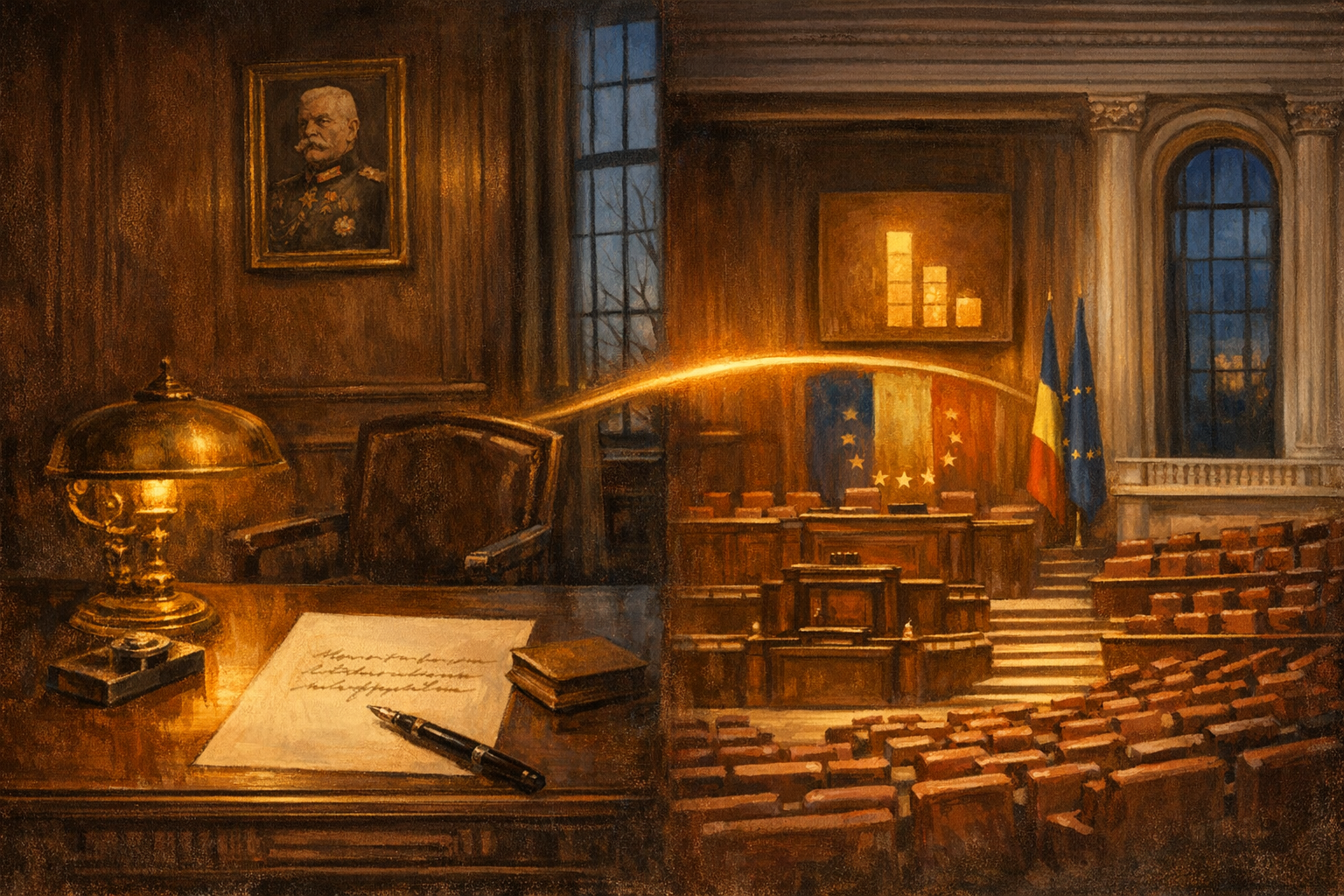
There was a Thursday afternoon in Berlin, ninety-six years ago, when the last German government formed by a parliamentary majority got up from the cabinet table and resigned, and never returned. The fight had been going on for six weeks. It was about unemployment insurance. It ended on 27 March 1930, when the Social Democrats decided that they could not stay in a government that was about to cut benefits to their own voters.
That evening their chancellor, Hermann Müller, walked into the office of the Reich President, an eighty-two-year-old Field Marshal named Hindenburg, and signed a single-paragraph resignation letter on the President's desk. Three days later Hindenburg appointed a new chancellor on the recommendation of an army officer named Schleicher. The new chancellor had no parliamentary majority. He did not need one. From that afternoon to the day Adolf Hitler was sworn in, two years and ten months later, every German government would govern by emergency decree.
The Social Democrats had walked out because they thought it would help them at the next election. Their voters, they reasoned, were the people getting hurt by austerity. Sitting in a coalition that imposed the austerity was bleeding their support. Walking out and running against it from opposition would let them reset.
It did not. They lost five points at the next election, in September 1930. They lost three more by July 1932. They never recovered.
The party that did recover was the National Socialists, who had received 2.6 percent of the vote in May 1928, 18.3 percent in September 1930, and 37.4 percent in July 1932.
This is the most studied parliamentary collapse of the twentieth century. It is also, on the central mechanic, almost indistinguishable from the parliamentary collapse that happened last night in Bucharest.
The Berlin mechanics
The German unemployment-insurance act of 1927 had been a Social Democratic achievement. It worked when there were 1.3 million unemployed. By the end of 1929 there were 2 million. By March 1930 there were over 3 million. The fund was insolvent.
The five-party coalition government in Berlin spent six weeks trying to agree how to refill it. The Social Democrats and the trade-union federation wanted contributions raised, with the Reich treasury filling any gap. The right-leaning bourgeois liberals (the DVP) wanted benefits cut. The Centre Party finance minister, Heinrich Brüning, drafted a compromise that split the difference.
On the morning of 27 March 1930, the SPD parliamentary group met to vote on the Brüning compromise. They rejected it. By the afternoon Müller had resigned. By the morning of 30 March, Brüning was chancellor in his place, governing by emergency decree under Article 48 of the Weimar constitution.
That summer Brüning called an early election to try to ratify his programme. The Reichstag elected on 14 September 1930 contained a Nazi delegation seven times the size of the previous one. Brüning continued to govern by decree, because no available coalition could produce a majority. So did the chancellor after him, Franz von Papen. So did the chancellor after him, Schleicher. So did the chancellor after Schleicher, who was appointed on the morning of 30 January 1933.
The Social Democrats, watching all this from opposition, never returned to power. The Weimar Republic ended without ever having another government formed on the basis of a parliamentary majority. Müller's was the last. The walk-out had taken twenty minutes.
The Bucharest vote
At twenty minutes to nine on the evening of Tuesday 5 May 2026, two hundred and eighty-one members of the Romanian parliament voted to bring down the centre-right pro-European Union coalition government of Prime Minister Ilie Bolojan, on a no-confidence motion sponsored jointly by the centre-left Social Democratic Party (PSD) and the far-right Alliance for the Union of Romanians (AUR). Four members voted against. The members of Bolojan's coalition did not vote at all.
The Social Democrats had been part of Bolojan's coalition until ten days earlier. They had been there for the same reason every European centre-left party in the past five years has been part of every centre-right coalition: because no centre-right coalition can pass a budget without them, and because keeping the centre-right honest is preferable, in the abstract, to letting an unrestrained right govern alone.
What broke the arrangement, in Romania as in Germany, was austerity. Bolojan had taken office in June 2025 with a mandate to bring Romania's budget deficit, the largest in the European Union at around 8 percent of GDP, down toward the eurozone's 3 percent ceiling. He had imposed public-sector wage freezes, pension caps, value-added-tax increases, and a 5-percent-of-GDP fiscal-consolidation programme. The cuts hit, with reasonable predictability, the public-sector workers, retirees, and rural pensioners who form the historical core of the PSD vote.
The PSD had won 22 percent in the December 2024 parliamentary election. By April 2026 it was polling 14 percent. The voters who had left it were not going to the centre-right. They were going to the AUR, which had been polling around 40 percent since the autumn of 2025, and whose leader George Simion had won 41 percent of the first round of the May 2025 presidential election before losing the run-off to the centrist independent Nicușor Dan.
The PSD leadership reasoned, in late April 2026, the way the SPD leadership had reasoned in late March 1930. The voters they were losing to the AUR were people who blamed the PSD for the austerity. Continuing to support the austerity in coalition would continue to bleed those voters. Walking out and opposing the austerity from outside the government, by contrast, would let the PSD recover its base, contain the AUR, and reset.
The walk-out was on the evening of 24 April. The vote was on the evening of 5 May. President Dan, who under the Romanian constitution must nominate a new prime minister, has now to choose among three options. Reconstitute the four-party pro-EU coalition under a different prime minister, possibly a technocrat. Form a centre-left government around the PSD. Or call early elections, in which the AUR would win.
The structural lesson
Romania is not Weimar Germany. Romania is in the European Union. Romania is in NATO. Romania has a centrist president of unimpeachable democratic credentials. The Romanian constitution does not contain an Article 48. The European Commission has institutional levers, including the suspension of European cohesion funds, that did not exist in 1930.
What Romania has in common with Weimar Germany in March 1930 is the specific calculation the centre-left has just made. The PSD has decided that supporting an austerity coalition costs more votes than walking out of one. The PSD has decided that the voters bleeding away to the far right will return when the austerity is being imposed by someone else. The PSD has decided that opposition is recoverable.
The Berlin lesson is that this calculation has been wrong every time it has been tried under conditions of fiscal stress and rising right-wing populism. The voters who left did not come back. The opposition the centre-left thought it would lead from did not exist. The next election, when it came, was won by the right.
It is possible Romania will be the exception. Romania is the more stable institutional environment. Romania has the European cushion. President Dan is not Hindenburg. There is no Schleicher waiting in a Bucharest barracks.
What there is in Bucharest, as there was in Berlin, is a centre-left party that has just spent eighteen months absorbing the political cost of austerity, and that has now concluded the cost is no longer worth bearing. Last time, that conclusion was the start of a much larger collapse. This time, it might just be a hard winter.
The 1930 walk-out took twenty minutes. The next election took five months to arrive. The next chancellor took two years and ten months.
This time, what comes next?