April to September 1971, London and Moscow
The Drunk Driver
London, August 1971. Vienna, May 2026. A drunk KGB officer in handcuffs and an antenna forest on a roof. Two host countries, fifty-five years apart, finally saying enough.
Every day, we find the historical story hiding inside the headlines. Riveting narratives that connect the past to the present, and make you wonder what happens next.
You'll receive one email per topic, per day. Pick as many as you like.
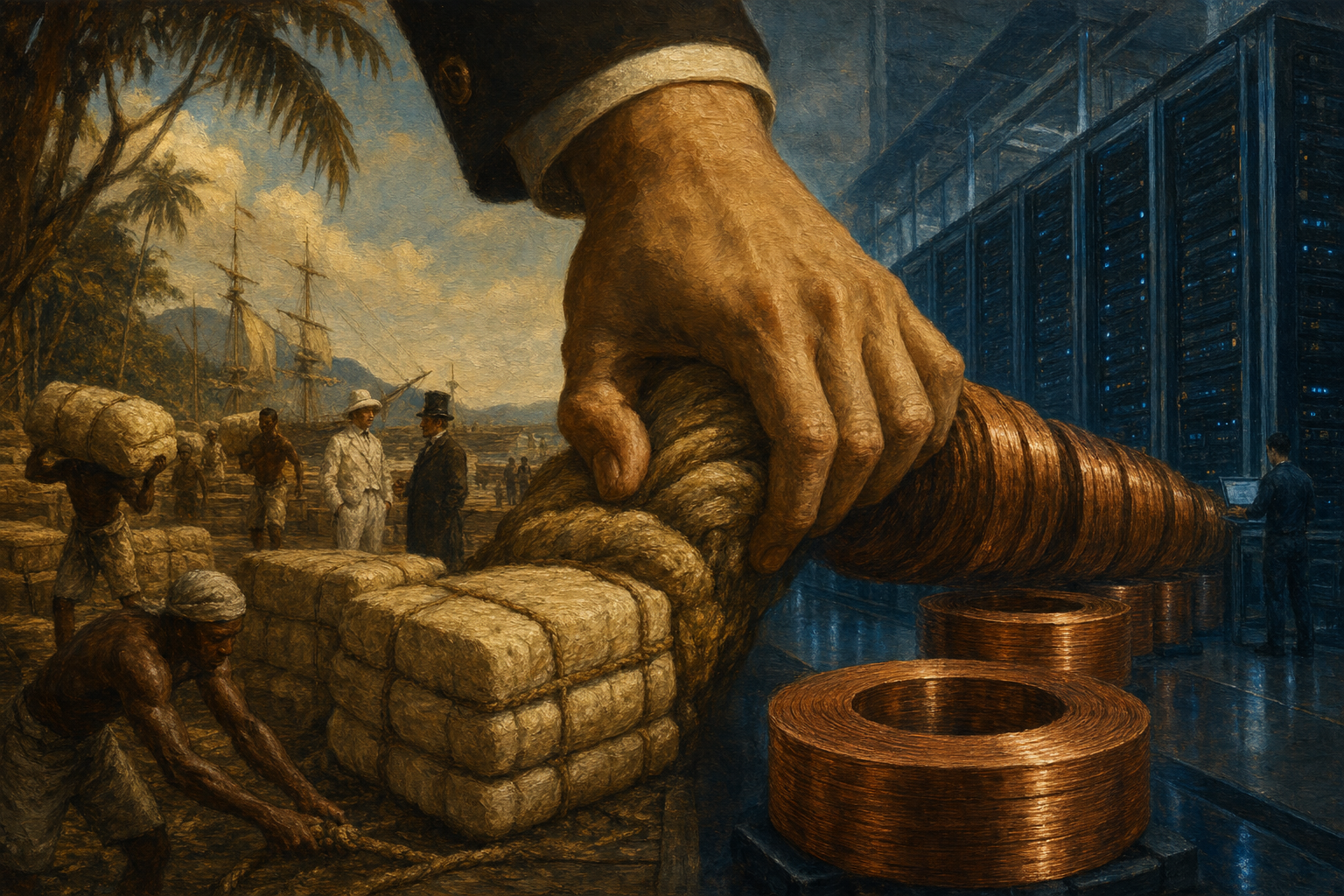
In 1925 the most valuable thing in America was a milky sap from trees on the far side of the world. Rubber ran every car, factory and phone line, Britain's colonies grew about three quarters of it, and Britain had just choked the supply: the Stevenson Plan restricted exports to drive the price from around thirteen cents a pound past a dollar. America, which bought most of the world's rubber, did not just pay. Commerce Secretary Herbert Hoover funded a global hunt for new supply, Harvey Firestone planted a million acres of Liberia, chemists chased synthetic rubber, and the cartel collapsed when the Dutch refused to join and flooded the market. Squeeze a customer hard enough and you do not make him pay; you teach him to never need you again. A century later it is copper for AI data centres and China's grip on rare earths, and the same scramble has begun.
Queen and worker bees hatch from identical eggs, yet one lives for years and lays a million eggs while the others live for weeks and never breed. For a century the textbook answer was a single food: royal jelly. In 2026 a team at UC Riverside showed the real answer is grander. Specialised worker bees build the queen a palace: a peanut-shaped 'royal crib' of custom wax with its own chemistry, and they cluster to keep it warm. Raise a would-be queen in ordinary wax instead and she develops poorly and often dies. The jelly feeds her; the crib crowns her. We love a story with one secret ingredient. Nature almost never works that way.
London, August 1971. Vienna, May 2026. A drunk KGB officer in handcuffs and an antenna forest on a roof. Two host countries, fifty-five years apart, finally saying enough.
Pearl Harbor, 1941. Montreal, 2026. Eighty-two years of telling blood when to clot, and the answer keeps getting better.
Paris, 1855. King's College London, 2026. The metal Napoleon III gave to his most honoured guests has just walked into the column of the periodic table that runs catalysis.
Tripoli, May 1801. The Strait of Hormuz, May 2026. The same convoy operation, the same word: humanitarian.
Brest-Litovsk, February 1918. Tehran, May 2026. The same gambit, in two languages.
A Barcelona-Oregon team has designed a synthetic DNA molecule that silences the gene driving heart disease. Fifty-three years ago, in a Tokyo basement laboratory, a Japanese biochemist found something that did the same thing in a sample of rice from a Kyoto grain shop.
London, November 1956. Berlin, May 2026. The same lever, in two languages.
This week, in two buildings of Sapienza University in Rome connected by 270 metres of open Roman air, physicists teleported the state of a single photon between two unmatched quantum dots. Einstein, who is the reason this is possible at all, would have hated every word of that sentence.
Caracas, 1959. Abu Dhabi, 2026. The same telegram, in reverse.
A research team in Switzerland just produced the first 3D images of immune cells killing cancer cells. The cells were doing something a Russian zoologist guessed at in 1882, alone in a Sicilian house, while his family was at the circus.