Every day, we find the historical story hiding inside the headlines. Riveting narratives
that connect the past to the present, and make you wonder what happens next.
Choose your topics
You'll receive one email per topic, per day. Pick as many as you like.
Today's Echo · History & Current Events
1922 to 1928, the British Empire and the United States
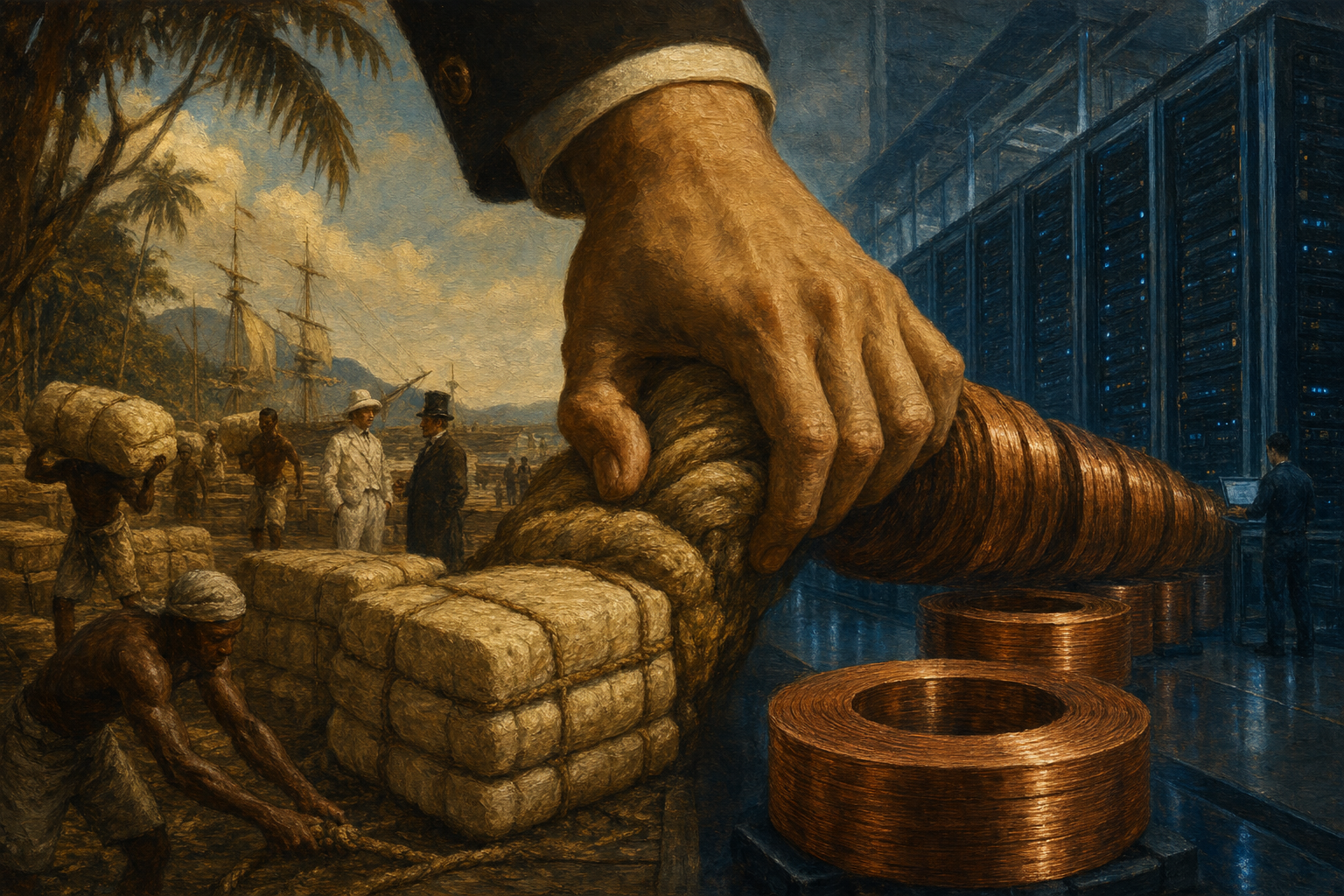
In 1925 the most valuable thing in America was a milky sap from trees on the far side of the world. Rubber ran every car, factory and phone line, Britain's colonies grew about three quarters of it, and Britain had just choked the supply: the Stevenson Plan restricted exports to drive the price from around thirteen cents a pound past a dollar. America, which bought most of the world's rubber, did not just pay. Commerce Secretary Herbert Hoover funded a global hunt for new supply, Harvey Firestone planted a million acres of Liberia, chemists chased synthetic rubber, and the cartel collapsed when the Dutch refused to join and flooded the market. Squeeze a customer hard enough and you do not make him pay; you teach him to never need you again. A century later it is copper for AI data centres and China's grip on rare earths, and the same scramble has begun.
•3 min readA century later the same dynamic has returned with metal instead of sap. The lifeblood of the AI age is copper (a single large AI-ready data centre can require up to about 50,000 tonnes) and rare earth elements used in magnets, motors and weapons. Analysts forecast a structural refined-copper deficit (J.P. Morgan projecting roughly 330,000 tonnes for 2026), with new mines averaging about 17.9 years from discovery to production. The choke point is as lopsided as rubber was in 1925: China processes around 90 percent of the world's rare earths and has used that control as leverage, prohibiting exports of gallium and germanium to the US from December 2024 and adding medium and heavy rare earths and magnets to its export-control list through 2025. Washington's response could have been written by Hoover: in February 2026 it launched a Strategic Critical Minerals Reserve (Project Vault), backed by a $10 billion EXIM loan, and pressed a global search for friendly supply, recycling and substitutes. The lesson of the rubber war is not that a choke point is permanent but the opposite: squeeze a customer hard enough and you teach him, and everyone watching, how to make sure he never needs you again.
Queen and worker bees hatch from identical eggs, yet one lives for years and lays a million eggs while the others live for weeks and never breed. For a century the textbook answer was a single food: royal jelly. In 2026 a team at UC Riverside showed the real answer is grander. Specialised worker bees build the queen a palace: a peanut-shaped 'royal crib' of custom wax with its own chemistry, and they cluster to keep it warm. Raise a would-be queen in ordinary wax instead and she develops poorly and often dies. The jelly feeds her; the crib crowns her. We love a story with one secret ingredient. Nature almost never works that way.
•3 min readIn 2026 a team at the University of California, Riverside (its Center for Integrative Bee Research) showed that royal jelly alone does not make a queen: the environment does much of the work. A specialised caste of young worker bees acts as royal builders, constructing the large peanut-shaped 'royal crib' from a custom wax that is softer, melts at a higher temperature, and carries a distinct chemical signature of fatty acids and signals, and they alter their own physiology to raise the temperature around the cell, like underfloor heating. Crucially, when would-be queens were raised in ordinary worker-cell wax instead of the royal crib, the larvae developed poorly and many died: they needed the 'smell and feel' of the royal wax to transform at all. So queen determination is a whole system, diet plus architecture, temperature and wax chemistry plus the labour of many bees, not a single ingredient. It is a recurring lesson in biology: we love single-cause stories (one gene, one molecule, one food), but nature's marvels are usually built from many small causes acting together. A queen is built, not dosed.
In February 1947, Britain's fuel minister had been warned that coal stocks were dangerously low. He bet on warm weather. The worst winter of the century arrived instead, and four million people lost their jobs in a week.
•5 min readOil Breaks $100 as Hormuz Blockade Takes Effect
In 1956 IBM put a checkers-playing machine on television. In 2025 a Tokyo lab got an AI-written paper through peer review. Both moments were overhyped, and both mattered anyway.
In 1924, a young anatomist in South Africa pulled a small fossilised skull from a box of rocks. It would take thirty years for the world to believe what it meant.
•5 min readTinshemet Cave rewrites Neanderthal-sapiens relationship
For 428 years, Denmark pointed cannons at every ship that entered the Baltic Sea and demanded payment. The toll made Denmark rich, triggered wars, and was eventually abolished not by force but by a cheque.
•5 min readUS Naval Blockade of the Strait of Hormuz
In 1984, a young Australian doctor was so certain the medical establishment was wrong about stomach ulcers that he infected himself to prove it. He was right -- and it took 21 years to get the Nobel Prize.
•5 min readIron telluride reclassified as superconductor
In 1192, the most feared warrior in Christendom marched twice to the gates of Jerusalem and turned back both times. He had won every battle. He could not win the peace.
•5 min readIran Ceasefire Talks Collapse in Islamabad
1570s–1644, Ming China and the East Asian Silver World
In 1399, an English king who had abolished parliamentary restraint on his own power was overthrown by a man from his own bloodline. The challenger said he only wanted what was his.
In 1954, the creator of the most powerful weapon on Earth was told he was a threat to national security. Not for what he had done, but for what he refused to do next.
•8 min readState vs creator over dual-use technology (Anthropic/Pentagon)