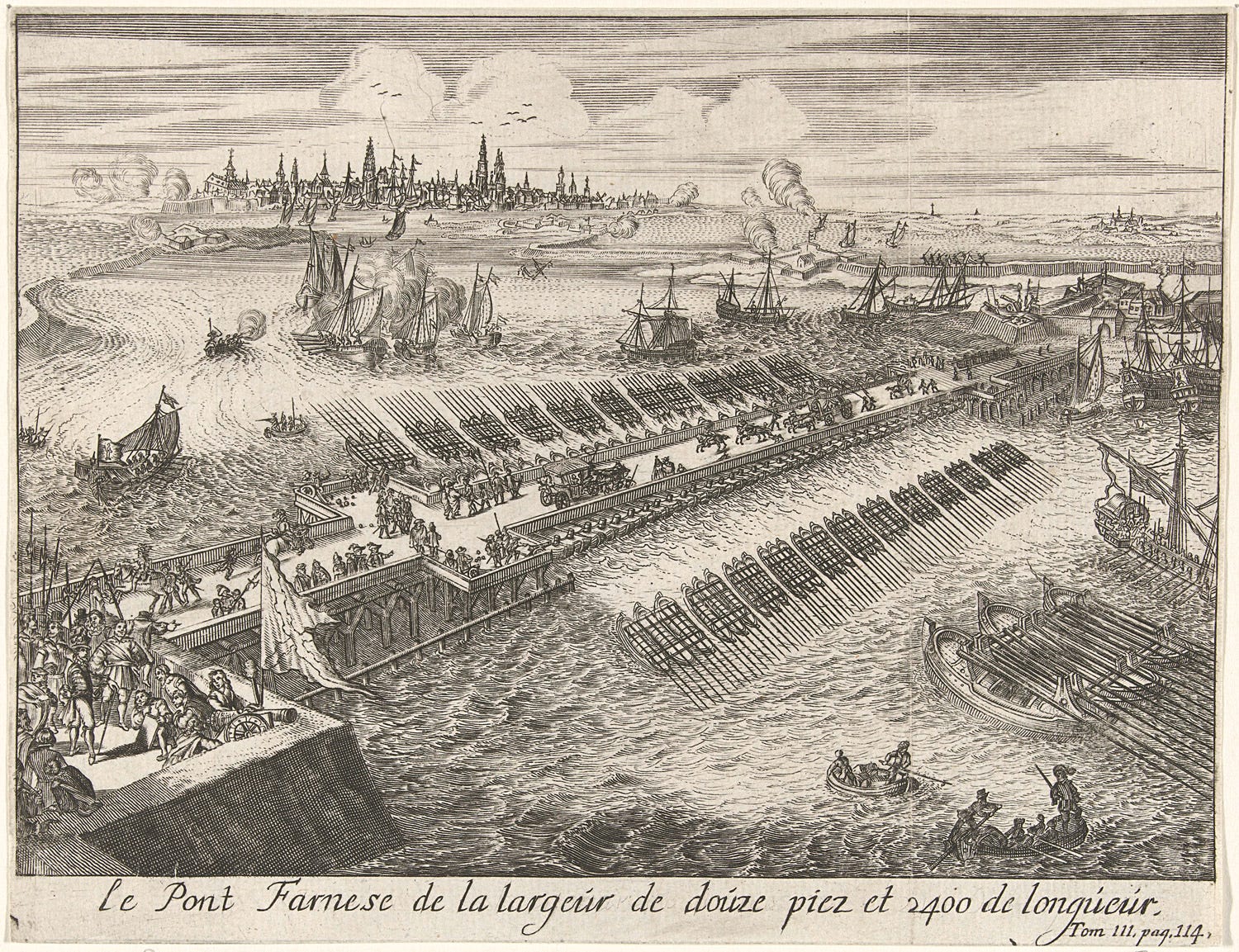
On the night of April 4, 1585, two abandoned-looking vessels drifted down the Scheldt River toward a 2,600-foot pontoon bridge that had been slowly strangling the city of Antwerp. One of them, the Hoop, carried a clockwork fuse ticking beneath roughly 7,000 pounds of gunpowder, tamped under masonry rubble and iron scrap. The other, the Fortuyn, held an equal charge with a slower fuse. Their target was the most audacious military engineering project in sixteenth-century Europe. Their designer, an Italian engineer named Federigo Giambelli, had built what were arguably the most sophisticated explosive devices the world had ever seen.
The Hoop struck the bridge and detonated. The blast killed approximately 800 Spanish soldiers, blew a gap in the structure hundreds of feet wide, and sent debris raining down for nearly a mile. Alessandro Farnese, Duke of Parma, the commander who had built the bridge, had been standing on it moments earlier. He survived only because he had stepped away.
To understand why a Spanish duke was besieging a city in what is now Belgium, you need to know that the Seventeen Provinces of the Low Countries -- modern-day Netherlands, Belgium, and Luxembourg -- belonged to the Spanish Habsburg crown through a chain of dynastic inheritance stretching back to the Dukes of Burgundy. These were not colonies. They were among the wealthiest territories in Europe, bound to a distant king in Madrid by marriage contracts and feudal obligation. When Philip II of Spain intensified Catholic orthodoxy and centralized control in the 1560s, the predominantly Calvinist northern provinces revolted. The conflict, which would eventually last eighty years, had been grinding on since 1568. By the 1580s, Farnese had been sent to crush what remained of the rebellion in the south, and Antwerp was the prize.
Antwerp in this period was not merely a prosperous city. It was the commercial capital of northern Europe. Its population exceeded 100,000, including some 10,000 foreign merchants from Spain, Portugal, England, Germany, Italy, and France. Its bourse, opened in 1531, was the world’s first dedicated commodity exchange. Its printers produced more books than Paris and Rome combined. To control Antwerp was to control the financial nervous system of half a continent.
Farnese understood this. He did not need to storm the walls. He needed to close the river.
The siege began in July 1584. That same month, on July 10, William of Orange -- the rebel leader and Antwerp’s most credible diplomatic advocate -- was assassinated in Delft, shot by a Catholic zealot named Balthasar Gerard. The city lost its best negotiator at the worst possible moment. England’s Queen Elizabeth I promised military support. France made similar noises. Meaningful relief never arrived.
Through the autumn and winter of 1584, Farnese’s engineers built their fortified pontoon bridge across the Scheldt downstream from the city. Chained timber booms flanked by artillery platforms. A physical gate across the jugular vein of European commerce. The bridge was completed on February 25, 1585. Commodity prices across the continent began swinging on dispatches about the blockade, much the way crude oil futures would respond to news from a different strait four centuries later.
Giambelli’s hellburners were the counterstrike, funded by Antwerp’s desperate defenders. And they worked. The explosion of April 4 was devastating.
Antwerp erupted in celebration. Church bells rang. Citizens believed the siege was broken.
It was not.
Farnese immediately set his engineers to repairing the bridge. The initial fix, according to contemporary accounts, was more facade than fortress, but it held long enough to restore the blockade. The city that had just watched its salvation detonate in a pillar of fire now watched the gap close again, plank by plank.
For four more months, Antwerp’s city council cycled through ceasefire proposals, negotiated supply corridors, and hoped for foreign intervention. Each round bought days, not resolution. Food prices inside the walls climbed relentlessly. Merchant families began quietly relocating their ledgers, their diamond stocks, their printing presses northward to Amsterdam, then a secondary grain-trading port happy to receive them.
On August 17, 1585, Antwerp surrendered on negotiated terms. Protestants were given four years to leave or convert. Many did not wait. Of the pre-siege population of roughly 100,000, only about 40,000 remained. The exodus that had begun during the siege accelerated into the largest forced migration of commercial capital in early modern European history. By 1600, roughly 40 percent of Amsterdam’s population consisted of immigrants, mainly from Antwerp. They brought their trade networks, banking expertise, diamond cutting, cartography, and printing. The Dutch East India Company, founded in 1602, was capitalized in significant part by Antwerp refugee money.
Farnese’s bridge did not merely coerce a city. It permanently rerouted the arteries of global commerce.
The Echo
On April 7, 2026, oil prices posted their largest single-day drop since the pandemic crash of 2020 -- West Texas Intermediate falling over 16 percent -- after the United States and Iran agreed to a two-week ceasefire, with Tehran pledging to allow safe passage through the Strait of Hormuz. The Dow surged over 1,300 points. Asian markets rallied. For a moment, the strait was open again. The bells were ringing.
The Strait of Hormuz handles roughly 20 percent of the world’s petroleum supply, a chokepoint concentration that would have been familiar to any Antwerp merchant watching Farnese’s bridge go up. A military actor has converted geography into a coercive instrument. Great powers have issued ultimatums. And the threatened parties are cycling through ceasefire negotiations and temporary arrangements, each arriving with an expiration date rather than a resolution.
Supporters of the administration’s maximum-pressure approach argue that the ceasefire itself validates the strategy: Iran came to the table precisely because the threat was credible, and the immediate market relief demonstrates that decisive posture reduces uncertainty faster than open-ended diplomacy. Critics, including some Republican voices questioning the scope of the confrontation, counter that a two-week pause is not a settlement. It is a fresh round of the same cycle Antwerp endured for fourteen months: ceasefire feelers that buy days, not durability, while the underlying coercive geography remains unchanged.
Both positions have merit. And that is what makes the Antwerp parallel instructive rather than merely decorative.
The hellburners map onto the asymmetric technical countermeasures -- drone swarms, fast-boat harassment, limpet mines -- that signal capability without triggering full escalation. Giambelli’s weapon worked perfectly. It killed hundreds, broke the bridge, and changed nothing structural, because the party controlling the chokepoint could absorb a spectacular blow and restore the blockade.
But the deepest lesson from 1585 is not about the bridge. It is about what happened during the months of uncertainty before the formal surrender. The real damage was not inflicted on August 17, when Antwerp capitulated. It was inflicted in the months when merchant families quietly moved their operations north, when ship captains rerouted cargoes to avoid the risk, when institutional trust in the channel’s reliability eroded one anxious dispatch at a time. By the time the city fell, the city had already left.
That is the mechanism to watch now. Not the spectacular closure. Not the ceasefire that buys another two weeks. The sustained uncertainty that causes every actor -- from Asian energy importers to Gulf sovereign funds to European refiners -- to quietly begin rerouting. Capital does not wait for the bridge to close. It leaves when the bridge becomes unreliable.
Last time, the rerouting created Amsterdam. The question now is simpler and harder.
When the bells stop ringing, where does the capital go?