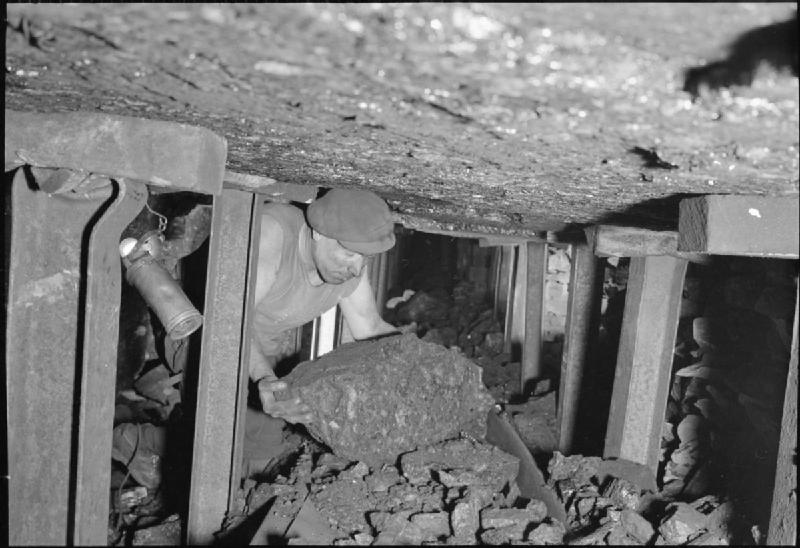
Emanuel Shinwell was not a careless man. A veteran Labour politician who had been organizing dock workers since before the First World War, he had been appointed Minister of Fuel and Power in 1945 with a straightforward mandate: keep Britain's lights on and its factories running. The country's entire economy, every train, every power station, every home with a hearth, ran on coal. There was no alternative. Oil was an American luxury. Natural gas was decades away. Coal was Britain, and Britain was coal.
In October 1946, civil servants warned Shinwell that coal stocks were running thin. Production at the newly nationalized mines was lagging, partly because absentee rates among miners had climbed to two and a half times prewar levels. The country was consuming coal faster than it was digging it up, and the margin between supply and demand was vanishing. The calculus was simple: if winter was mild, Britain would scrape through. If winter was severe, the country would run out of fuel.
Shinwell gambled on mild.
On January 23, 1947, the temperature dropped and did not come back up for two months. Snow buried roads and railways across the country. Drifts blocked the routes between collieries and power stations. Coal that existed in the ground could not reach the places that needed to burn it. By the first week of February, the crisis was no longer a question of supply. It was a question of triage.
Shinwell made the choice that defines every energy crisis: homes or factories. On February 7, he cut electricity to industry completely. Factories across England shut their gates. Domestic power was restricted to nineteen hours per day. Television broadcasts were suspended. Radio was curtailed. Magazines were ordered to cease publication. Newspapers shrank to a few pages.
Within days, unemployment exploded. Four million workers were idle. Two million were drawing unemployment insurance. Industrial output for the year was projected to fall by ten percent before the snow had even melted. The damage was not merely economic. Britain was still operating under wartime rationing. The population was already cold, already hungry, already exhausted from six years of war. The fuel crisis did not arrive in a country with reserves of patience. It arrived in a country that had spent every reserve it had.
Shinwell received death threats and was placed under police guard. He blamed the weather, the railways, and capitalism. The public blamed him. He was forced out of the ministry by October.
The crisis ended when spring arrived, but its consequences did not. The winter of 1947 accelerated Britain's acceptance of American economic aid, which arrived the following year as the Marshall Plan. It exposed the fragility of an economy built on a single energy source with no strategic reserve and no fallback. And it demonstrated a principle that every energy-dependent nation has been forced to relearn at regular intervals since: the distance between sufficiency and catastrophe, in an energy system with no margin, is one bad winter.
The Echo
On Monday, April 13, 2026, the United States began enforcing a naval blockade on all maritime traffic entering and exiting Iranian ports through the Strait of Hormuz. By Tuesday morning, Brent crude had broken above $100 a barrel, climbing over 40 percent since the conflict began in late February. US Energy Secretary Chris Wright acknowledged that prices would remain "high, and maybe even rising" until "meaningful ship traffic" resumed through the strait.
The structural parallel is not the blockade itself. It is the margin.
Shinwell's Britain did not run out of coal because there was no coal. There was coal in the ground. The system failed because the margin between production and consumption was too thin to absorb a shock. The coal existed. It could not reach the power stations. The distinction between having a resource and being able to use it turned out to be the only distinction that mattered.
The global oil market in April 2026 faces the same arithmetic. Oil exists. Saudi Arabia, the UAE, and other producers have spare capacity. American shale production is near record levels. The resource is not scarce in absolute terms. What is scarce is the infrastructure of delivery: the twenty-one-mile strait through which roughly twenty percent of the world's petroleum supply passes daily. The blockade has not removed oil from the earth. It has removed the corridor through which oil reaches the refineries, the tankers, and eventually the petrol stations and heating systems of half the world.
Supporters of the blockade argue it is precision economic warfare. Iran's government depends on oil exports for the majority of its revenue. By preventing tankers from reaching Iranian ports, the blockade cuts Tehran's income without requiring a single additional bomb. Non-Iranian shipping is explicitly permitted through the strait. The weapon is not high prices. It is zero sales. An Iran that cannot sell oil cannot fund its military, its proxies, or its nuclear programme. The blockade does what diplomacy could not: make the status quo financially unsurvivable for Tehran.
Critics respond that the blockade's collateral effects undermine its precision. Oil is a global commodity. Removing Iranian supply from the market, even while allowing other traffic through, tightens global supply and pushes prices above $100 for everyone. American consumers, European manufacturers, and Asian economies that have no stake in the dispute all pay more. India and China, both significant importers of Iranian crude, face supply disruptions they did not choose. The blockade starves Iran of revenue, but it taxes the rest of the world to do it.
Both arguments engage with real economic forces. But Shinwell's lesson is about something neither side is discussing: the margin.
Britain in 1947 did not experience an energy crisis because someone chose to cut off supply. It experienced an energy crisis because the system had been running with no buffer, and a foreseeable shock arrived that the buffer could not absorb. The question Shinwell failed to ask was not "will winter be mild?" It was "what happens if it isn't?"
The global oil system has been running with thin margins for years: underinvestment in refining capacity, just-in-time supply chains, limited strategic reserves in importing nations. The Hormuz blockade did not create this fragility. It revealed it. And the difference, as Shinwell learned, is academic when the lights go out.
He gambled on a mild winter. The winter was not mild.
The margin is everything. Until it isn't there.