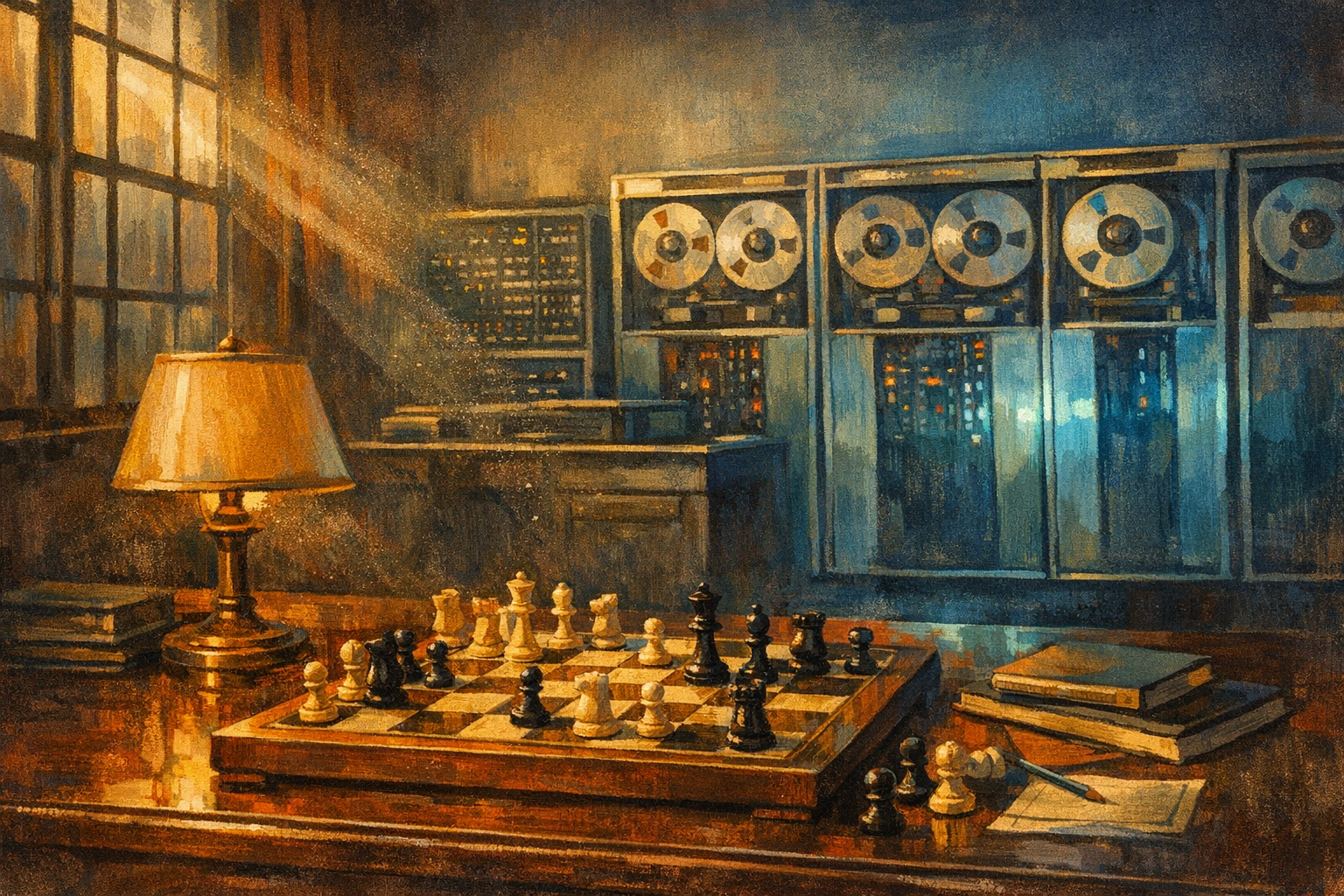
On February 24, 1956, a morning television audience in the United States watched a man named Will Rogers Jr. sit at a desk in a CBS studio in New York while, somewhere else, an IBM 701 computer played checkers against a human expert. The game took about an hour. The machine did not win. But it was said to have demonstrated something more unsettling than winning: it was said to be learning.
The man who had built it was Arthur Samuel, an IBM engineer from the company's Poughkeepsie laboratory. Samuel had started writing a checkers program in 1952 because he needed a small, well-defined problem to showcase the capabilities of the 701, the company's first commercial electronic computer. By 1955 he had added a learning component, a system that adjusted its evaluation of board positions based on the outcome of past games. The CBS segment is widely regarded as the first public demonstration of what would later be called artificial intelligence.
That summer, Samuel travelled to Hanover, New Hampshire, for an eight-week meeting that John McCarthy, Marvin Minsky, Nathaniel Rochester, and Claude Shannon had proposed under the title "the Dartmouth Summer Research Project on Artificial Intelligence." The proposal document, drafted in September 1955, was the first use of the phrase. Forty-seven names appear on the attendee list; only a few stayed the full duration. Samuel was among the visitors. His checkers work was discussed.
Three years later, in the July 1959 issue of the IBM Journal of Research and Development, Samuel published a paper titled "Some Studies in Machine Learning Using the Game of Checkers." In that paper he coined the term. Machine learning, he wrote, was the field of study that gave computers the ability to learn without being explicitly programmed. The phrase sat in academic footnotes for decades before becoming the most used technical term of the 21st century.
The Game That Was Not What It Seemed
The moment Samuel's program entered the wider public imagination came in 1962, when it played a game against a man named Robert Nealey and won. Nealey was a blind checkers player from Stamford, Connecticut, and the IBM press office described him as a master. The result was celebrated in the general press and repeated for decades as the moment a computer first beat a human expert at a cognitive task.
Almost every part of that framing was misleading. Nealey was not the champion of Connecticut; he won that title four years later, in 1966. He had never competed at the national level. The game against Samuel's program was a single encounter, and the two rematches that followed, at Nealey's insistence, were both won by Nealey. In 1966, when Samuel's program was entered in a world championship tournament, it lost every one of its eight games against top players. The world's reigning champion, Marion Tinsley, would not be defeated by a computer for another three decades. The program that finally did it was a different program, built by a different team, at the University of Alberta, in 1994.
The 1962 game was a real milestone and also a substantial exaggeration. It was what happens when a technical community that understands the limits of its work meets a press that does not, and a corporate marketing operation that would rather the public not know the difference. The researchers knew. They kept working. The machine-learning paper that named the field came out three years before the game it is most associated with, and it did not mention Nealey once.
The Echo
On March 12, 2025, a Tokyo-based company called Sakana AI, co-founded by David Ha and Llion Jones, announced that one of its systems had produced a scientific paper that had passed peer review. The paper, titled "Compositional Regularization: Unexpected Obstacles in Enhancing Neural Network Generalization," had been submitted to a workshop at the International Conference on Learning Representations and accepted with reviewer scores of 6, 7, and 6. The review average put it in the top 45 percent of submissions to that workshop. Sakana's system, called the AI Scientist v2, had hypothesised the research question, designed the experiments, run them, analysed the results, generated the figures, written the manuscript, and submitted it without human edits to the text. The only humans involved in the loop were the ones who gave the agent a literature corpus to read.
As with the 1962 game, almost every part of that framing invited careful reading. The workshop was the "I Can't Believe It's Not Better" track, known for accepting negative results that would not fit the main conference. Its acceptance rate is roughly double the main ICLR track. The workshop organisers had agreed in advance that three of the forty-three submissions would be AI-generated, and reviewers were told this and asked to do their normal job regardless. The accepted paper was a negative result: it found that compositional regularization did not help neural networks generalise and sometimes hurt them. By prior agreement with the conference leadership, the paper was withdrawn after acceptance. No AI-authored work was published.
A separate independent audit of the AI Scientist v2, posted to arXiv a few weeks earlier, found that 42 percent of the experiments the system designed failed because of code errors, and that its novelty-detection mechanism was effectively a keyword search. Several ideas the system flagged as new were well-established in the literature. IEEE Spectrum quoted researchers making a distinction the Samuel story should have made familiar. There is a difference, one said, between passing peer review and contributing knowledge to a field.
And yet.
A system with no training specific to the task had produced a paper whose methodology, prose, figures, and framing were plausible enough to three reviewers who had been warned to look for fakes. The three papers Sakana submitted that workshop cycle were the first such attempt at scale. The company made no claim that the work was as good as a strong PhD student's, and the critics who pointed that out were making a stronger case for the milestone than they realised. The correct comparison is not to Timothy Gowers or Terence Tao. It is to Arthur Samuel's checkers program, which at the moment it was written could not have told you how it knew what it knew, which lost almost every serious game it played, and which named the field that eventually built the system now writing papers about itself.
What the Pattern Means
In both moments a real threshold was crossed and a larger threshold was loudly claimed. In both moments the specialists knew exactly what had and had not happened and were drowned out by the non-specialists. In both moments the more interesting truth was slower to arrive than either camp wanted. The Samuel programme coined a term that described its own eventual successor. The Sakana system produced a paper that its own independent auditors could criticise in detail, because the paper was legible enough to criticise in detail.
The useful question is not whether peer review has been passed. Peer review is a sampling procedure, not a verdict. The useful question is what a system that writes plausible papers at the workshop tier will be doing in three years. The answer in checkers took thirty-two years from 1962, and it ended with a program that played better than every human alive.
We keep underestimating the apprentice because the apprentice is not yet the master. The apprentice never is.