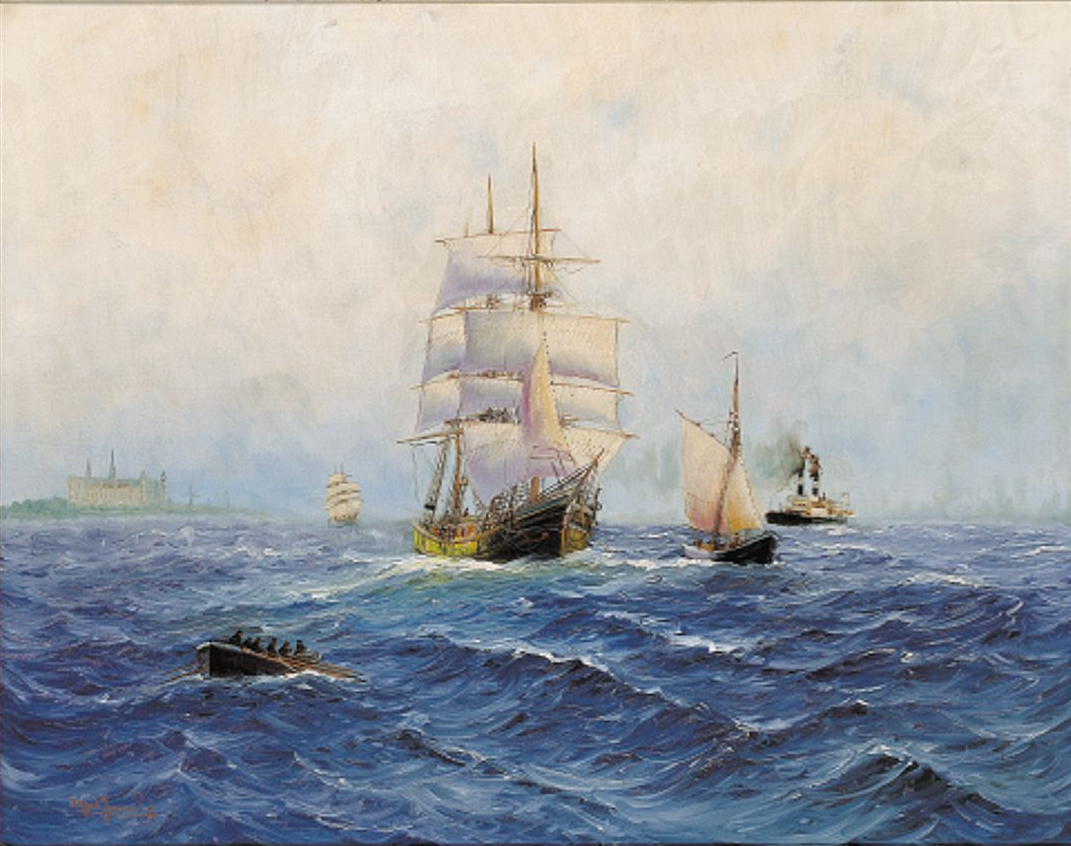
The Øresund is four kilometers wide. At its narrowest point, between the Danish town of Helsingør and the Swedish town of Helsingborg, a competent cannoneer on either shore could hit a ship in the channel. In 1429, King Eric of Pomerania looked at this geography and saw a cash register.
He built Kronborg Castle at Helsingør, mounted it with guns, and decreed that every foreign vessel passing through the strait, whether bound for Denmark or not, must stop and pay a toll to the Danish Crown. Ships that refused were fired upon. Ships that tried alternate routes through the Great Belt or Little Belt found tolls there too. Denmark did not merely control a chokepoint. Denmark monetized every drop of Baltic commerce for over four centuries.
The Sound Dues, as they became known, were elegantly simple in concept and staggeringly lucrative in practice. By the sixteenth century, the toll had been refined from a flat per-ship fee to a percentage of cargo value, typically one to two percent. This made the system self-scaling: as Baltic trade expanded, Denmark's revenue grew automatically. At their peak, the Sound Dues constituted two-thirds of the Danish Crown's total income. The kingdom's wealth, its palaces, its fleet, its diplomatic weight, all of it rested on the simple proposition that geography is destiny and whoever controls the narrow place controls the money.
The arrangement was, naturally, despised by everyone who had to pay. The Dutch, whose Baltic grain trade was the lifeblood of their economy, negotiated reduced rates and periodically schemed to circumvent the system. The Swedes, who controlled the eastern shore of the strait after 1658, were exempted from the toll as a condition of peace, only to have the exemption revoked after their defeat in the Great Northern War of 1720. The English, who by the 1840s were sending roughly four thousand ships a year through the Sound, regarded the dues as an archaic extortion racket incompatible with the principles of free navigation. The friction generated by the toll was an official cause of at least one major war, the Torstenson War of 1643, and a contributing factor in several others.
And yet the system endured. For 428 years, from 1429 to 1857, Denmark extracted payment from the world's shipping. It survived the Protestant Reformation, the rise of the Dutch Republic, the Napoleonic Wars, and the early industrial revolution. It survived because no single nation was willing to bear the cost of breaking it by force, and because Denmark always collected just little enough to make compliance cheaper than confrontation.
It ended not with a battle but with a bill. In 1857, fourteen European nations signed the Copenhagen Convention, which abolished the Sound Dues permanently and declared the Danish straits international waterways. In exchange, they paid Denmark a lump sum of 33.5 million rigsdalers. The nations of Europe collectively decided it was cheaper to buy the chokepoint open than to keep paying rent on it forever.
Kronborg Castle still stands at Helsingør. Shakespeare set Hamlet there, though he called it Elsinore. The cannons are silent. The ships pass free.
The Echo
On April 12, 2026, President Donald Trump announced that the United States Navy would impose a blockade on the Strait of Hormuz. Starting Monday at 10 a.m., CENTCOM would interdict all maritime traffic entering and exiting Iranian ports. Trump specifically ordered the Navy to "seek and interdict every vessel in International Waters that has paid a toll to Iran."
The language is revealing. A toll. The framing positions Iran's control of the Hormuz chokepoint as the same kind of arrangement Denmark maintained at Helsingør: an unearned geographic rent extracted from global commerce by whoever happens to control the narrow place. The American response is to replace Iran's toll with American control, enforced not by a castle with cannons but by two carrier strike groups and their escorts.
Supporters of the blockade argue it is the logical next step after Islamabad's failed negotiations. Iran refused to commit to forgoing nuclear weapons and has kept the strait effectively closed to normal shipping despite the ceasefire. A targeted blockade of Iranian ports, while allowing non-Iranian traffic through the strait, applies maximum economic pressure while maintaining the principle of free navigation for the rest of the world. The US is not closing the strait. It is opening it, on American terms.
Critics argue that a naval blockade is, under international law, an act of war, and that imposing one during a nominal ceasefire fundamentally changes the conflict's character. They note that the blockade applies to "vessels of all nations accessing Iranian ports," meaning the US is now dictating which countries can trade with Iran, a claim of authority over international commerce that will draw objections from China, India, and other nations with Iranian trade relationships. The further the blockade extends, the more nations it drags into the dispute.
Both arguments contain real weight. But the Sound Dues suggest something about how chokepoint disputes actually resolve that neither side may be considering.
Denmark's toll lasted 428 years not because Denmark was the strongest power in Europe. It usually was not. The toll survived because it was calibrated to extract the maximum revenue at the minimum provocation: high enough to enrich Denmark, low enough that war was always slightly more expensive than compliance. Every nation that used the Baltic resented the toll. None was willing to fight a war to end it. The system persisted through inertia, precedent, and the cold arithmetic of cost.
When it finally ended, it ended not through military force but through economic negotiation. The European powers did not storm Kronborg Castle. They calculated what free passage was worth to them, pooled their resources, and bought Denmark out. The 33.5 million rigsdalers was not a defeat for Denmark. It was a negotiated exit, a one-time payment that recognized geographic reality while establishing a new legal principle: that international straits should be open to all.
The question hanging over the Strait of Hormuz is whether the current crisis resolves through force or through the same cold arithmetic that opened the Øresund. Someone controls the narrow place. The shipping nations of the world need it open. The cost of keeping it closed, in oil prices, supply chain disruption, and military expenditure, is calculable. So is the cost of buying it open.
Denmark took the cheque. The cannons went quiet. The ships still pass.
The narrow place is always worth more open than closed. The only question is who pays, and how.