Raymond Dart almost missed it. The box of limestone rubble from the Buxton Limeworks quarry at Taung, South Africa, arrived at his Johannesburg laboratory on November 28, 1924, on the same day he was dressing as best man for a friend's wedding. He was meant to be at the church. He opened the box anyway.
Inside, embedded in a block of breccia, was a fossilised face. Small. Childlike. Forward-facing eyes. A jaw that was neither ape nor human. Dart, a 31-year-old Australian anatomist who had been appointed to the University of the Witwatersrand barely two years earlier, recognised immediately that he was holding something that should not exist according to the prevailing theory of human evolution.
The Skull Nobody Wanted
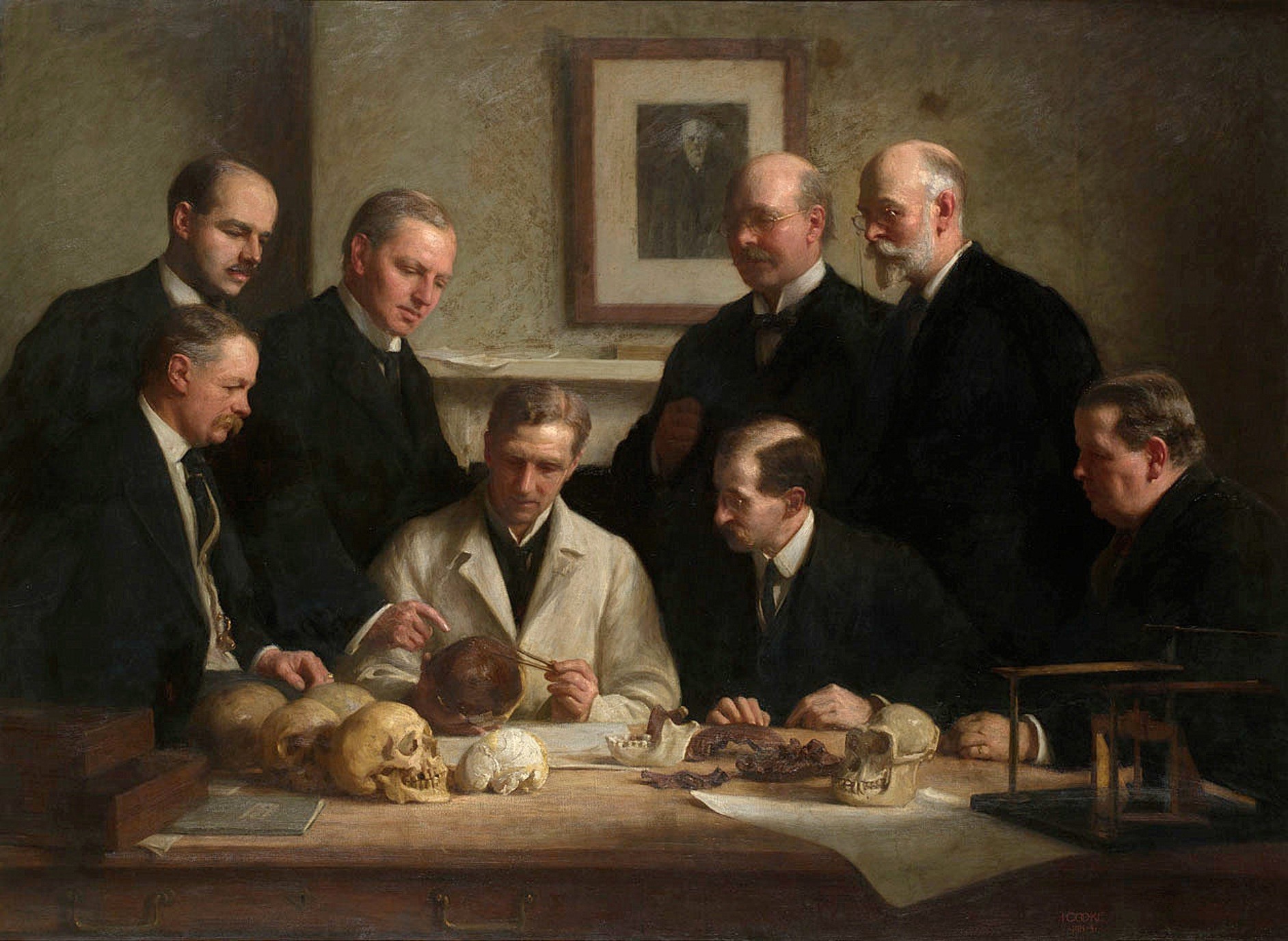
In the 1920s, the scientific consensus was clear: humanity had evolved in Europe or Asia. The so-called Piltdown Man -- fragments of skull and jaw found in a gravel pit in Sussex, England, in 1912 -- appeared to confirm this. Piltdown had a large, modern-looking brain case paired with an ape-like jaw, which matched the establishment's expectation that the brain had evolved first. The leading paleoanthropologists in Britain -- Arthur Keith, Arthur Smith Woodward, and Grafton Elliot Smith -- had built their careers on interpreting Piltdown and its implications.
Dart's Taung Child contradicted everything. Its brain was small. Its face was humanlike. And it was African. On February 7, 1925, Dart published his analysis in Nature, naming the species Australopithecus africanus -- the southern ape of Africa -- and arguing that it represented an early ancestor in the human lineage.
The response from London was devastating. Keith dismissed the skull as a juvenile ape and nothing more. Smith Woodward aligned with the establishment view. Dart was reportedly refused the opportunity to present the original specimen to leading British scientific bodies. The establishment did not merely disagree with Dart. They treated his claim as an embarrassment -- a colonial amateur overreaching from the periphery.
For nearly thirty years, the Taung Child sat in relative obscurity while Piltdown Man held the centre of the field.
The Fraud and the Vindication
The turning point came in 1953, when Kenneth Oakley, Joseph Weiner, and Wilfrid Le Gros Clark proved that Piltdown Man was a forgery -- a medieval human cranium combined with an orangutan mandible, its teeth filed down, the whole thing stained with chemicals to simulate age. The fraud that had anchored the European-origin theory for four decades was exposed in a single devastating paper.
With Piltdown demolished, the African fossils that had been accumulating since Dart's discovery -- Robert Broom's adult Australopithecus specimens from Sterkfontein in 1936 and Kromdraai in 1938, the Leakeys' finds in East Africa -- suddenly cohered into an overwhelming case. Humanity's cradle was not Sussex. It was southern and eastern Africa.
Dart, vindicated at last, became the founding figure of a new understanding of human origins. But the delay had cost a generation. For thirty years, the dominant narrative had been not just wrong but propped up by a deliberate deception -- and the self-correcting machinery of science had failed to catch it because the fraud confirmed what the establishment already believed.
The Echo
Last week, a team of researchers published the first findings from Tinshemet Cave in central Israel, and once again a cave is rewriting what we thought we knew about our ancestors.
The study, published in Nature Human Behaviour, reveals that Neanderthals, archaic Neanderthal-like hominins, and Homo sapiens did not merely coexist in the region across a span of roughly 130,000 to 80,000 years ago -- they actively shared stone tool technologies, hunting strategies, and burial customs. All three groups used centripetal Levallois techniques, hunted large game in similar patterns, and placed their dead in flexed positions on their sides with grave goods including animal bones, antlers, basalt pebbles, and ochre. Over 7,500 ochre fragments were recovered, sourced from locations 60 to 100 kilometres away in the Galilee and the Negev -- evidence of long-distance exchange networks that crossed species boundaries.
These burials, dating to approximately 100,000 years ago, are among the earliest known instances of intentional hominin burial, predating European and African formal burials by tens of thousands of years.
The dominant narrative of human evolution for the past century has been one of replacement. Homo sapiens arrived, outcompeted the Neanderthals, and they disappeared. The story is clean, linear, and familiar -- the smarter species wins.
Tinshemet complicates that story beyond recognition. If three distinct human groups shared tool-making techniques, burial rituals, and long-distance trade networks across millennia, the relationship was not competition but collaboration. The Neanderthals did not simply lose to us. They lived alongside us, taught us, learned from us, and were eventually absorbed -- not conquered.
Supporters of the replacement model argue that isolated evidence of cultural exchange does not disprove broader patterns of competitive displacement, and that a single site in Israel may not represent global dynamics. They note that Neanderthal populations did ultimately decline and that genetic evidence shows limited interbreeding.
But the Tinshemet evidence -- formal burials with shared customs, tool technologies crossing species lines, ochre trade networks spanning a hundred kilometres -- is difficult to reconcile with a narrative of simple conquest. As the researchers note, these are not the signatures of enemies occupying the same territory. They are the signatures of neighbours.
The parallel to Dart's Taung Child runs deep. In both cases, physical evidence from a cave overturned the dominant story of who we are. In 1924, the establishment could not accept that humanity came from Africa. In 2026, a new cave is challenging the idea that our species rose by defeating every rival it encountered.
Dart spent thirty years waiting for science to catch up with what a small skull had already told him. Tinshemet's researchers may not have to wait as long. But the lesson is the same.
The hardest story to change is the one a species tells about itself.