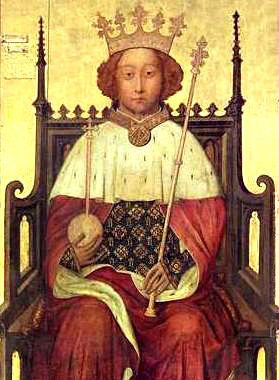
In the summer of 1397, Richard II of England arrested three of the most powerful nobles in the kingdom: the Duke of Gloucester, the Earl of Arundel, and the Earl of Warwick. They were members of the Lords Appellant, a group that had humiliated him nine years earlier by seizing control of government and executing several of his closest allies. Arundel was beheaded. Gloucester died in custody, almost certainly murdered. Warwick was exiled. Then, in January 1398, Richard summoned Parliament to Shrewsbury and used it to abolish itself. The assembly declared that no legal restraint could be placed on the king. It delegated its remaining authority to a handpicked committee of twelve lords and six commoners, all chosen from Richard's inner circle. Richard was thirty years old and had been king since the age of ten. He now controlled the treasury, the courts, the military, and the mechanism for making law. England's political system had been redesigned around a single person.
There was one problem. Richard's cousin, Henry Bolingbroke, Duke of Lancaster, was still alive.
Bolingbroke had been one of the Lords Appellant in 1388, though a junior one. Richard had not executed him, perhaps because Bolingbroke's father, John of Gaunt, was the richest and most powerful magnate in England and Richard's own uncle. Instead, in 1398, Richard banished Bolingbroke for ten years following a dispute with another nobleman. When John of Gaunt died in February 1399, Richard made the move that would destroy him: he seized the entire Lancaster inheritance, the largest private fortune in England, and extended Bolingbroke's banishment to life.
It was a miscalculation of historic proportions. By confiscating the Lancaster estates, Richard sent a message to every landowner in England: no property was safe from a king who recognized no restraint. The nobility, even those who had supported Richard, understood the implication. If the crown could take Lancaster, it could take anything.
In June 1399, while Richard was campaigning in Ireland, Bolingbroke landed at Ravenspurn on the Yorkshire coast with a small retinue. He claimed, publicly and repeatedly, that he had come only to reclaim his inheritance. He was not seeking the crown. He wanted only what was rightfully his.
The northern magnates joined him anyway. Within weeks, Bolingbroke controlled the country. Richard, returning from Ireland to find his support evaporated, surrendered at Flint Castle in August. On September 30, 1399, in a carefully orchestrated ceremony at Westminster Hall, thirty-three articles of deposition were read aloud and accepted unanimously by an assembly of lords and commons. Richard, according to the official record, abdicated voluntarily, citing his own unworthiness. Whether the abdication was genuinely voluntary is a question historians have debated for six centuries.
On October 13, Henry Bolingbroke was crowned Henry IV. Richard was imprisoned in Pontefract Castle, where he died the following February under circumstances that remain unclear.
The man who had dismantled every institutional check on his power was undone in fourteen weeks by someone from his own family, his own court, his own political world. Bolingbroke did not arrive at the head of a foreign army or a peasant rebellion. He arrived as an insider claiming his due, and the system that Richard had built to protect himself could not survive the challenge because it had alienated the very people it depended on.
The Echo
Tomorrow, April 12, 2026, Hungarians go to the polls in what may be the most consequential European election in years. Viktor Orban, who has governed Hungary since 2010 with successive supermajorities, faces a challenger who emerged from inside his own political machine.
Peter Magyar was a member of Orban's Fidesz party for over two decades. He held senior positions at state-run institutions. His ex-wife, Judit Varga, served as Orban's justice minister. Magyar was, by every measure, a product of the system. In February 2024, he broke with Fidesz over a scandal involving a presidential pardon granted to a man convicted as an accomplice in a child sexual abuse case, a pardon that Varga had countersigned. Within months, Magyar had founded the Tisza party and was drawing the largest opposition rallies Hungary had seen in a decade.
The polls now show Tisza leading Fidesz by margins ranging from six to twenty-five points, depending on the pollster. The spread itself is revealing: government-aligned polling firms show a tight race, while independent pollsters show a rout. That divergence, unprecedented in Hungarian polling history, tells its own story about the information environment Orban has built.
The structural parallels to 1399 are precise. Orban, like Richard, has systematically redesigned the political system to consolidate power. Since winning his supermajority in 2010, he has rewritten the constitution, redrawn electoral districts so that 54 percent of the popular vote yields nearly 70 percent of parliamentary seats, placed allies in control of courts and regulatory bodies, and built a media ecosystem in which most outlets, public and private, align with the government. The system is not merely favorable to Fidesz. It was engineered by Fidesz.
Supporters of Orban's governance model argue that these changes reflect a legitimate democratic mandate, repeatedly renewed by voters in four consecutive elections. They contend that Orban's "illiberal democracy" provides stability, cultural coherence, and protection from what they see as the overreach of Brussels-led liberalism. Hungary's economy has grown, EU funds have flowed, and Orban has positioned the country as a distinctive voice in European affairs. If voters want something different, the argument goes, the ballot box is right there.
Critics counter that the ballot box is not, in fact, "right there" in any meaningful sense when the districts are gerrymandered, the media is captured, the courts are stacked, and the rules have been written to convert a modest popular majority into an unassailable supermajority. They point to a system that permits "voter tourism," allowing supporters to register in districts where their votes carry maximum weight, and note that the public broadcaster functions as a government communications office.
Both arguments contain truth, and both contain their own blindnesses.
What the Richard II parallel illuminates is not which side is right. It is the structural vulnerability that both cases share. Richard built a system that could not be challenged through normal channels because he had closed those channels. But the system depended on the acquiescence of the people inside it. When Bolingbroke returned, the nobles did not rally to Richard, not because they loved Bolingbroke, but because Richard's seizure of the Lancaster inheritance had shown them that no one inside the system was safe from the system's master. The institutional capture that was supposed to guarantee Richard's permanence became the very thing that made his support collapse overnight.
The question for Hungary tomorrow is whether the same dynamic applies. Orban has built a more sophisticated apparatus than Richard ever imagined, one that uses democratic forms to produce predetermined outcomes. But Peter Magyar is Bolingbroke's equivalent: not a foreign challenger or a radical alternative, but a man from inside the machine who says, in effect, that the machine has gone too far.
Whether that is enough depends on something no poll can measure.
Henry Bolingbroke said he only wanted his inheritance. He got the crown instead.