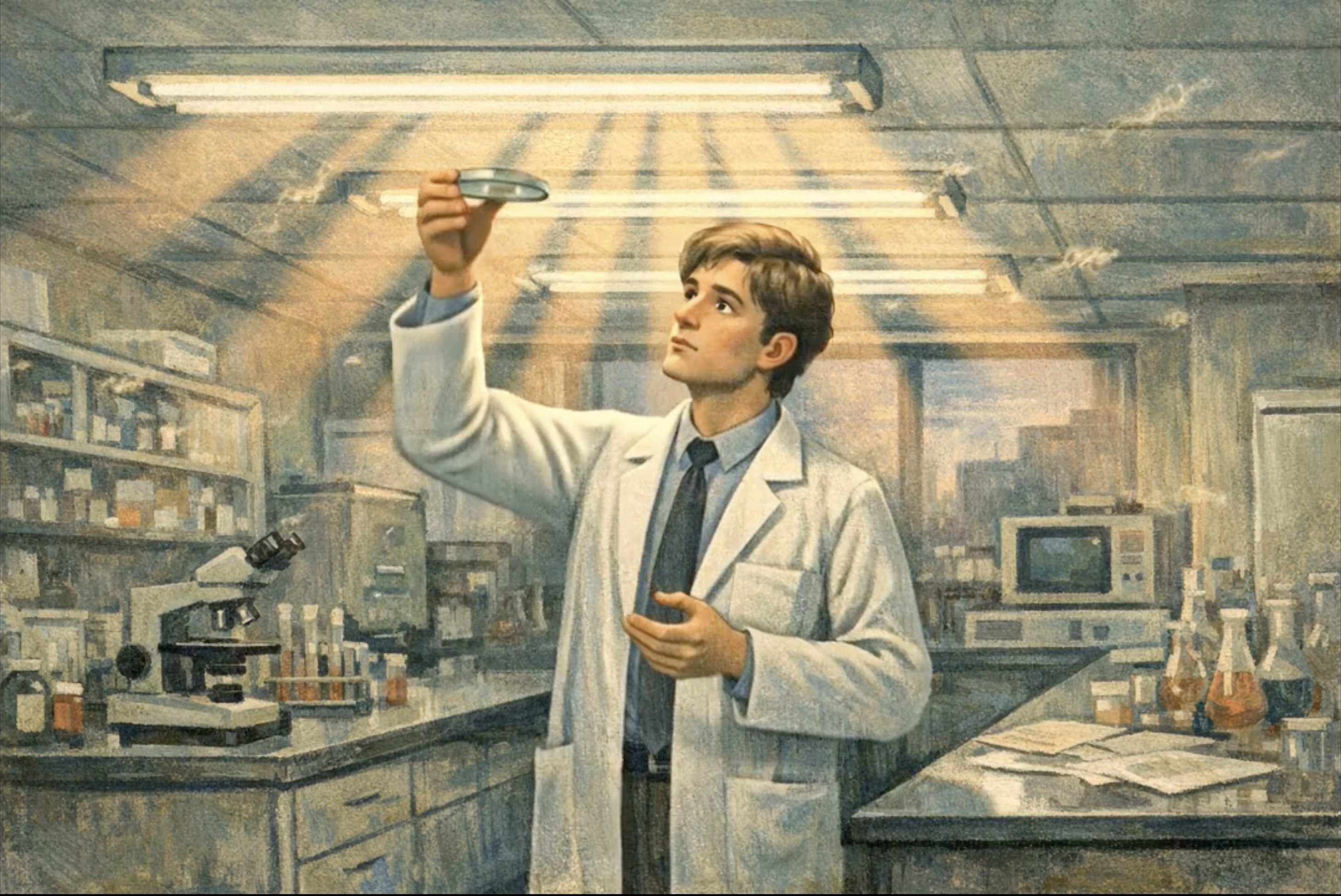
One morning in the summer of 1984, Barry Marshall walked into his laboratory at Royal Perth Hospital, picked up a petri dish containing a cloudy broth of Helicobacter pylori bacteria, and drank it.
He was 32 years old. He had a wife, Adrienne, and four children. He had not sought ethics approval for what he was about to do. He had not told his wife. He knew that if he had asked permission, the answer would have been no.
The Bacteria Nobody Believed In
Robin Warren was a pathologist with a quiet obsession. Beginning in June 1979, he had noticed something odd in stomach biopsies: small, curved bacteria colonising the tissue near ulcers and areas of chronic inflammation. He mentioned it to colleagues. They shrugged. Everyone knew that bacteria could not survive in the hydrochloric acid of the human stomach. The pH was too low. The environment was too hostile. Ulcers were caused by stress, spicy food, and excess acid production. This was settled science. Textbooks said so.
Warren kept looking. In biopsy after biopsy, he found the same spiral-shaped organisms clustered around damaged tissue. He was a careful man, methodical rather than dramatic, and he documented everything. But documentation without explanation is just data. He needed someone who could culture the bacteria and run experiments.
He found Barry Marshall, a young internal medicine trainee with more energy than institutional caution. Marshall agreed to try culturing the organisms from biopsy samples. For months, nothing grew. Thirty-four consecutive attempts failed. The standard protocol called for incubating cultures for 48 hours. After 48 hours, the plates were clean. The bacteria appeared to be unculturable -- which, to the sceptics, proved they were irrelevant.
Then came Easter 1982. Marshall set up his thirty-fifth batch of culture plates on a Thursday before the long weekend. The lab was closed for five days instead of two. When he returned the following Wednesday, the plates were covered in colonies. The bacteria had simply needed more time.
He had Helicobacter pylori.
The Self-Experiment
What followed was a two-year campaign of persuasion that went nowhere. Marshall and Warren published their findings. Gastroenterologists were unimpressed. The pharmaceutical industry had built a billion-dollar franchise around acid-suppressing drugs. The idea that a simple course of antibiotics could cure most ulcers threatened an entire commercial ecosystem. At conferences, Marshall was ridiculed and shouted down. Reviewers rejected papers. The consensus held: stress causes ulcers.
Marshall decided to become his own experiment. He first confirmed via endoscopy that his own stomach was free of H. pylori and showed no signs of disease. Then he drank the broth. Within days, he developed nausea, vomiting, and halitosis. His wife -- who had not been consulted -- was furious. An endoscopy on day ten confirmed acute gastritis with heavy bacterial colonisation, exactly what he and Warren had predicted.
He treated himself with antibiotics and bismuth subsalicylate. The infection cleared. The gastritis resolved. He had proven, on his own body, that H. pylori caused gastric disease.
The medical establishment took another decade to fully accept it. The National Institutes of Health did not issue a consensus statement endorsing antibiotic treatment for ulcers until February 1994 -- ten years after Marshall's self-experiment. Warren and Marshall received the Nobel Prize in Physiology or Medicine in 2005, twenty-three years after the Easter weekend discovery.
The lesson was not just that bacteria cause ulcers. It was that an entire field had been so confident in its existing explanation that it could not see what was growing on the plate.
The Echo
On April 1, 2026, the journal Nature published two back-to-back papers that overturned another decades-old scientific certainty -- this time in physics.
Iron telluride, FeTe, has been classified in textbooks as an antiferromagnetic metal since it was first characterised. Not a superconductor. Not close to one. It was filed, categorised, and largely ignored by researchers hunting for new superconducting materials -- despite having a nearly identical crystal structure to iron selenide, FeSe, which is a well-known superconductor.
A team led by physicist Cui-Zu Chang at Penn State decided to look closer. Using molecular-beam epitaxy, they grew atomically precise films of FeTe and then annealed them under tellurium flux -- a process that removed hidden interstitial iron atoms embedded within the crystal structure. These stray atoms, invisible to earlier, less precise experiments, had been masking the material's true electronic behaviour for decades.
With the contaminant removed, FeTe became a superconductor at approximately 13.5 Kelvin. Scanning tunnelling microscopy revealed a striking "quantum dance" -- superconductivity emerging in a repeating droplet-like pattern that follows a moire superlattice, a phenomenon more commonly associated with twisted graphene sheets.
The implications extend well beyond a single material. If FeTe was hiding superconductivity behind a veil of impurities for decades, how many other "known" materials are similarly misclassified? The periodic table is full of compounds whose properties were characterised decades ago with instruments far less precise than what exists today. Chang's team has demonstrated that re-examining old materials with new tools can yield discoveries as significant as synthesising entirely new ones.
The parallel to Marshall and Warren is structural, not superficial. In both cases, a contaminant -- acid that "couldn't" harbour bacteria in one, excess iron atoms in the other -- prevented researchers from seeing what was actually there. In both cases, the existing classification was so firmly established that it discouraged re-examination. And in both cases, the breakthrough came not from discovering something new, but from removing something that was in the way.
Marshall drank a petri dish because no one would listen. Chang grew a perfect crystal because the imperfect ones had been lying.
The most dangerous phrase in science is not "I don't know." It is "We already know."