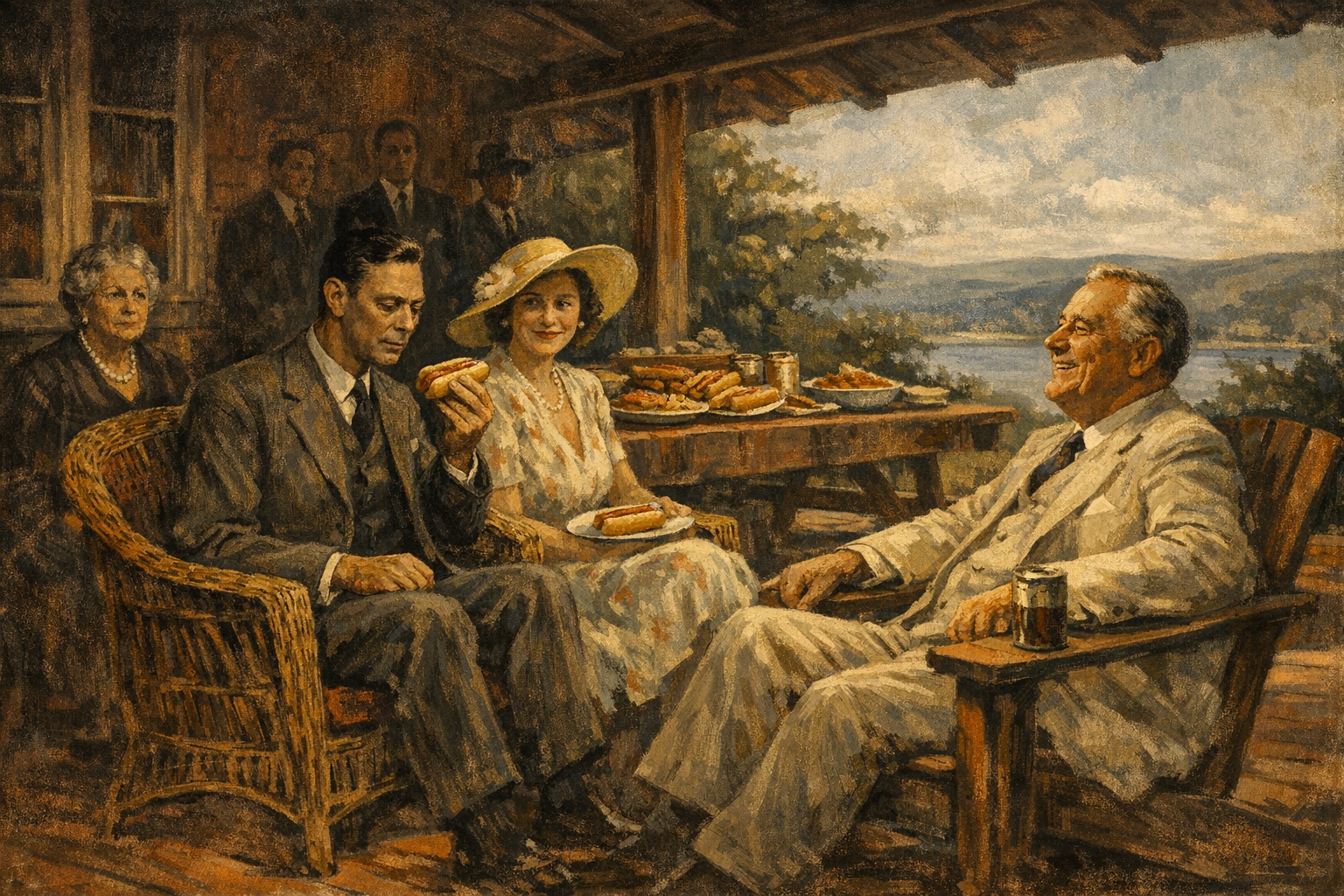
On the afternoon of 11 June 1939, on the front porch of a stone cottage on a hill above the Hudson River, the King of the United Kingdom of Great Britain and Northern Ireland was handed a hot dog. He had never seen one before. He picked it up by one end and held it as a man might hold a small mortar shell. Beside him, the President of the United States's mother, Sara Roosevelt, was visibly horrified. The President was not. Franklin Roosevelt watched with the satisfaction of a host who had got exactly what he asked for. The King took a bite. The next morning the New York Times ran the headline that would go down in American food history: KING TRIES HOT DOG AND ASKS FOR MORE.
His name was George VI. He had been on the throne for two and a half years. He had not expected to be on the throne. His older brother Edward VIII had abdicated in December 1936 to marry an American divorcée, dropping the crown into George's reluctant hands like an unwanted parcel. He had a stammer, made famous decades later by a film. His doctors had told him, gently, that the strain of the office was likely to kill him.
In early June 1939 he and his wife Elizabeth, the future Queen Mother, became the first reigning British monarchs ever to set foot on American soil. Not in colonial times. Not after the Revolution. Not in any of the visits between, of which there had been none. The reason for the trip was not subtle. The German Wehrmacht was, that summer, on the brink of invading Poland. The British Cabinet had concluded that war was probable, and probably soon. American public opinion, after twenty years of isolationism, was hostile to anything that looked like a return to European entanglement. The Roosevelt administration could not, by law and by politics, send formal aid. What it could do was invite a king to a picnic.
After two days of formal banquets and parades in Washington, the President drove the royal couple up to his family home at Hyde Park, New York. There he abandoned the protocol. He served them cocktails in oversized glasses, fed them strawberry shortcake, and on the third day took them up to Top Cottage, his hilltop retreat, for what he called an old-fashioned American picnic. The menu was hot dogs, baked beans, smoked turkey, and beer in cans. The British party was advised in advance, gently, that the protocol was that there was no protocol.
The King and Queen ate. The papers ran the photographs. The American public, which had spent the previous decade reading about a foreign monarch with a stammer, a Nazi-friendly brother, and an ex-king who had traded the Crown for a divorcée, was charmed. Three months later, on 3 September, Britain and France declared war on Germany. Within eighteen months, Roosevelt had pushed the Lend-Lease Act through Congress against fierce opposition. Lend-Lease kept Britain in the war: by 1945 it had transferred more than thirty billion dollars in food, fuel and weapons to an ally that had long since run out of dollars to pay for them. Historians have argued ever since about how much of that was Roosevelt's craft and how much was the public mood the picnic helped create. The Americans no longer thought of the British as the people who had burned down the White House in 1814. They thought of them as the people whose King had eaten hot dogs and asked for more.
The Echo
Charles III is in Washington this week.
He arrived on Sunday with Queen Camilla, the second reigning British monarch ever to make a US state visit, and the first since his mother made hers in 2007. The official occasion is the 250th anniversary of American independence. The unofficial occasion is harder to phrase. Tensions between London and Washington have not been this raw since the early 1980s. The United States has been at war with Iran since the end of February. The Trump administration asked the United Kingdom for military assistance, which Prime Minister Keir Starmer publicly declined. The President responded in his customary register. The Strait of Hormuz has been closed for two months and the price of Brent crude is still over a hundred dollars a barrel.
Charles spent yesterday at the White House. There was tea with the President. There was a tour of Mrs. Trump's beehive. There is, this evening, a state banquet in the East Room. Tomorrow morning he will deliver a joint address to Congress, the second such address ever given by a British monarch and the first since his mother gave hers in May 1991. The official agenda is, as the Foreign Office statements put it, the deepening of the special relationship. The unofficial agenda is more or less unchanged from 1939. A king has been put on a plane and sent across the Atlantic so that two governments that disagree can be photographed together liking each other.
The eighty-seven years between June 1939 and April 2026 are not a clean line. King Charles is not George VI. The Iran war is not the Second World War. The United States in 2026 is not the half-isolationist republic of the late thirties. But the form of the gesture is the same. A monarch with no executive power has been deployed because the politicians, just now, cannot do what is needed.
Whether it works the way Hyde Park worked is anybody's guess. The 1939 picnic did not, by itself, win the war. It did not, by itself, make the special relationship. What it did was lower the temperature in a particular room at a particular moment, and create a photograph that the people who needed to win the next argument could put on the front page. The hot dogs are still in the catalogue of American history, eighty-seven years later.
Whatever Charles is served at the state banquet tonight, somebody is hoping the same thing about it.