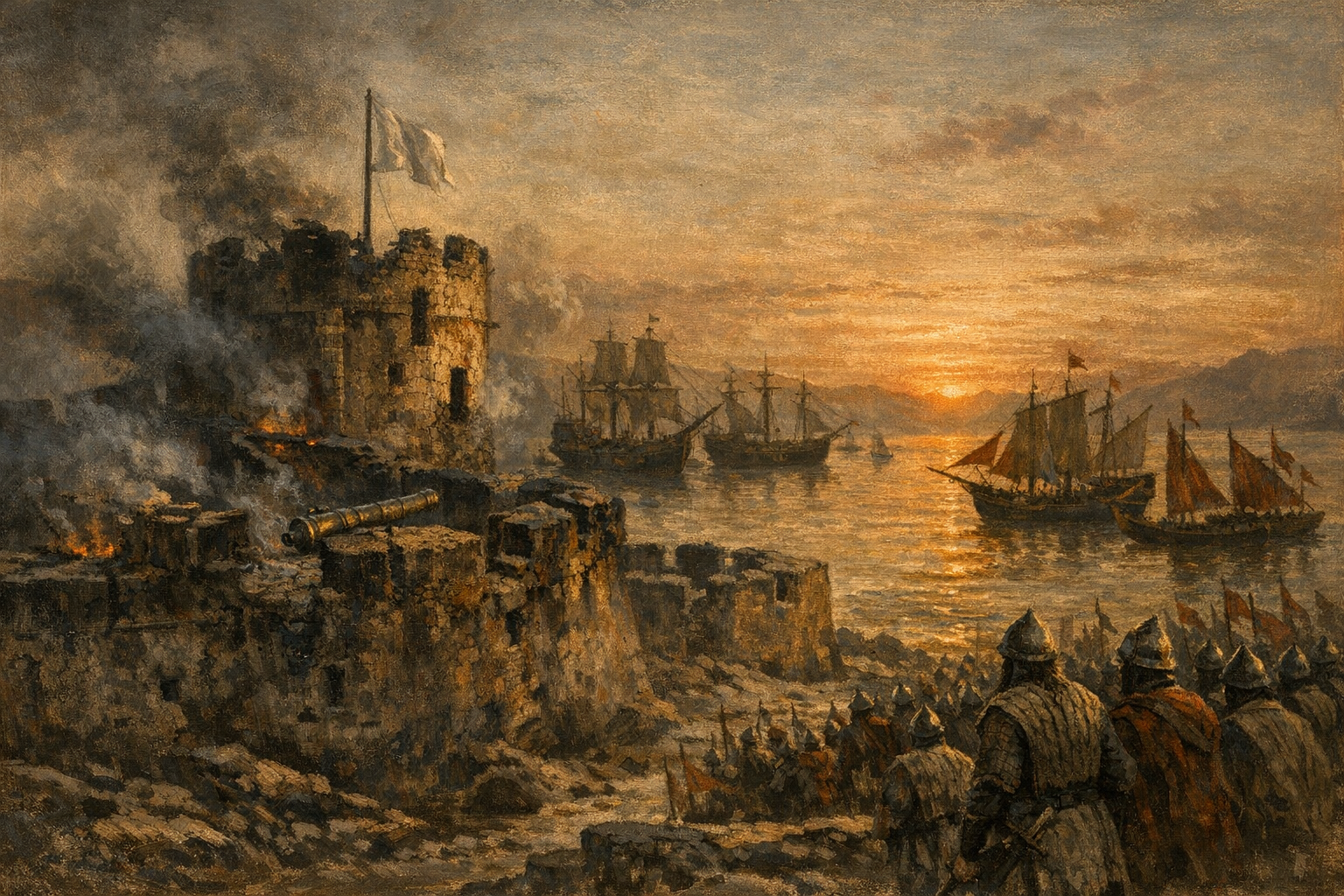
On the morning of 23 April 1622, the Portuguese garrison of the fortress of Ormuz, perched on a hot, salt-bleached island at the mouth of the Persian Gulf, ran up a white flag. They had held the place for one hundred and fifteen years. They had taxed every cargo of pepper, silk, pearls, horses and Indian indigo that passed through the strait that still carries the island's name. They had repelled Ottoman fleets, Arab armies and the gathering complaints of half the merchants of Asia. What finally cracked them was a thing they did not see coming: an alliance between the Shah of Persia and a chartered English trading company whose head office sat above a tavern in London.
The story of how the Strait of Hormuz changed hands in 1622 is, in almost every detail, the inverse of the story now being typed into headlines.
In the autumn of 1507, a Portuguese admiral named Afonso de Albuquerque had sailed into the same harbour with seven ships. The kingdom of Hormuz was a wealthy little vassal of the Safavid Empire, its bazaars described by Venetian travellers as the richest entrepot on earth, where merchants from Genoa, Hangzhou, Calicut and Cairo all met to bargain. Albuquerque demanded the right to build a fortress, an exemption from local customs, and an annual tribute of 15,000 ashrafi gold pieces. While the boy-king Seyf ad-Din wavered, Persian envoys arrived at the audience and asked, pointedly, when their master's tribute would be paid. Albuquerque replied that bullets, cannonballs and arrows were the currency Portugal struck for that purpose. He then proved it.
For more than a century afterwards, Portuguese guns at Ormuz and at Muscat, on the Arabian shore opposite, controlled the only sea route between Europe and the great trading basins of the Indian Ocean. Every captain paid. Every cargo was inspected. The Estado da Índia, the Portuguese empire of the sea, drew a steady, immense rent from the chokepoint. Portuguese officials at Ormuz collected customs dues that, by some seventeenth-century estimates, rivalled the entire revenue of the kingdom of Portugal.
The Safavids, increasingly powerful inland under Shah Abbas I, watched this with growing irritation. They had sea coast but no navy. Their silk, the most valuable export of the empire, was being squeezed through the Portuguese filter at the strait, then resold by Lisbon at a margin Tehran could not capture. By the early 1600s, Abbas was hunting for a partner who could supply ships.
He found one, improbably, in the English East India Company. The company was twenty years old, undercapitalised by the standards of its Dutch rival, and barely solvent. But it had warships in Asian waters and a grievance against the Portuguese, who had been harassing its trade. In 1622, the Persian governor of Fars, Imam-Quli Khan, made the deal. Five English warships and four pinnaces would carry the Persian army to Hormuz. In return, the English would gain a privileged share of the Persian silk trade, and half the customs of the captured port forever.
The campaign was brisk and surprisingly modern. Shah Abbas's troops landed first on the smaller island of Qeshm. The Portuguese fortress there was bombarded by English broadsides while Persian sappers approached the walls. On 23 January 1622, an English officer named William Baffin, the same Baffin who had spent years searching for the Northwest Passage and who has a vast Arctic bay named after him, stood in the open with an astrolabe, taking the angles of the castle wall in order to measure its height and distance. A Portuguese cannonball hit him in the belly. According to the East India Company's later account, "he gave three leaps, and died immediately." The Arctic explorer was buried in the sand of the Persian Gulf.
Qeshm surrendered on 1 February. The combined Anglo-Persian fleet then crossed the few miles of water to Ormuz itself. The English ships sank what was left of the Portuguese squadron in the bay. The Persian army landed and dug in. After two months of siege, the Portuguese garrison mutinied against its own commanders. On 23 April 1622, the gates were opened.
Portugal's century of tolling the Persian Gulf ended that morning. The Estado da Índia survived elsewhere for another two hundred years, but it was never again the master of the strait. The English East India Company, in its share of the spoils, set up a trading post a few miles up the coast at a fishing village called Bandar Abbas, named for the Shah, that became one of the seeds of British power in the Gulf for the next three centuries.
The Echo
Now read the dispatches from this week.
On 24 April 2026, US Central Command confirmed that three American aircraft carriers, the Gerald R. Ford in the Red Sea, the Abraham Lincoln in the Arabian Sea, and the newly arrived George H. W. Bush, are operating in the Middle East together. It is the first such deployment since the buildup to the invasion of Iraq in 2003. They are there because Iran, on 28 February, declared the Strait of Hormuz closed to commercial traffic. About a fifth of the world's seaborne oil normally passes through the strait. Brent crude crossed one hundred dollars a barrel on 8 March, the first time in four years, and peaked near one hundred and twenty six. The International Energy Agency has called the disruption the largest in the history of the global oil market. Asia is rationing. American envoys Steve Witkoff and Jared Kushner are flying to Islamabad this weekend, where Iran's foreign minister Abbas Araghchi is already in the room, and the Pakistanis are trying to mediate.
The geometry of 1622 has not changed. The strait is still about twenty sea miles wide at its narrowest, and the traffic that has to thread it has been squeezed into a corridor of two-mile lanes. Whoever sits on it can squeeze the world. What has changed is the cast. Four centuries ago, a Western fleet held the strait against a Persian shah, and the shah hired a different Western fleet to dislodge it. This time, the Iranian state is the one closing the gate, and the Western fleets are the ones outside, looking in.
There is a temptation, on weeks like this, to talk about Hormuz as if it were a fact of nature, an immovable feature of the global economy. It is not. The strait has changed hands by force at least three times in its recorded life: under Albuquerque, under Shah Abbas and the English, and under the British Royal Navy in the nineteenth century. Each transition was triggered by the same thing. The current owner overplayed the leverage that geography had handed him, and somebody else, often an unlikely coalition, decided the toll had become more expensive than the war.
Whatever is being negotiated in Islamabad this weekend, it is the latest scene in a play with four centuries of stage directions. The cannonballs Albuquerque struck as currency are still in circulation.