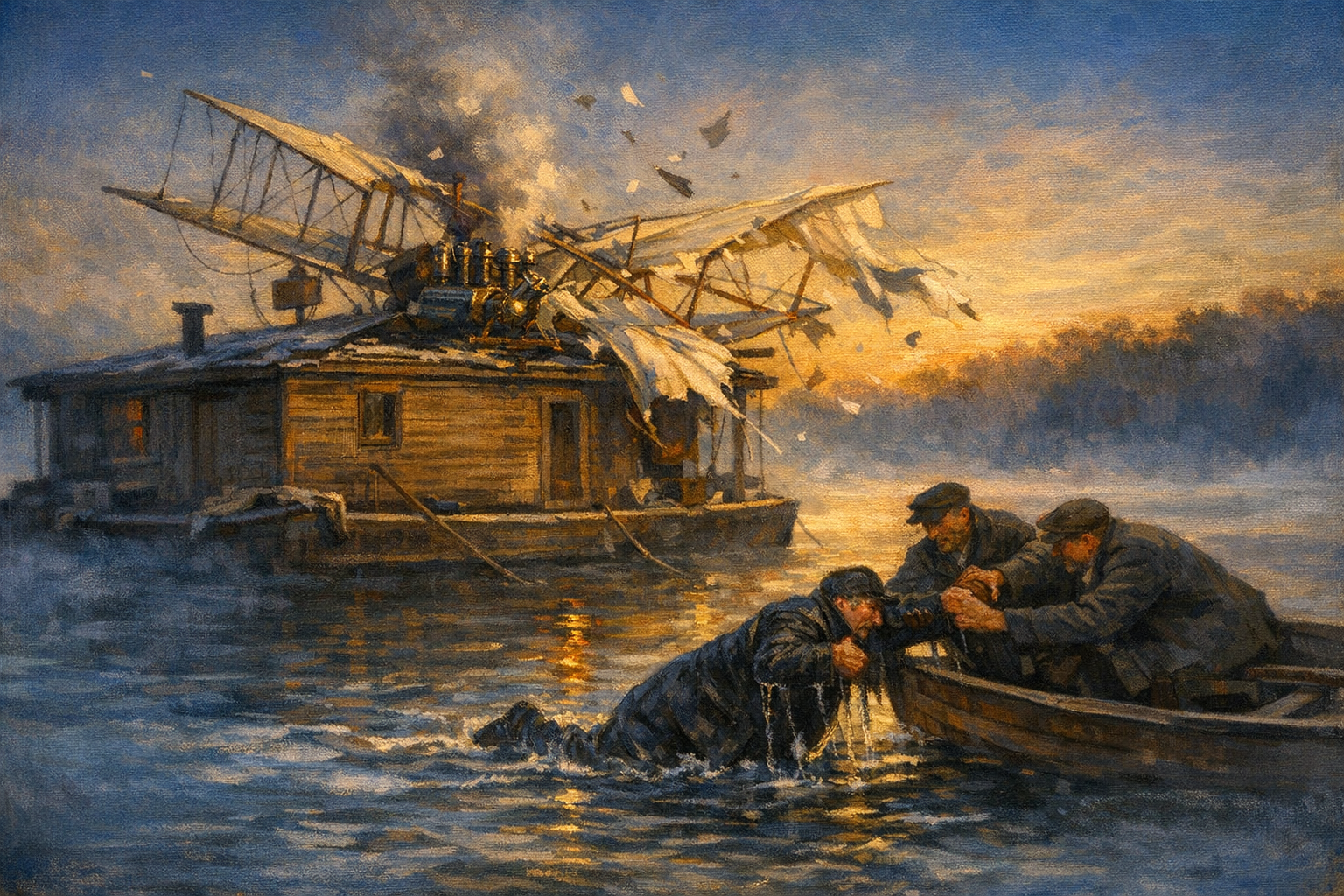
On the morning of December 8, 1903, a houseboat sat anchored in the Potomac near Quantico, Virginia. On its roof rested a delicate framework of wood, fabric, and an experimental five-cylinder engine: the Aerodrome, designed by Samuel Pierpont Langley, Secretary of the Smithsonian Institution. The pilot, Charles Manly, climbed into the operator's seat. A spring catapult flung him into the air. The frame collapsed at once. Manly went into the river. He was pulled out coughing and unhurt. It was the second time in two months.
The Aerodrome had been built with $50,000 from the War Department, the largest single research grant in American science to that date. It had now flown a total distance of zero feet.
Two days after Langley's first crash on October 7, the New York Times had published an editorial titled "Flying Machines Which Do Not Fly." The argument was logical, dignified, and wrong. If birds had needed roughly ten thousand years to evolve flight, the editorial reasoned, then "the flying machine which will really fly might be evolved by the combined and continuous efforts of mathematicians and mechanicians in from one million to ten million years."
It was the considered opinion of one of the most respected newspapers in America, applied to a problem the most respected scientist in America had spent five years and a small fortune failing to solve. Both the Times and Langley believed the same thing. Powered flight was a hard problem because it was a deep problem. It would require centuries, possibly geologic ages. The hardest part, the Smithsonian believed, was the lift-to-weight ratio of an engine that could push something heavier than air through the sky. Langley had built that engine. The Aerodrome's motor was, in fact, an engineering marvel. The catapult had been calibrated. The math had been done.
What the math had failed to anticipate was that the airplane is not principally a propulsion problem. It is a control problem. An airplane in flight is an unstable system being constantly corrected, in three axes, by a pilot whose body is wired into the pitch of the wings, the yaw of the rudder, and the roll of the wingtips. You cannot calculate this. You have to feel it. Most of the work is in the parts of the body and brain that handle balance.
Two bicycle mechanics in Dayton, Ohio, with no government funding, no academic appointments, and no engineering degrees, had been figuring this out for four years. In 1901 they built a wind tunnel inside their bicycle shop out of a wooden box, a hacksaw blade, and bicycle-spoke wire. They tested two hundred scale-model wing shapes inside it, then thirty-eight in detail. They learned that long narrow wings beat short stubby ones. They took their gliders to Kill Devil Hills, North Carolina, every season because the dunes were soft and the steady wind off the Atlantic let them feel what was happening to the airframe in real time. They had taught their bodies to fly.
Nine days after Langley's second crash, Orville Wright lay flat on the lower wing of the Flyer, his hips strapped into a wooden cradle that warped the wingtips when he shifted his weight. The engine roared. He released the restraining wire. The Flyer lifted off the launch rail at Kitty Hawk on December 17, 1903, and stayed in the air for twelve seconds. They flew it three more times that morning. The longest flight, with Wilbur at the controls, covered 852 feet in 59 seconds.
The newspapers, including the New York Times, missed the story almost entirely. It would be nearly five years before the Wrights were widely believed. Once they were, the U.S. Army Signal Corps signed a contract within months, and within sixteen years a Vickers Vimy crossed the Atlantic non-stop.
*
On April 23 of this year, Nature put a robot named Ace on its cover. The paper, written by researchers at Sony AI, is titled "Outplaying Elite Table Tennis Players with an Autonomous Robot." In matches conducted under International Table Tennis Federation regulations, Ace defeated three professional opponents in March, including Miyuu Kihara, currently ranked in the top twenty-five of the women's world singles. Its end-to-end reaction latency, photon to paddle, is 20.2 milliseconds. The fastest elite human player measures around 230 milliseconds, more than ten times slower.
For four decades, this was supposed to be impossible.
In 1988, the roboticist Hans Moravec wrote that it was "comparatively easy to make computers exhibit adult-level performance on intelligence tests or playing checkers, and difficult or impossible to give them the skills of a one-year-old when it comes to perception and mobility." The principle came to be called Moravec's paradox. Chess and law and accountancy were easy for machines. Picking up a coffee cup was hard.
The reasoning, dignified and wrong, was that perception was a deep problem. A billion years of evolution, Moravec argued, were encoded in the muscles and nerves and reflexes of any living animal. You could not calculate that. The hardest things to teach a computer would be the things a toddler does without thinking.
Half the AI field has spent the last three years quietly stunned by how thoroughly that prediction has come apart. We have neural networks that fold proteins, drive cars in the rain, fly drones through forests, and now return a topspin forehand against a top-twenty-five professional in twenty milliseconds. The chess problem turned out to be hard. The pick-up-the-coffee-cup problem turned out to be merely large. The first required a new kind of algorithm. The second required gradient descent and a billion frames of practice.
In 1903, the establishment decided that powered flight was deep. It turned out to be merely hard. In 1988, it decided that toddler-level dexterity was deep. It turned out to be merely large.
We already know what happens when the first prediction collapses. Within five years, the U.S. Army has signed contracts. Within sixteen, the Atlantic is crossed.
The pilot of the Aerodrome, by the way, walked away unhurt.
They always do.