In the last week of March 1878, a Prussian industrialist named Wilhelm von Kardorff was summoned to a meeting with the Chancellor. Kardorff was an unusual man. He sat on the boards of iron foundries and, at the same time, owned a large estate east of the Elbe where he grew rye. He embodied, in one biography, the two great economic interests of Imperial Germany. That, presumably, is why Bismarck wanted to see him.
The Chancellor came to the point. He had decided, he said, to abandon free trade.
For most of the previous decade, Germany had been the model student of British liberal economics. In 1873 the Reichstag had voted to abolish the last protective duties on iron, finishing a long march toward a unified, customs-free German market. Bismarck had backed the policy. The National Liberals, his governing partners, had cheered it. Steel rails, locomotives, agricultural machinery: cheap inputs were the foundation of the new empire's industrial growth. Why would anyone want to make them dearer?
Then came the Panic of 1873.
The crash began in Vienna and rolled west through Berlin and across the Atlantic to New York. Banks failed. Railways went bankrupt. Iron prices collapsed. And while German industry was reeling, two new technologies were quietly rewriting the rules of global trade.
The first was the steel-hulled steamship. The second was the American railroad.
Together they made it possible to grow wheat in Iowa or Manitoba, ship it to Chicago by rail, and deliver it to Hamburg or Liverpool more cheaply than a peasant could cart it from the next province. Freight rates from the American Midwest to European ports fell by more than half in a decade. The Junker landowners of East Prussia, who had made comfortable fortunes selling rye to the cities, suddenly found themselves competing with grain that had crossed an ocean and still arrived cheaper than their own.
At the same time, German foundries were being undercut by British and Belgian iron. The Central Association of German Industrialists, founded in 1876, began to lobby for protection. So did the Association of Tax and Economic Reformers, an alliance of the great agrarian landowners. In 1878 the two groups joined forces.
It was a strange marriage. Industrial Germany and rural Germany had spent the unification decade glaring at each other across the class divide. Now they discovered a common interest. Foreigners were eating their lunch.
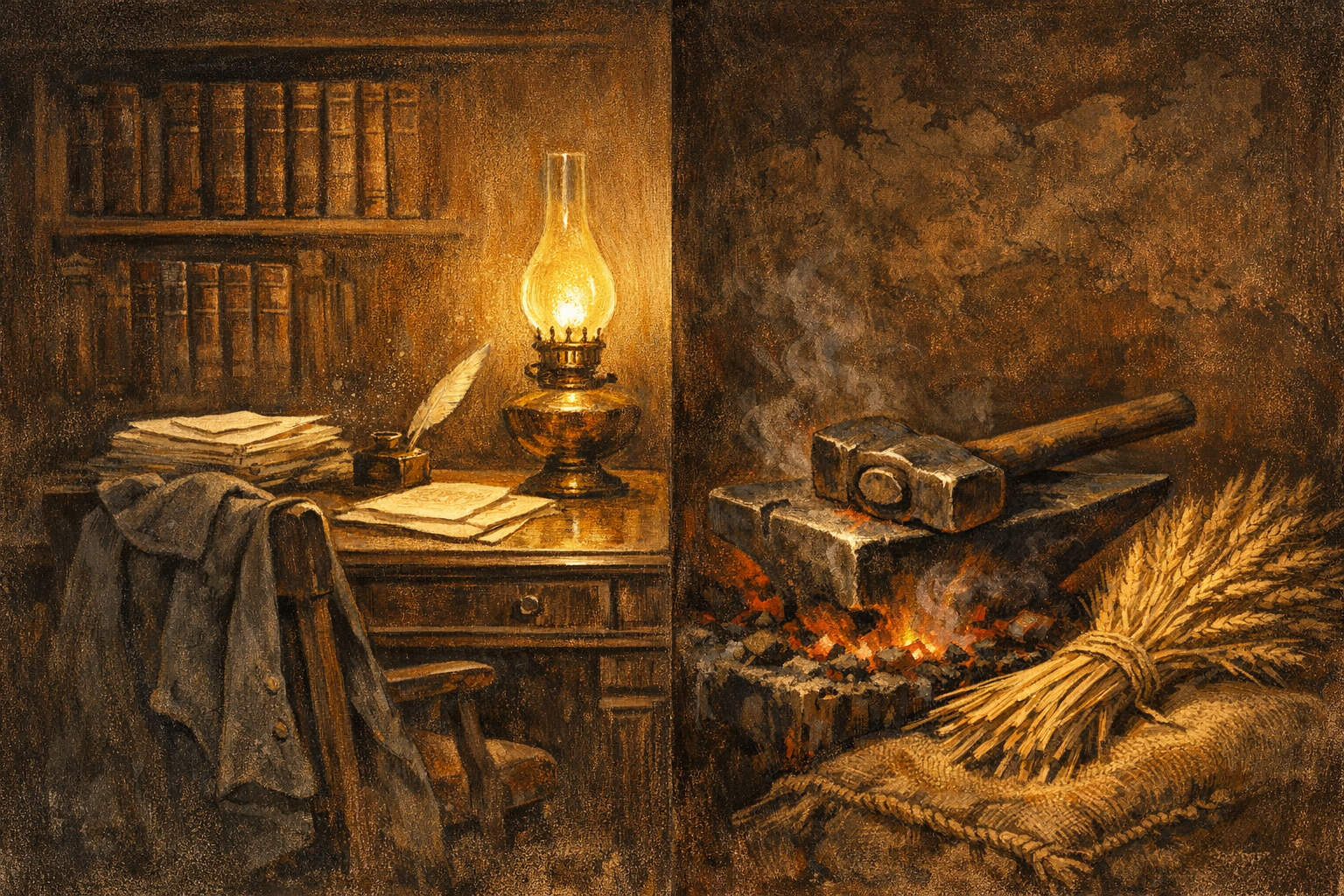
This is what Kardorff was telling Bismarck, and what Bismarck wanted to hear. Later, German historians would give the alliance its memorable name. The marriage of iron and rye.
The breaking of the Liberal coalition followed quickly. Bismarck sounded out the Conservative Party and the Catholic Centre, both already inclined toward protection. The 1878 elections delivered the votes. The National Liberals, who had built their identity on Manchester economics, fractured. On 12 July 1879, after weeks of furious debate, the Reichstag passed the new tariff law by a majority of one hundred. Iron, machinery, livestock, and grain were now taxed at the German border. Wheat, rye, and oats paid a duty of one mark per hundred kilograms. The free-trade Reich was over.
Defending the bill, Bismarck made an argument any modern reader will find eerily familiar. He did not, he insisted, want to protect Junker rents. He wanted to protect German security. "If we really came to a position in which we could no longer produce the grain which we must necessarily consume," he told the chamber, "then in what state would we be if in wartime we had no Russian grain imports and perhaps simultaneously were blockaded along our coasts?"
A nation, he was saying, that depends on foreign suppliers for the things it needs to fight is not a sovereign nation at all.
The argument worked. The tariff passed. And then, almost immediately, every other large economy in the West did the same thing.
France raised its duties, eventually closing under Jules Méline in 1892. The United States ratcheted up through the McKinley Tariff of 1890 and the Dingley Tariff of 1897. Russia raised its border. Italy raised its border. Even Britain, the temple of free trade, would argue itself into the Chamberlain tariff reform debates of 1903 and finally close the door in the 1930s. The world the Victorians had spent half a century building, of cheap goods crossing borders without hindrance, was being dismantled, country by country, in response to the same shock.
The marriage of iron and rye did exactly what its sponsors wanted. It saved the Junkers from extinction. It funded the Krupp foundries. It paid for the welfare reforms that bought social peace. It also entrenched a coalition between heavy industry and reactionary landowners that would dominate German politics for the next half century, narrow its political imagination, and make the country's economic interests inseparable from a particular kind of state power. Tariffs once raised are very seldom lowered. Especially when the people they protect become the people who choose the government.
By 1914 every great power sat behind its own tariff wall, with its own captive colonies, its own preferred suppliers, and its own list of grievances against everyone else's. By 1930 the cycle reached its grotesque conclusion in the Smoot-Hawley Tariff and the cascade of retaliation that helped turn a recession into a global depression. The marriage of iron and rye was not the only cause of any of that. But it was the moment the nineteenth century stopped believing in open trade, and started believing in walls.
The Echo
On the evening of 13 April 2026, in a windowless room in Brussels, negotiators from the European Council and the European Parliament reached a deal. The deal raises the tariff on out-of-quota steel imports to fifty percent. It cuts the duty-free quota by forty-seven percent, to 18.3 million tonnes a year. The number is not arbitrary. It is the volume the bloc imported in 2013, the year Brussels has decided the steel market "became unbalanced." A new melt-and-pour rule will require importers to certify where the metal was actually made, not just where it was finished. Thirty product categories are covered. The measure enters force on 1 July.
The text was welcomed by Eurofer, the European steel industry's lobby, which credited the deal with saving 230,000 jobs. The opposing lobby, of European steel users (carmakers, white-goods manufacturers, construction firms), warned that more expensive inputs would cost their members more. The decisive vote was made possible by an unusual coalition: greens worried about carbon-intensive imports, conservatives worried about strategic autonomy, social democrats worried about plant closures in their constituencies. The argument that carried the day, again and again, was that you cannot build an industrial economy, or fight a war, on metal you do not control.
China, which now produces more than half the world's steel, is not named in the regulation. It does not need to be.
The arithmetic is the same as 1879. A continent that built its prosperity on open trade has watched a rising producer flood its markets with cheaper goods, partly through superior scale, partly through subsidy. The producers being undercut have organised. The consumers being protected have not. The political middle, which used to make the case for open markets, has gone quiet. The bill passes.
What is harder to see in Brussels in April 2026 is what was equally hard to see in Berlin in July 1879. Protectionism, once it works, is very difficult to put down. It rewards the people who lobbied for it. It punishes the consumers who never showed up to the meetings. It changes which industries you have, which workers you train, which votes you need. The Junkers did not weaken after 1879. They became the German state.
Bismarck was right that a country which cannot produce its own steel cannot defend itself. He was also, in the end, the man who taught Europe that the answer to a global crisis was higher walls. The next time anyone tried to lower them, it took two world wars and the ruin of the continent.
The European Union was, until very recently, the institution most committed to the opposite proposition. That a continent which traded freely with the world, and within itself, would never again fight itself.
Last time, the marriage of iron and rye took fifty years to deliver its consequences.
This time, what comes next?