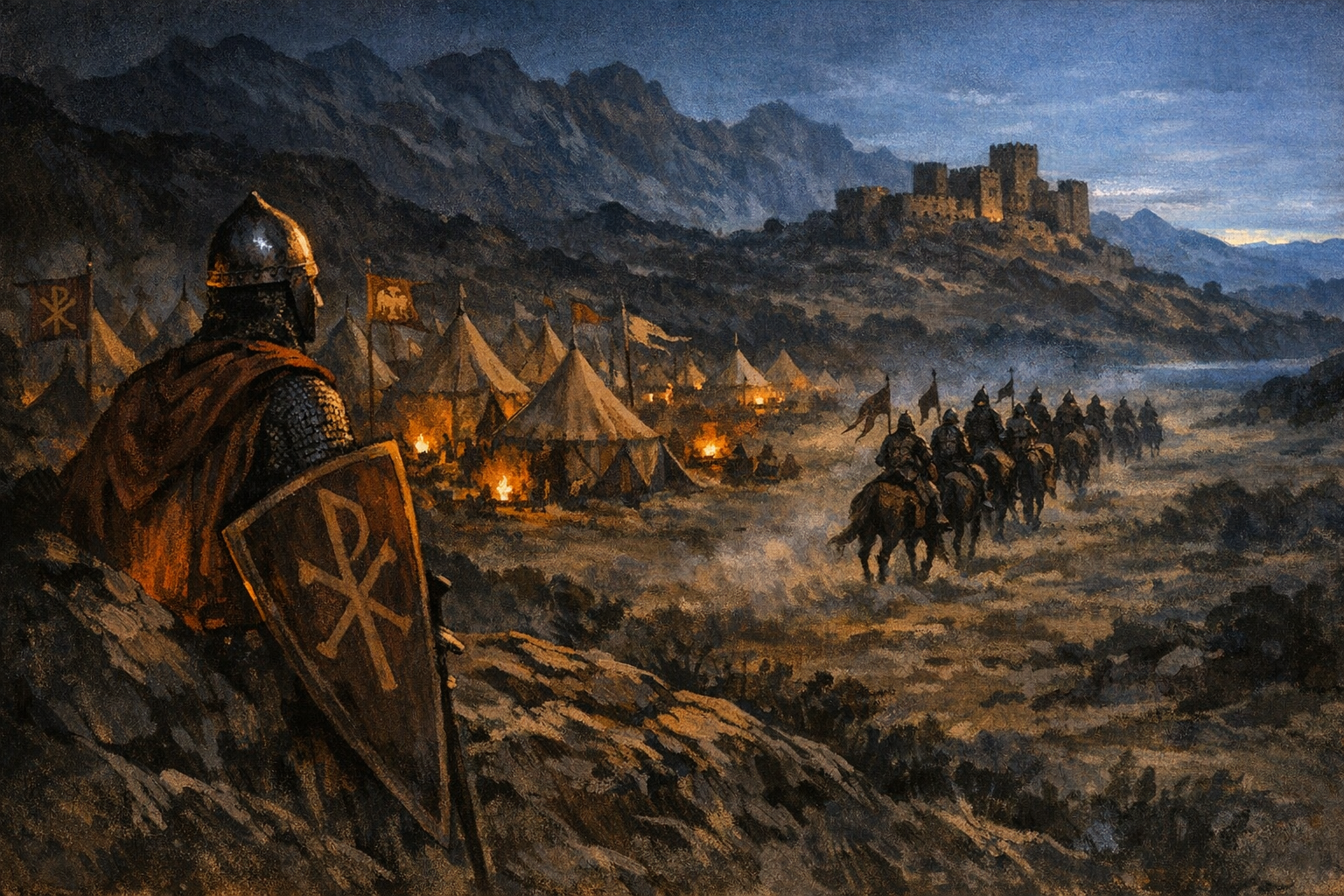
On the night of 25 August 1071, in a high meadow near the small fortress of Manzikert in what is now far eastern Turkey, the Emperor of the Romans counted his army. He had marched out with roughly forty thousand men. By the campfires, the count was already lower. About a thousand of his Turkic horsemen, the Uz mercenaries he had hired off the Eurasian steppe, had recognised cousins in the enemy camp during the day's skirmishing and quietly slipped across to join them. Romanos IV Diogenes still meant to give battle in the morning.
Romanos was a soldier-emperor of the older Byzantine type. The empire he had inherited three years earlier was, on paper, the strongest power east of the Mediterranean. But its old themes, the locally recruited provincial militias that had held the Anatolian frontier for centuries, had been allowed to wither. Land grants had been folded back into court estates. Real soldiering had been increasingly contracted out. The Frankish knights from the West, the Pecheneg cavalry from beyond the Danube, the Norman adventurers fresh from southern Italy, the Russian and Bulgarian companies, the Uz horsemen now trotting toward the wrong side of the line, were all paid for by a treasury that had decided, a generation earlier, that gold was cheaper than levy. They were good fighters. They were also, all of them, on a contract.
Across the lines stood Sultan Alp Arslan of the Great Seljuk Empire, who had not particularly wanted this battle. Alp Arslan had been campaigning in Syria. He turned for Manzikert only because the emperor had moved first. By the time the two armies faced each other on 26 August, the Seljuks had fewer men than the Byzantines had brought, but they had something Romanos had quietly given up: a single coherent core that would not desert.
The fight was brisk, ugly, and decided as much by Byzantine politics as by Seljuk tactics. As the Seljuk light horse drew the Byzantine centre out into a feigned retreat, Romanos sent word to his reserve to wheel forward and protect the line. The reserve was commanded by Andronikos Doukas, the son of the emperor's most powerful political rival back in Constantinople. Andronikos read the order, looked at the field, and led the rear-guard off the battlefield. The remaining Pecheneg auxiliaries, seeing what was happening, deserted. By dusk Romanos was a prisoner, taken alive by Alp Arslan's bodyguard. He was, briefly, treated with great courtesy, ransomed back, and sent home.
He did not make it. The Doukas faction, who had engineered the catastrophe, met him at the Bosphorus. They had him blinded with a hot iron, badly. He died of the infection a few months later, on the island of Proti, on 4 August 1072.
That should have been the end of the story. It was the beginning. Roussel de Bailleul, the captain of the Frankish and Norman cavalry who had fought at Manzikert and survived, returned to imperial service for two years and then defected. In 1073 he marched three thousand Franco-Norman troopers into central Anatolia, conquered the regions of Galatia and Lycaonia, and set up his own short-lived principality with the city of Ankara as its capital. The empire had to send the future emperor Alexios Komnenos to take him in 1075, and Alexios could only do it by stratagem. Meanwhile the Seljuks, finding no organised Byzantine resistance left in the interior, began to settle. By 1080, just nine years after Manzikert, they had taken roughly seventy-eight thousand square kilometres of Asia Minor. A generation after that, the same Alexios Komnenos sent envoys west asking the Pope for help. The First Crusade was, in a real sense, Constantinople's call for a different kind of mercenary.
The Echo
Now read the dispatches from this week.
On the morning of 25 April 2026, the al-Qaeda-affiliated jihadist coalition known as JNIM and a Tuareg-and-Arab separatist alliance called the Azawad Liberation Front launched a coordinated offensive across central and northern Mali. By the end of the next day, they had captured Kidal, partially captured Gao, and struck Mopti, Sévaré, Senou and the capital itself, Bamako. Mali's defence minister Sadio Camara was reportedly killed in his own residence in Kati, alongside members of his family. General Assimi Goïta, the colonel who took power by coup in 2020 and again in 2021, went into hiding. Russian mercenaries of the Africa Corps, the rebadged Wagner Group the junta had hired to replace the departing French and UN missions, were entrenched in the old MINUSMA peacekeeping camp at Kidal. On 26 April they withdrew under escort by the very rebels they had been hired to defeat, and set fire to the camp behind them as they left.
Mali in 2026 is not Byzantium in 1071. Mali is a much younger state, half a continent away, fighting a different kind of war. But the failure mode rhymes. A central authority that had let its own indigenous military atrophy, that had bet its security on a polyglot foreign contract, watched the contract come due in a week. The mercenaries did not lose because they were bad fighters. They quietly walked off, in formation, under the escort of their nominal enemies, because the contract said nothing about staying when the situation looked unwinnable. The local political elite, which had built the contract in the first place, was occupied with its own internal feud while the periphery burned.
The lesson the Byzantines drew from Manzikert took thirty years and a Komnenos restoration to act on, and even then it was incomplete. They never quite re-learned how to defend their own borders without bringing somebody else in to do it. The Italians at the walls of Constantinople in 1453 were the last and most expensive expression of the same habit. The lesson available this week to the heirs of the 2020 Mali junta, if any of them are still around to draw one, is older than the empire that learned it first. A mercenary's loyalty is the price of his contract. The borders cost more.