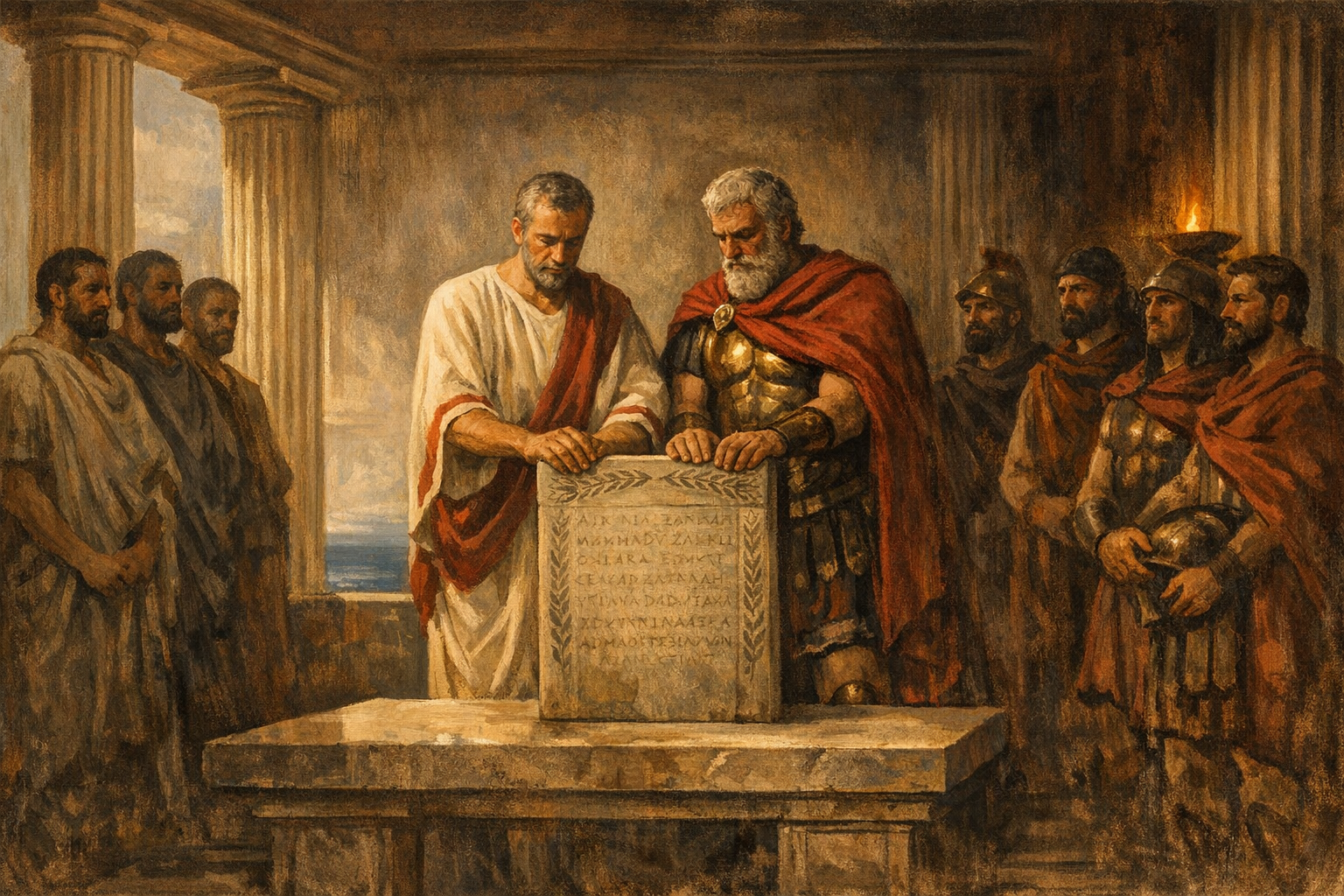
In the spring of 421 BC, in the eleventh year of a war that had run inconclusively across the eastern Mediterranean, the two great Greek powers signed a truce. The Athenians, led by a wealthy and devoutly conservative general named Nicias, agreed with the Spartans, led by King Pleistoanax, to end hostilities for a period of fifty years. The treaty bore Nicias's name. It promised the return of captured fortresses, the exchange of prisoners, the restoration of trade. It was hailed in both cities as the close of an exhausting struggle. The Athenian assembly thanked the gods. Spartan delegates went home loaded with the captured shields of dead Athenian hoplites.
Eighteen months later the peace was already finished. The Spartans had never surrendered the strategic Thracian city of Amphipolis to Athens, as the treaty required. The Athenians had never given back Pylos, the Messenian fortress they had captured five years earlier. Several of Sparta's most important allies, Corinth and Boeotia and Elis and Megara, had refused to ratify the treaty at all. The Athenian general Alcibiades, an ambitious thirty-year-old aristocrat who had outmanoeuvred Nicias for political control of the Assembly, was busy assembling a coalition of Sparta's enemies in the Peloponnese. By 418 BC the Spartans had crushed that coalition at the Battle of Mantinea. Three years after that, in 415, Athens launched the Sicilian Expedition, a one hundred and thirty-four trireme adventure to conquer Syracuse on the other side of the Greek world. Two years after that, Athens had lost the entire expedition, perhaps fifty thousand men, and the strategic initiative. The empire never recovered. By 404 BC Sparta had taken the city, dismantled the long walls, and ended the war.
What had the Peace of Nicias actually done? It had not ended any of the disputes between Sparta and Athens. It had not addressed the grievances of either side's allies. It had not enforced its own terms. What it had done was give both cities time. Athens used that time to imagine that the war was won and that it could afford an extra one. Sparta used it to consolidate its Peloponnesian alliance and to wait for Athens to make a mistake. The peace, in the contemporary judgement of Thucydides, was a "suspicious truce" that observed neither the letter nor the spirit of an actual treaty. He was right.
The Echo
Now read the dispatches from this week.
On the evening of 25 April 2026, a roadside bomb on the highway between the cities of Cali and Popayán in southwestern Colombia killed twenty-one people. By the morning of 28 April, dissident factions of the demobilised FARC, splinter groups of the ELN, and the Estado Mayor Central guerrilla command had carried out twenty-six attacks with explosives and drones against civilians and military positions across the southwest. The country votes for a new president on 31 May.
The peace that has been falling apart in Colombia is President Gustavo Petro's "total peace" initiative, launched at the start of his term in August 2022. Its premise was the inverse of the previous Colombian counter-insurgency. Instead of trying to defeat each armed group militarily, Petro proposed to negotiate with all of them simultaneously, including FARC dissidents, the ELN, and the urban gangs. Bilateral ceasefires were agreed. Many were partial. Some were honoured. Almost all of them, in the consensus judgement of analysts who have followed the policy, were used by the armed groups to extend their territorial control, recruit young men, refit and rearm. According to ACLED's data, the total number of combatants in Colombia's armed groups has risen by approximately eighty-five percent since 2017, to more than twenty-five thousand. Petro is constitutionally barred from a second term. His party's candidate, the senator Iván Cepeda, has promised to continue the strategy if elected.
A mid-level Colombian army officer, quoted by the International Crisis Group earlier this year, put it more candidly than the official line: "It is painful, but we have to admit that the threats have overtaken our ability to combat them. If tomorrow there are no more negotiations, we will not have the capacity for a military response."
Colombia in 2026 is not Athens in 421 BC. The geometry of an Andean guerrilla war is not the geometry of a hoplite phalanx. The Peace of Nicias was a treaty between two great powers; the Total Peace is a tangle of bilateral ceasefires between an elected government and dozens of armed factions of varying ideology and discipline. They are not the same thing. But the lesson available from Thucydides is the same one his Athenians and Spartans had to learn the hard way. A peace that does not enforce its own terms is not a peace. It is a clock. Both sides will use the time on it. The side that uses it better will write the second war.
The Cali-Popayán highway is, this week, a clock running out.