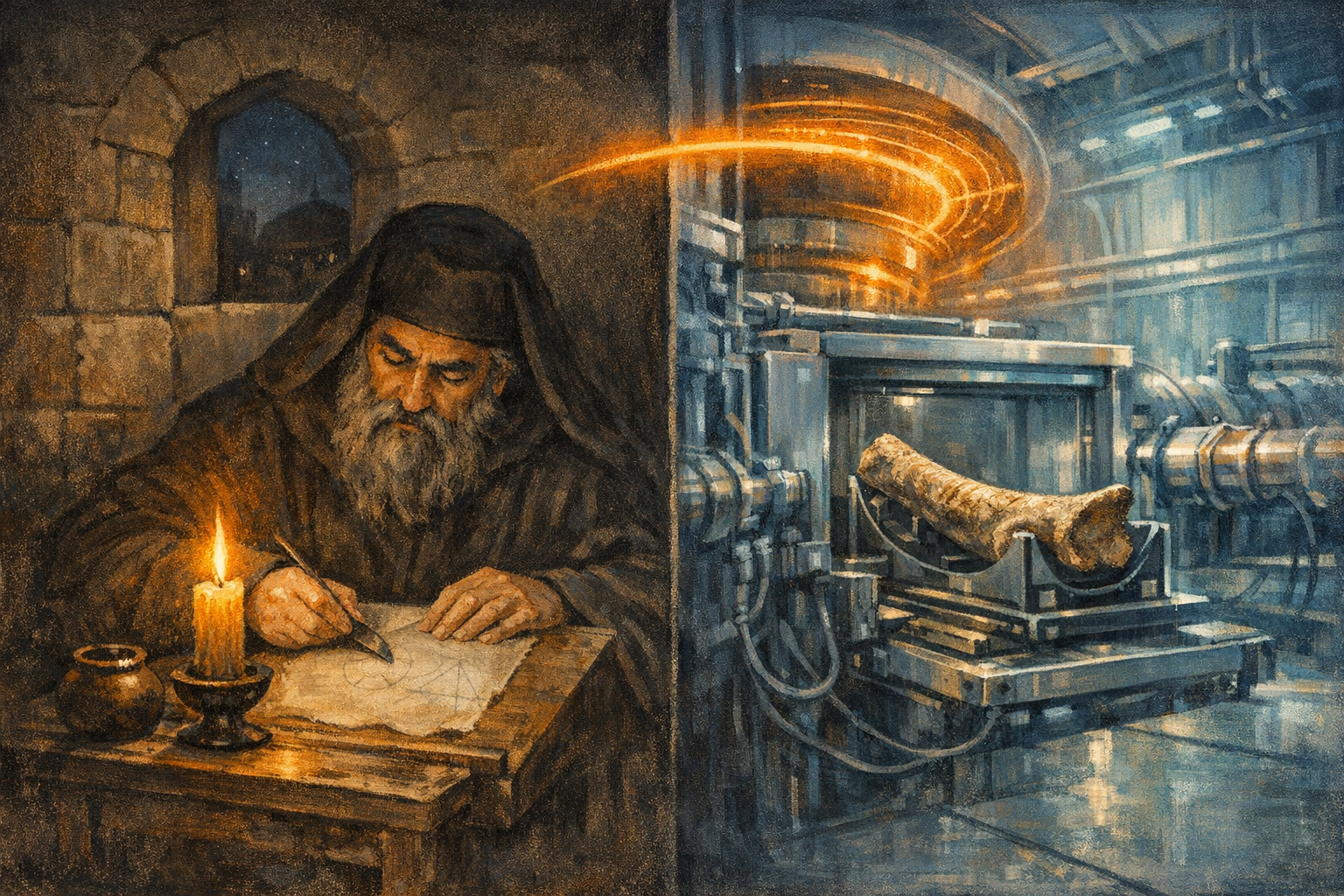
In April of 1229, in Jerusalem, a monk called Johannes Myronas finished a prayer book.
He had assembled it the way scribes assembled most books in the thirteenth century. He took apart older manuscripts whose contents nobody read any more. He scraped each leaf with a knife. He rinsed the parchment with chalk and milk to lift the last shadow of ink. Then he turned the cleaned hides ninety degrees, folded each in half, and copied a Greek Orthodox liturgy onto them in the elegant Byzantine hand of his order. He signed and dated his work on the fourteenth of April.
The math went under the prayers.
The math was Archimedes.
It included the only complete copy of a treatise called Method of Mechanical Theorems, in which Archimedes had explained how he discovered his geometry before he proved it. To find the volume of a sphere, he wrote, you imagine the sphere split into infinitely many infinitely thin slices, and you weigh those slices on an imaginary balance against shapes whose volumes you already know. The notion that he had reasoned with infinite divisions in the third century BCE is a small bombshell in the history of mathematics. It means that nineteen centuries before Newton or Leibniz, a Greek scientist had already practised the central trick of calculus.
Johannes Myronas could not read it. By 1229 the geometric idiom of Archimedes was already ancient and obscure. He needed parchment, and parchment was expensive, and old math was abundant. Centuries of monks before him had done the same.
This kind of recycled manuscript has a name: a palimpsest, from the Greek for "scraped again." When you erase a page, you do not actually erase a page. You smear it. Microscopic specks of the original ink remain, soaked into the parchment fibres, invisible to anyone holding a candle close to the page.
In 1906 a Danish philologist named Johan Ludvig Heiberg travelled to a monastery library in Constantinople, where the Myronas prayer book had been catalogued without ceremony for centuries. Heiberg was looking for one specific palimpsest. He spread the leaves under a magnifying glass and squinted at the faint shadows underneath the prayers. Over weeks of work, with a notebook and a hand lens, he made out perhaps half the lost text. He published what he could read. Then he gave the manuscript back, and history nearly ate it.
The book vanished during the First World War. Someone painted forged Byzantine miniatures over four pages, hoping to raise the price. It surfaced at Christie's in New York on the twenty-ninth of October 1998 and was bought by an anonymous American billionaire for two million dollars. He sent it to the Walters Art Museum in Baltimore.
The Walters team tried every imaging trick they had: ultraviolet, infrared, multispectral, raking-light photography. Each technique read more than Heiberg had. Each had limits. Some pages, blackened by mould or buried under the painted forgeries, refused to give up their text.
In May of 2005 the manuscript was driven across the country to Stanford and slipped into a synchrotron.
A synchrotron is a particle accelerator that whips electrons around a ring at almost the speed of light. As the electrons bend through a magnetic field, they emit X-rays a billion times brighter than a hospital scanner. At the Stanford Synchrotron Radiation Lightsource, a staff physicist named Uwe Bergmann had realised that the iron pigment in medieval ink would fluoresce under exactly the right X-ray energy. Old monks had ground iron salts and oak galls into their writing fluid. The iron was still there, in the parchment, waiting.
Bergmann's team scanned each leaf line by line for hours. Wherever Archimedes had written, the parchment glowed faintly. Wherever Myronas had written on top, it glowed too, but at slightly different energies, and the patterns could be untangled.
Pages that had been blank to Heiberg lit up in entire paragraphs. They recovered the rest of the Method, the only known copy of Stomachion (a treatise on a fourteen-piece geometric puzzle), and a clean version of On Floating Bodies. The forged paintings, set on top of the priceless math, turned out to be transparent to the X-rays. Archimedes glowed straight through them.
Synchrotron light, it turned out, was a kind of time machine. Anything written in iron was still readable, eight centuries after a man with a knife had tried to make it disappear.
\ \ \*
This week, in Saskatoon, Canada, a physics PhD student named Jerit Mitchell published a paper that turns the same time machine on something far older.
Mitchell works at the Canadian Light Source, a synchrotron facility built into the campus of the University of Saskatchewan. In 2019 the Royal Saskatchewan Museum lent him a single fossilised rib from a Tyrannosaurus rex called Scotty, the largest T. rex skeleton on Earth, dug out of the Frenchman River badlands by a high school teacher in August of 1991.
The rib has a healed fracture in it. Sometime around sixty-six million years ago, the dinosaur snapped a bone, survived, and laid down new tissue around the injury. Then it died, was buried, and the soft tissue should have rotted away long before the rest of the rib turned to stone.
It did not entirely rot.
Mitchell scanned the fossil with the same kind of fluorescence map that had read Archimedes. The iron in the long-vanished blood vessels had not vanished. Iron from Scotty's red blood cells, plus iron salts seeping in from the surrounding mud, had together templated a network of mineralised casts in the exact shape of the original vasculature: pyrite at first, then weathered into goethite and hematite, laid down in two clean concentric layers around the healed fracture. The body had drawn its own diagram of recovery in iron oxide.
In 2026, a Canadian particle accelerator read the cardiovascular schematic of a healing T. rex.
The mainstream paleontological view in 2005, when Bergmann was scanning the Archimedes Palimpsest at Stanford, was that no organic structures could survive sixty-five million years. A North Carolina State paleontologist called Mary Schweitzer had just claimed soft, flexible blood vessels inside a different T. rex (Museum of the Rockies specimen 1125), and the field had reacted with venom. She was accused of contamination, of hallucination, of confusing bacterial slime with biology. The dispute ran for two decades.
Mitchell's iron-templated, layer-by-layer reconstruction of healing tissue is one of the cleanest validations Schweitzer has had. The vessels are not soft tissue any more. They are not Schweitzer's vessels. But the message is the same: the boundary between "biology" and "fossil" is more porous than the textbooks said. Time deletes less than we think. It just files the records under a different element.
Two stories, then, eight centuries apart. A monk in Jerusalem and a hungry predator in Saskatchewan. A sheet of parchment and a ribcage. Ink and blood. In each case, the thing the world thought was lost had simply gone quiet. It had pressed itself into iron, waited, and waited some more, until somebody pointed a beam of accelerated light at it.
In a week when the news has been talking about machines that summarise the past in seconds and brain-mimicking chips that promise to slash the energy cost of artificial thought, it is worth remembering that the more mysterious recording technology is much older than us. Pyrite preserved a dinosaur's healing wound for sixty-six million years. Iron-gall ink preserved Archimedes for two and a quarter thousand. The accelerated light that reads them was invented in our lifetime. What it reads is everyone else's.
The right beam, applied at the right energy, finds the iron in everything.
Iron does not forget.